
The AI Agent Shift You Shouldn’t Ignore
You run a business. Someone on your team handles customer messages, another enters data into three different systems, and a third spends half the morning checking inventory before making promises to clients. You’ve seen the demos where “AI agents” do all this automatically—connecting one tool to another, making decisions, getting things done. But most of those demos feel like they were built for companies with a data science team, not for your operation.
So when a tech giant announces a new “reinforcement learning framework” called Molt, your first instinct might be to tune out. Don’t. This particular release points to something that will directly affect how you use software in the next few years.
The key isn’t the technical name. It’s that the machinery for building AI that can take action—not just suggest text—is becoming dramatically simpler to manage. And that simplicity eventually lands in the everyday tools you already use.
TL;DR
- NVIDIA released Molt, a more compact AI training framework for “agentic” systems.
- For you, this means AI agents will become more practical and reliable for day-to-day business tasks.
- You don’t need technical skills—just a clearer idea of which processes you’d like to automate.
What This Means
Let’s translate “agentic reinforcement learning.” An AI agent is software that can complete a goal in multiple steps. Instead of just answering a query, it can plan, call a tool like your e-commerce database, review the result, and adapt if something goes wrong. Training these agents is a giant engineering effort. In the past, frameworks required huge amounts of code, which meant endless maintenance and tweaking. That is why most small businesses never even considered building their own.
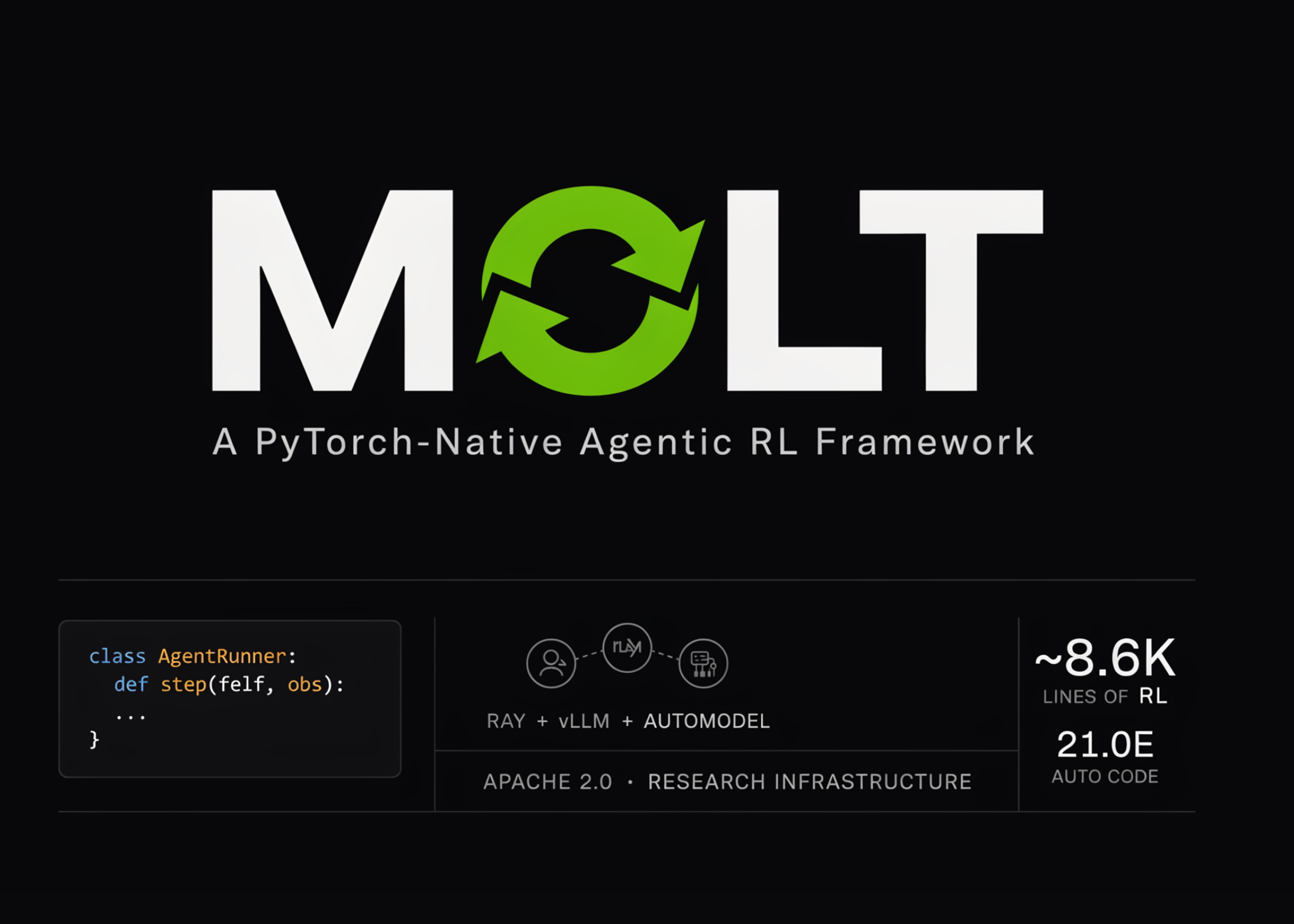
Molt, from NVIDIA’s NeMo team, tackles that problem by making the entire codebase far smaller. The RL code is roughly 8,600 lines, compared to about 62,000 lines for a widely used alternative like Verl. That’s around a 7× reduction. It also uses standard components like Ray and vLLM, so the work doesn’t get stuck on reinventing the wheel. The whole system still runs on serious hardware—the shipped recipes assume 2 nodes of 8 H100 GPUs—but the point is that the software side has become manageable. Fewer lines of code mean fewer places for bugs and faster improvements. That matters because the AI you eventually buy will be built on this progress.
The biggest shift is not that AI can talk. It’s that AI can act—and the technology to teach it to act is becoming smaller, more efficient, and more accessible.
How This Applies to Malaysian SMEs
The first place you’ll feel this is customer service. Imagine a WhatsApp or email assistant that doesn’t just pull from an FAQ, but genuinely helps: it checks your stock level in the inventory system, verifies your courier’s delivery coverage, and then books a replacement order—without any human in between. Molt is built for exactly this kind of multi-turn tool-use agent. It also supports LLM-as-judge reward loops, a technique where one large language model evaluates the performance of another agent during training. That could mean your future assistant gets better at detecting tone, understanding complaints, and resolving them cleanly.
Then think about your internal processes. Molt supports code-execution agents—software that can generate a report, run the calculations, and return a finished table to your operations team. We know Malaysian SMEs often live in spreadsheets and manual handoffs. An agent that compiles, checks, and presents data across your finance, sales, and inventory sheets could shorten month-end closing from days to hours. Because Molt treats agents as ordinary Python programs, your developer can integrate it with the same tools you already use, from SQL databases to shared folders.
Finally, consider the ecosystem effect. Even if you never touch Molt, framework improvements trickle down. The POS systems, accounting suites, and CRM platforms you subscribe to will be the first to embed these advances. As the training infrastructure grows more compact, feature updates arrive faster and smaller vendors can afford to offer powerful automation. That is the practical takeaway: not that you need to buy anything today, but that the AI inside your existing software is about to get noticeably more useful.
| Framework | Approximate RL code size | What it signals |
|---|---|---|
| Verl | 62,000 lines | Powerful but heavy to maintain |
| Slime | 25,000 lines | Middle ground, more moving parts |
| Molt (NVIDIA) | 8,600 lines | Compact, agent-focused design |
Numbers as reported in the MarkTechPost announcement.
Practical Takeaways
- Document your repetitive multi-step tasks. Which processes take three or more manual steps and cross multiple systems? Those are prime candidates for agent-based automation.
- Ask your software vendors about agentic features. Find out whether their roadmap includes AI that can take action, not just generate text.
- Start with a small pilot. For example, an auto-answerer that can also update a spreadsheet or book an appointment. One reliable outcome is better than ten demos.
- Clean up your data. Agent systems work best when your customer, inventory, and order information is structured. If it’s only in someone’s head, start there.
- Talk to a freelance automation specialist. Even one who follows open-source frameworks like Molt can help you evaluate what’s worth trying now versus later.
The Bigger Picture
The direction is clear: AI is moving from “typing into a box” to “actually running parts of the business.” The ability to train reliable agents on more modest hardware means the whole field is heading toward the mainstream. For Malaysian SMEs, the advantage is access to that future sooner—without needing to hire a research team. But the readiness test remains human. Are you prepared to trust an agent with your inventory numbers or a customer refund? That’s a practical question, not a technical one. Start by identifying one single process you’d automate tomorrow. Then ask a trusted tech partner whether the current generation of tools can do it. You might be surprised how much closer we are than the headlines suggest.
Ready to Streamline Your Operations?
Your business should run itself. AutoRunBiz deploys AI agents to automate your daily operations — WhatsApp orders, invoicing, customer follow-ups, and accounting. Book a free 15-min ops audit to see where automation fits your business →