
An AI Story Worth Your Attention
You run a business, not a research lab. When you hear about a new artificial intelligence framework, your first thought is usually: does this affect my daily operations? The answer is often no, but occasionally a release signals something bigger—a shift in how quickly practical AI tools will reach your business. NVIDIA’s recent open-source release, Molt, is one of those signals. It comes from NVIDIA’s NeMo team, and while its name may sound like a chemistry term, its real significance is about making AI agents leaner, faster, and more capable of doing genuinely useful work.
For a Malaysian SME owner, the practical question is simple: when will automation tools get better at handling multi-step tasks without constant oversight? Molt is a glimpse into that future. It is a framework for training AI agents that can use tools, execute code, and interact with software—exactly the kind of capability that will eventually power your customer service chatbot, inventory manager, or sales assistant. You don’t need to understand the technical details, but you should understand the trend.
What Happened
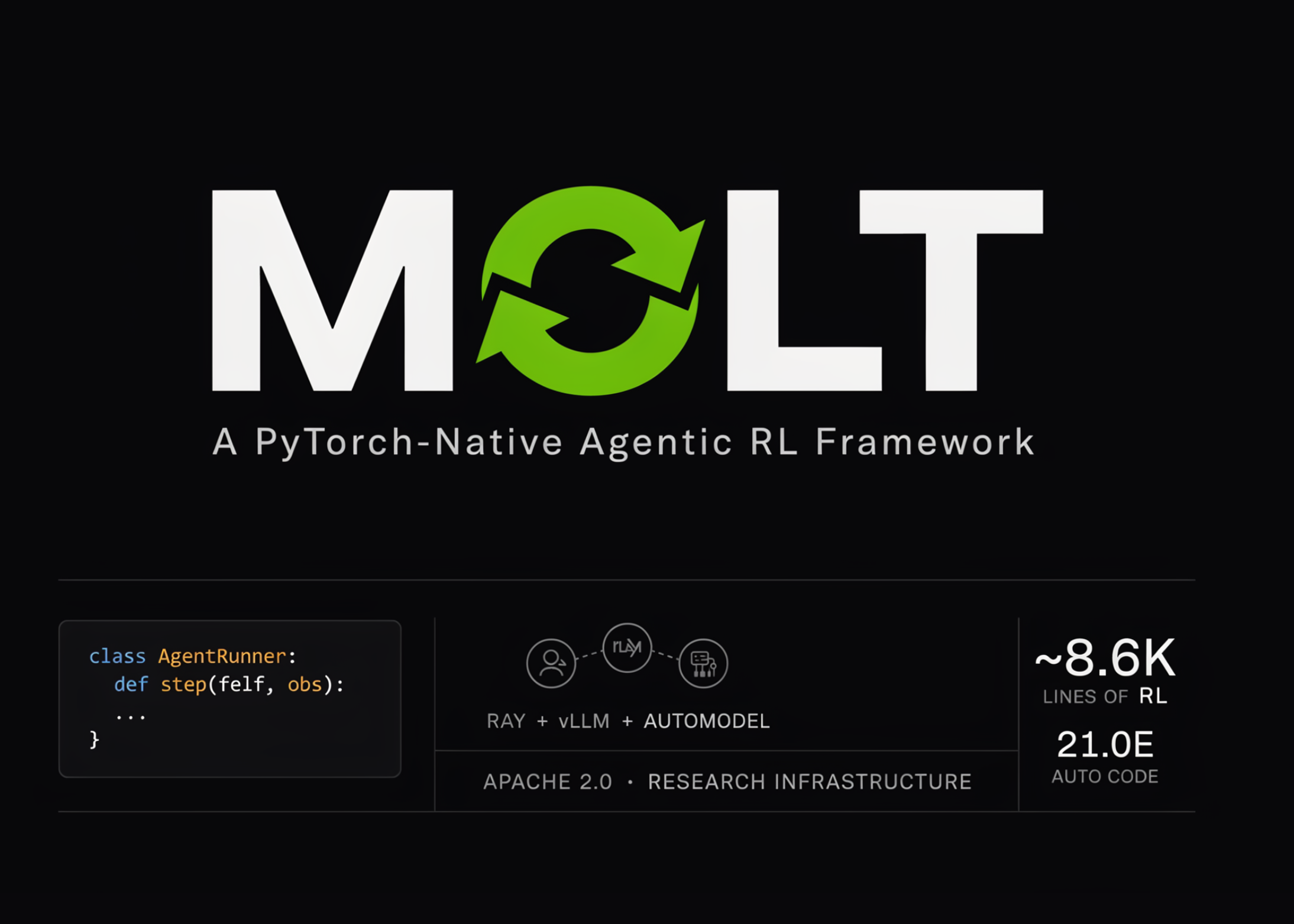
NVIDIA’s NeMo team released Molt, a PyTorch-native agentic reinforcement learning framework designed to be dramatically more compact than existing alternatives. According to the official announcement, the framework consists of roughly 8.6K lines of reinforcement learning code. In contrast, similar frameworks like verl run about 62K lines, slime about 25K lines, and OpenRLHF about 7.2K lines. That size difference matters because a smaller codebase is easier for researchers to hold in their heads and for AI coding assistants to reason about.
Molt is distributed under the permissive Apache 2.0 license and ships with launch scripts and a prebuilt container as stated in the source article. The architecture composes Ray for placement, vLLM for rollout, and NVIDIA AutoModel with FSDP2 for training—none of which are forked, meaning upstream improvements arrive as a simple container pin rather than a complex re-engineering effort. The applications it supports include multi-turn tool-use agents, code-execution agents, vision-language environments, LLM-as-judge reward loops, and on-policy distillation onto smaller student models.
Of course, the hardware requirements are far beyond a typical Malaysian SME. The shipped recipes assume 2 nodes of 8 H100 GPUs, split evenly between training and rollout according to the article. But the existence of Molt is not about you owning that hardware. It is about the direction of AI research: efficiency first.
Why This Matters for Malaysian SMEs
Consider how your business automates tasks today. You might use a chatbot for customer inquiries, a scheduling tool for appointments, or a software robot for data entry. These are typically single-step automations. The next wave of automation will be agentic—AI systems that can perform a sequence of actions across different software tools without waiting for your command at every step. Molt’s focus on tool-use and code-execution agents is a direct signal that AI will soon handle more of your workflow. Imagine an AI that receives a customer order, checks your inventory in your accounting system, places a purchase order with your supplier via email, and schedules the delivery—all in one continuous loop.
For a Malaysian SME with 5 to 50 employees, the benefit is not just time savings. It is the ability to gain an edge over larger competitors without expanding your headcount. You can already see the roots of this in tools widely used in Malaysia, such as cloud-based accounting software and e-commerce platforms that integrate with multiple government services. As frameworks like Molt mature and become the basis for commercial automation products, small teams will get access to capabilities that used to require a dedicated software department.
There is also a practical angle for business owners who are not technically inclined. The source article describes Molt’s design philosophy with an unusual quote: “The codebase should be compact enough for a researcher to hold in their head, and for an AI coding assistant to read and reason about in its entirety.” That philosophy translates to fewer bugs, quicker updates, and more reliable behavior. When your automation vendor builds on top of such technology, your experience becomes smoother. The days of “AI that half-works” are slowly being replaced by AI that can be verified and corrected efficiently.
What You Should Watch Next
| Molt Fact | What It Means for You |
|---|---|
| Roughly 8.6K lines of RL code per the source | Lighter AI code means your tools get fixed and improved faster. |
| Apache 2.0 open-source license as reported | No single vendor can lock your automation into a proprietary corner. |
| Supports tool-use and code-execution agents according to the paper | Future AI assistants can actually perform actions, not just provide answers. |
| Agents are plain Python programs as detailed | Developers can integrate your existing business APIs more easily. |
The codebase should be compact enough for a researcher to hold in their head, and for an AI coding assistant to read and reason about in its entirety.
The Bigger Picture
Molt is research infrastructure, not a commercial product. You will likely never deploy it directly. But the underlying philosophy has important implications for Malaysia’s business community. The AI industry is moving away from bloated, resource-hungry models and toward focused, efficient systems. This is accompanied by the practice of distillation, where a large model teaches a smaller model to perform on par. The source article highlights “on-policy distillation onto a smaller student” as one of Molt’s applications in the original announcement. That means the expensive, frontier-scale research happening now will eventually be compressed into tools that run on your office laptop or a modest cloud instance.
For Malaysian SMEs, the strategy is simple: stay informed, but do not rush to adopt cutting-edge AI directly. Instead, watch what your software vendors do with these open frameworks. When automation vendors integrate smarter agentic capabilities into their products, you will know that the industry is maturing. The release of Molt is a reminder that AI is not just about generating text or images anymore. It is about taking real action across the digital tools that run your business.
Your Practical Next Step
You don’t need to know the difference between PyTorch and Ray. What you need is a clearer view of how AI agents can serve your specific workflows. If you are a Malaysia-based SME running an e-commerce store, think about order verification, supplier communication, and return handling. If you run a service business, think about appointment scheduling, lead follow-up, and client reporting. These are the workflows where agentic AI will make its mark.
Instead of chasing every headline, schedule a conversation with your business automation partner about how agent-based workflows could improve your current processes. Ask them about their roadmap for adding capabilities like multi-step action, tool usage, and self-correction. The technology behind Molt may be aimed at research labs, but its ripple effects will reach your business sooner than you think.
The key takeaway is this: AI is becoming more capable of working with your existing software, not just generating words. And in a competitive market like Malaysia, having an AI that can execute a full process—rather than just chat—will be the difference between staying ahead and falling behind.
Ready to Streamline Your Operations?
Technology moves fast. Your operations should keep up. AutoRunBiz builds AI systems that run your daily workflows — from WhatsApp order capture to accounting. Book a free 15-min ops audit →