
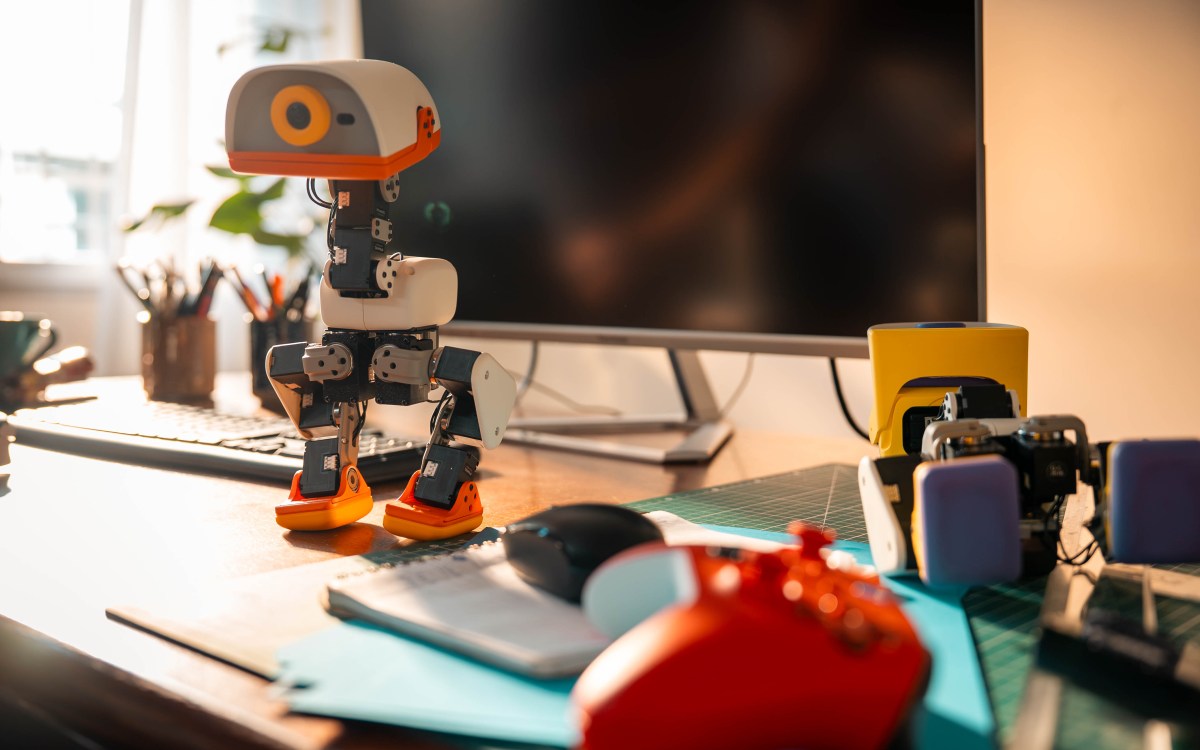
Small Robots, Practical Lessons for Your Business
You may not be planning to buy a duck-shaped robot for your shop, office, warehouse, or workshop. That is perfectly reasonable. Most Malaysian SME owners are focused on keeping daily operations moving: replying to customers, checking stock, arranging deliveries, managing staff, and making sure nothing important is missed.
However, the launch of Microduck points to something worth watching. A small, open-source robot can see its surroundings, move around, pick up objects, and learn new behaviours through software. More importantly, its hardware, software development kit, simulation tools, and reinforcement-learning training stack are intended to be accessible to developers. That brings physical automation closer to smaller businesses, schools, and local solution providers.
TL;DR: Microduck is a 25-centimetre robot designed to be taught new tasks using open software and training tools. Its biggest lesson for your business is not the robot itself, but the move towards affordable, customisable automation that can be tested before being used in real operations.
For Malaysian SMEs, this may eventually make it easier to automate repetitive physical work without depending entirely on one closed system or one specialist vendor.
What This Means
Microduck is described by Hugging Face as an open-source robot that can be taught new tricks using reinforcement learning. In plain language, reinforcement learning allows a system to improve its behaviour through repeated training, feedback, and adjustment. A business could potentially train a robot in a computer simulation first, then transfer the behaviour to the physical machine.
The robot is reported to stand 25 centimetres tall, carry objects weighing up to 800 grams, and perform actions such as waddling, crouching, standing after falling, picking items up with its beak, and roller skating. These figures and capabilities are reported by TechCrunch.
Microduck uses a camera, lidar sensors, and two inertial measurement units. A camera helps it interpret visual information, lidar helps measure distance and surroundings, while inertial sensors help track movement. According to the source article, the simulation environment, software development kit, and full reinforcement-learning training stack are available on GitHub through the project.
The phrase open source matters here. With a closed product, you normally depend on the manufacturer’s software, updates, integrations, and permitted use cases. With an open system, developers can inspect more of the technology, modify it, and build their own applications. That does not automatically make the system safe or private, but it can provide more visibility and control.
“The useful question is not whether you need a robot today. It is whether your business is ready to describe repetitive work clearly enough for a robot to learn it tomorrow.”
How This Applies to Malaysian SMEs
1. Retail and small warehouses can start by mapping repetitive movement. If you operate a mini-market, pharmacy, parts store, or online retail business, staff may repeatedly move lightweight items from shelves to packing tables. A small robot may not replace the whole process, but it could eventually assist with item collection, shelf checking, or moving selected objects across a controlled area. The practical first step is to document which tasks involve predictable routes, standard object sizes, and limited safety risks.
For example, you could separate your stockroom tasks into three groups: items that are easy to identify, items that are fragile or irregular, and items that require human judgement. The first group is the best candidate for future automation. A robot that can carry up to 800 grams, as reported by TechCrunch, would not handle every warehouse requirement, but it could be suitable for demonstrations, lightweight samples, or small components.
2. Food businesses can learn from simulation before changing operations. Restaurants, bakeries, central kitchens, and catering operators often have repeated processes: checking trays, moving containers, monitoring queues, or identifying whether a workstation needs attention. Physical automation in a kitchen is difficult because of heat, spills, hygiene requirements, and changing layouts. Still, the idea of training in simulation is useful even before you buy hardware. You can create a digital process map, test different workflows, and identify where automation might create problems.
Suppose you run a bakery with several preparation stations. Before introducing any machine, you could record the sequence for collecting trays, checking labels, and moving finished products. A simulation or simple digital workflow can reveal bottlenecks, unclear handovers, and missing information. This gives you a safer starting point than placing a robot into a busy working area and hoping it adapts.
3. Service businesses can use robotics as a controlled learning project. Training centres, tuition businesses, creative studios, electronics workshops, and technology resellers may find open-source robots useful for demonstrations and internal experiments. The value may come less from production and more from building staff capability. A team that learns how to configure sensors, test behaviours, and monitor data will be better prepared for future automation projects.
In Malaysia, this could also support collaboration with polytechnics, universities, local system integrators, and technical communities. You do not need an internal robotics department to begin. You can define one narrow challenge, such as recognising objects on a table or navigating between marked points, then ask a qualified partner to create a supervised pilot.
4. Hospitality and visitor-facing businesses should focus on interaction boundaries. Hotels, showrooms, event venues, and visitor attractions may use small robots for guided demonstrations or educational activities. A cute design can attract attention, but a public-facing robot must have clear rules. You need to decide where it can move, what it may record, who can control it, and how staff will stop it quickly.
The source article notes that open-source software can improve auditability, but it does not guarantee privacy. Applications added later may access cameras or microphones and may send information to external services. That warning is especially relevant if your business operates in a customer-facing environment. You should treat sensors as business systems, not harmless accessories.
Practical Takeaways
- List repetitive tasks: Record activities that happen frequently, follow a consistent sequence, and involve lightweight objects.
- Start with simulation: Test a workflow digitally or on paper before introducing physical equipment into a busy workspace.
- Choose one narrow pilot: Avoid asking a robot to solve an entire department’s problems at once.
- Set safety boundaries: Mark operating areas, define emergency stop procedures, and keep humans responsible for final decisions.
- Review sensor access: Know whether cameras, microphones, lidar, and other sensors collect or transmit information.
- Separate open source from automatic privacy: Inspect applications and data flows instead of assuming openness makes everything secure.
- Prepare clean operating data: Clear labels, consistent layouts, and documented procedures make automation easier.
- Involve staff early: Your employees understand exceptions, awkward objects, and customer behaviour that a demonstration may miss.
- Work with suitable partners: Look for a local integrator, training provider, or technical institution that can support testing and maintenance.
A Simple Automation Readiness Table
| Business activity | Readiness signal | Possible first experiment |
|---|---|---|
| Stock movement | Fixed routes and lightweight items | Move labelled sample containers between two marked points |
| Quality checking | Clear visual differences | Use a camera to identify missing labels under supervision |
| Customer service | Repeated questions and simple directions | Use a robot display for information, while staff handle exceptions |
| Staff training | Interest in practical technology | Run a supervised workshop on sensors, simulation, and safe testing |
The table is a planning framework, not a claim that Microduck can perform each task today. The reported robot capabilities include movement, object handling, sensing, and trainable behaviours, but every real deployment requires testing in the specific environment where you intend to use it. The underlying product details come from TechCrunch.
Questions to Ask Before You Test a Robot
Begin with the work, not the gadget. Ask whether the task is genuinely repetitive, whether the workspace changes often, and whether a mistake could harm a person, damage stock, or disrupt customer service. If the answer is yes, the task may need better process documentation before automation.
Next, ask where the robot’s data goes. Does the system process camera information locally? Are recordings stored? Can third-party software access the sensors? Who controls updates and permissions? Open-source components may make inspection easier, but you still need someone responsible for reviewing the complete application and network setup.
Finally, plan for failure. What happens when the robot falls, loses connection, picks up the wrong object, or meets a customer? A reliable pilot includes a manual fallback, a clear shutdown process, and a way to record what went wrong.
The Bigger Picture
The wider trend is a gradual shift from automation that only large factories can afford or customise towards smaller, more adaptable systems. Microduck is a particularly visible example because its design is approachable, but the important development is the combination of low-cost hardware, open software, simulation, and community learning.
For Malaysian SMEs, this does not mean every shop or office should purchase a robot. It means the barrier to experimenting with physical automation may continue to fall. Your advantage will come from knowing your processes well, protecting customer and business data, and testing one useful task at a time.
Over the long term, businesses that document workflows, maintain clean operational information, and train staff to work alongside technology will have more choices. You may eventually use robots, smart cameras, automated guided equipment, or software agents. The preparation is similar: understand the task, define the boundaries, measure the result, and keep a human accountable.
Microduck may look like a novelty, but it raises a serious business question: which small, repetitive task in your company is structured enough to teach, test, and improve? That is where your practical automation journey should begin.
Ready to Streamline Your Operations?
Your business should run itself. AutoRunBiz deploys AI agents to automate your daily operations — WhatsApp orders, invoicing, customer follow-ups, and accounting. Book a free 15-min ops audit to see where automation fits your business →