
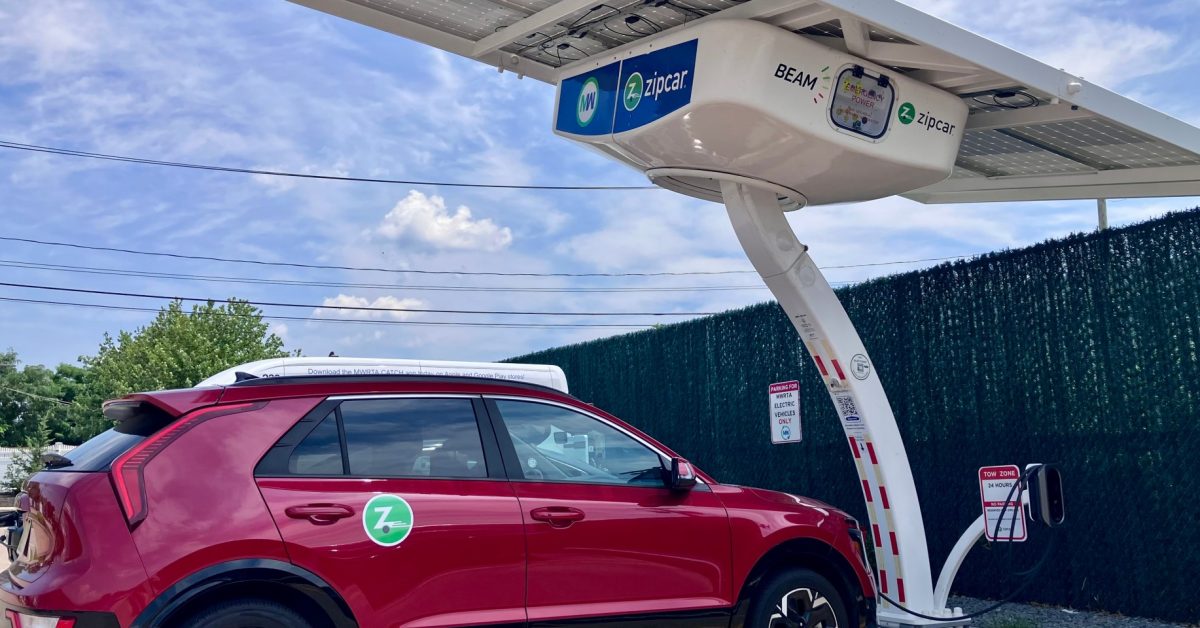
That van parked behind your shop could be charging itself right now
Look out the back of your shop lot. Is a delivery van sitting there, doing nothing? For most Malaysian business owners, the answer is yes — and it will stay that way for most of the day. That’s an idle asset taking up space while the clock ticks.
Now imagine the same van charging itself from the sun while it’s parked. No digging cables through the pavement. No waiting for the utility company. Just solar panels on top of a charging unit, storing energy while the van waits for its next delivery run.
That’s the idea behind a new pilot launched in late July 2026 in Greater Boston. The Metropolitan Area Planning Council set up CommunityEV Carshare at four locations, pairing Zipcar’s shared electric cars with Beam Global’s EV ARC off-grid solar chargers. And the concept has serious relevance for Malaysian SMEs.
TL;DR: The pilot pairs shared electric vehicles with solar chargers that don’t need a grid connection. Malaysia gets far more sunshine than Boston, so the same model could let your business run electric vehicles and even offer customer charging — without waiting for grid upgrades or lengthy infrastructure projects.
What This Means
A conventional EV charger must be wired into the electricity grid, then upgraded, tested, and approved. In Malaysia, that can involve months of coordination. An off-grid solar charging unit works differently: it’s one self-contained structure with solar panels on top, battery storage in the middle, and EV charging ports mounted on the side. It generates its own electricity, stores it, and feeds it to vehicles — all without a single cable connected to the grid.
Each Beam Global EV ARC unit in the pilot can charge two vehicles at once and generate enough solar energy for up to 265 miles (~425 km) of driving per day. Because the electricity is produced on-site, the pilot isn’t adding any demand to the local power network.
| Pilot factor | What the data shows |
|---|---|
| Locations | 4 communities across Greater Boston |
| Vehicles charged per unit | 2 at a time |
| Driving energy per unit, per day | Up to 265 miles (~425 km) |
| Median trip length in the EV fleet | 25.5 miles (~41 km) |
| Time household vehicles spend parked | 95% |
Source: Electrek’s coverage of the CommunityEV Carshare pilot
That last number is the secret to why this works. The US Department of Transportation says household cars are parked around 95% of the time, and the median trip in Zipcar’s Boston EV fleet is just 25.5 miles. Short trips, long parked periods, slow solar charging — they fit together perfectly.
“The cars spend plenty of time parked between relatively short journeys, giving the solar chargers time to recharge their batteries.” — the working principle behind the Zipcar and Beam Global pilot, from Electrek.
Transportation is the largest source of emissions in Massachusetts at 38%, which is why the state is testing this model. Malaysia’s cities face similar vehicle-related pressures — but our location near the equator is a natural advantage.
How This Applies to Malaysian SMEs
Start with your own fleet behaviour. If you run a catering business, an e-commerce operation, or a maintenance service, your vehicles probably follow a rhythm: busy in the morning, parked at midday, busy again in the afternoon. Those idle hours in the middle are precisely when a solar charger tops up the battery. You don’t need a nationwide charging network; you need a single parking space with daylight.
Malaysia’s equatorial climate makes off-grid solar a stronger bet here than in Boston. The Sustainable Energy Development Authority (SEDA) has spent years encouraging rooftop solar because our sun is dependable across all 12 months. A business in Selangor or Johor can expect consistent charging output with little seasonal variation — something Boston business owners can’t rely on.
The sharing component is the part worth copying. Zipcar members reserve vehicles through an app, and the car belongs to them for the booking period. For an SME, that’s an argument for a shared internal fleet instead of a vehicle per staff member. If you have two vans and five drivers, an automated booking system removes the scheduling fights, the lost keys, and the question of “whose turn is it?” The pilot shows that shared vehicles work when the booking experience is slick and automated.
There’s also a customer-facing opportunity. If your premises have parking space — a restaurant, workshop, clinic, or retail shop — an off-grid solar charger turns your location into a destination. EV drivers need to charge for 20
Ready to Streamline Your Operations?
Your business should run itself. AutoRunBiz deploys AI agents to automate your daily operations — WhatsApp orders, invoicing, customer follow-ups, and accounting. Book a free 15-min ops audit to see where automation fits your business →