
Why a Story About AI Hardware Belongs on Your Radar
If you run a small business in Malaysia, a headline about “GPU management” probably sounds like someone else’s problem. It isn’t. The argument making rounds in AI circles right now—that idle GPUs have become “the new grounded aircraft”—is not really about hardware at all. It is about a far older business truth: an asset only earns while it is working. That truth is about to determine which Malaysian SMEs get real value from AI, and which ones quietly burn their budgets on tools that sit parked at the gate.
Aviation learned this lesson the hard way. An aircraft’s costs accrue by the calendar hour—financing, depreciation, insurance, scheduled maintenance—whether the plane is in the air or sitting on the tarmac. Revenue accrues only by the flight hour. The airlines that survive are not necessarily the ones with the biggest fleets; they are the ones that keep their planes busiest (source).
What Happened
A recent article on the Hugging Face blog, published by the team at Dharma-AI, draws a direct line from grounded planes to idle GPUs. A GPU accrues cost by the calendar hour too—through financing, depreciation, power, and cooling—whether or not it is doing anything useful in that moment. Its output accrues only by the compute hour. For years, the enterprise AI race was won on model quality: bigger models, tougher benchmarks, better leaderboard positions. That capability arrived bundled with a dependency. Production AI runs on specialised hardware, and today that hardware is almost entirely GPUs—expensive, supply-constrained, and in demand far beyond what is available (source).
The scale of what the biggest players are doing makes this concrete. In 2020, Microsoft built OpenAI a dedicated supercomputer: more than 10,000 GPUs and 285,000 CPU cores, reported at the time as one of the five largest systems in the world, assembled to train GPT-3. By 2026, that number reads like a starting point, not a ceiling. Anthropic has been running simultaneous multi-gigawatt commitments across four separate hardware platforms—Amazon, Google, Microsoft, and AMD—while Meta signed a comparable multi-gigawatt deal of its own. Spreading commitments across four vendors at once is what compute scarcity looks like when a buyer has effectively unlimited capital and still cannot get enough from any single source (source).
The same pattern shows up downstream of the labs in a different form. Enterprises consuming AI through an API run into a problem where the economics of a proof of concept separate almost completely from the economics of production volume. So a growing number of enterprises acquire their own GPUs and run models locally, trading a variable, linearly scaling expense for a fixed one. That shift turns the GPU into infrastructure sized for growth and demand peaks. The day the cluster comes online, the question stops being “can we get accelerators?” and becomes “can we keep them busy?”—and only the first question had a procurement team assigned to it (source).
“Utilization, not intelligence, is the next real constraint in AI.” — Dharma-AI, Hugging Face blog
Why This Matters for Malaysian SMEs
You probably do not own a single GPU. That is not the point. You almost certainly use AI. That content generator your marketing team opens twice a week, the chatbot on your website, the accounting software with AI-powered receipt scanning, the inventory forecasting tool in your ERP—every one of them runs on GPUs somewhere, and every one of them follows the same structure: the commitment accrues by the calendar month, but value only accrues when somebody actually uses it. An SME that subscribes to an AI tool and opens it once a week is flying a grounded aircraft. The utilisation rate is the single metric that separates tools that earn their keep from tools that quietly drain the business (source).
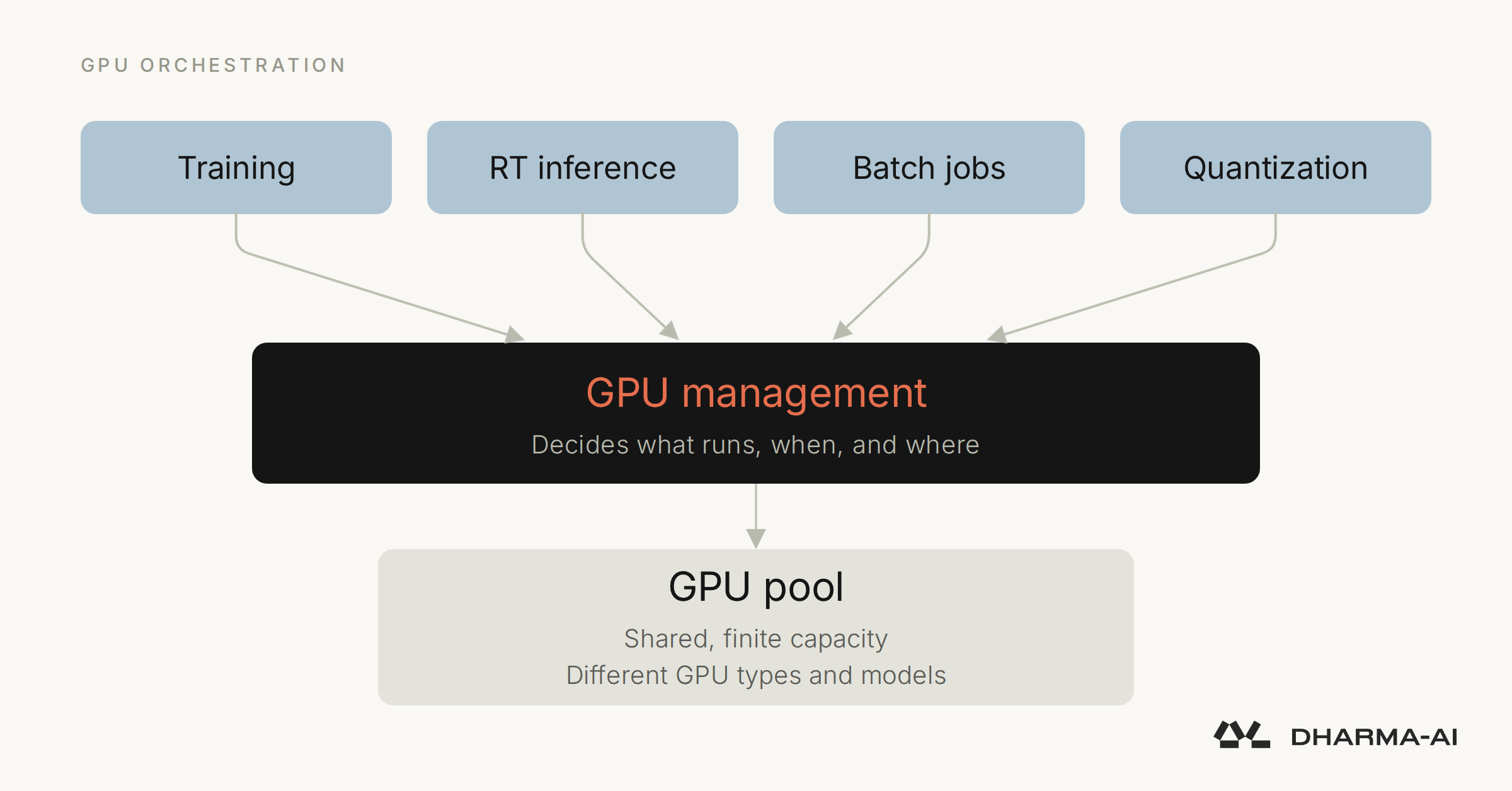
The article makes a second point that translates directly to your operations: infrastructure has to be sized for the peak. Training runs, batch jobs, and real-time traffic all land at once, so companies provision for that moment—and leave a meaningful share of capacity idle outside it. Malaysian SMEs do the same thing in everyday ways. You hire temporary staff for the month-end rush. You book extra delivery vehicles for the festive-season spike. You upgrade your POS system for a big sale promotion. None of that is wrong. But two businesses with identical tools and identical budgets will end up with very different results, and most of the gap traces back to one measurement: how much of what they own is doing something useful at any given moment (source).
There is a deeper layer too. The article notes that a cluster full of busy GPUs can still be wasting most of its potential, because different workloads—real-time inference, batch processing, training, fine-tuning, embedding generation—each want something different from the hardware. A scheduler tuned for one will misallocate the other three almost by default. For your business, this looks like: your sales team using AI to draft proposals, your admin team using it for data entry, your marketing team using it for social media captions, and each of them using a different tool with no shared workflow. The capacity is there. The utilisation is scattered. The fix is not buying more. The fix is measuring and managing what you already hold.
The Bigger Picture
The article argues that intelligence carried the industry this far, but utilisation is where the next real constraint is forming. For Malaysian SME owners, that is encouraging news. It means you do not need the most advanced AI or the largest technology budget to win. You need to use what you already have properly. The businesses that lead over the next few years will not be the ones buying the most AI. They will be the ones with the highest utilisation rate of the AI they already pay for. That is a discipline, not a purchase.
So how do you put this into practice? Start treating your AI tools like aircraft. Log actual usage over a 30-day window, not what you assume you use. Identify the subscriptions that are parked at the gate. If a tool is not earning its keep through active use, either restructure how your team works so it gets used, or drop it. The article makes a final observation worth sitting with: a broken operation keeps planes on the ground no matter what else goes right. In your context, that means messy data, unclear processes, and staff who do not know what the tool can do will keep your AI grounded no matter how good the software is.
Here is a practical checklist to keep your AI flying:
- Audit your actual usage. Pull the logs. A 30-day snapshot of who opened which tool and when will shock you.
- Match the tool to the job. Real-time customer queries need a fast, responsive tool. Batch document processing needs a throughput-focused one. One size misallocates everything.
- Measure utilisation, not ownership. Two businesses with identical software will diverge on this single number.
- Fix the process before you add the headcount or the hardware. A broken workflow keeps your capacity grounded no matter what you buy.
- Plan for the peak, then manage the off-peak. Size for demand, but have a plan for what the idle time gets used for—just like an airline schedules maintenance and crew training around flight gaps.
The grounded aircraft analogy works because it strips away the hype. An aeroplane only earns while it flies. A GPU only earns while it computes. And an AI subscription only earns while your team actually uses it. For Malaysian SMEs, the smartest technology decision you will make this year is not choosing which new AI tool to acquire. It is deciding that the ones you already have will spend more time in the air.
Ready to Streamline Your Operations?
Technology moves fast. Your operations should keep up. AutoRunBiz builds AI systems that run your daily workflows — from WhatsApp order capture to accounting. Book a free 15-min ops audit →