
The AI Hardware You Trusted Is Sitting on the Tarmac
If you run a Malaysian SME, you’ve felt this exact moment. The AI tools you adopted worked brilliantly in the pilot phase. Then, at 10 a.m. on a busy Tuesday, everything slows to a crawl. Your customer-service chatbot gives half-answers. The monthly report that used to take minutes now takes hours. Support tells you it’s “compute constraints.” Nobody gives you a straight answer.
Here’s the uncomfortable truth: the problem isn’t artificial intelligence. It’s utilization — how much of your AI infrastructure is actually doing something useful at any given moment. Airlines learned this lesson decades ago. An aircraft’s meter runs by the calendar hour — financing, depreciation, insurance — whether that plane is flying or parked. Revenue only comes from flight hours. A plane parked on the ground is the difference between an airline that survives and one that doesn’t. Your GPUs are now the exact same story.
TL;DR: Idle GPUs are grounded aircraft — the meter runs whether they’re working or not. The new edge in AI isn’t owning more hardware; it’s how much of it you keep busy. For Malaysian SMEs, this means measuring your current AI utilization and scheduling work around quiet hours, before adding anything new.
What “GPU Utilization” Actually Means
Let’s remove the jargon. A GPU is a calculator built for AI work — training models, running predictions, generating text. If you use AI through an API like OpenAI or Claude, you’re renting someone else’s GPU by the token. If you host your own machine — maybe to keep customer data in-house for PDPA compliance — you’re committing power, cooling, and replacement value every hour, regardless of whether a job is running or the machine just sits there humming.
The article that sparked this thinking makes the point unforgettably: a GPU’s meter runs by the calendar hour, and it produces output only during the compute hour. Capacity sitting idle isn’t “spare.” It’s waste, just like a wide-body aircraft parked at an airport during peak travel season.
Even worse: a GPU that shows as “busy” can still be wasted. A cluster can report high average occupancy while several queued jobs wait for a GPU type that happens to be busy running something else entirely. In plain language: your AI server is running one job that’s a poor fit, while three other tasks sit in a queue because they need a different setup. Your dashboard says 90% busy. The genuinely useful output is closer to 40%.
How This Applies to Malaysian SMEs
You might be thinking: “I don’t own a GPU. This doesn’t apply to me.” But it does — in three concrete ways.
1. You’re hitting token walls, not intelligence walls. If you use AI through subscriptions or APIs, the article’s point about the bottleneck moving from models to compute shows up in your daily life as token limits, slower responses at peak hours, or being nudged toward a higher tier. Your AI didn’t get dumber. The infrastructure got congested. Even the most well-funded labs on the planet treat compute access as a live strategic constraint — one major AI lab was reportedly running commitments across four separate hardware vendors at once just to stay competitive. If the giants are hedging across providers, your SME needs a backup AI provider too — not because the AI can’t do the job, but because compute availability is now the constraint.
2. You sized for the peak — and now you watch the quiet hours go to waste. Consider a logistics company in Johor with one GPU server handling delivery route optimization and customer tracking queries. The hardware was chosen for the 8 p.m. peak, when all the drivers finish and the day’s data lands at once. The other twenty hours, it sits nearly idle. That’s the exact trap the article describes: infrastructure sized for the peak leaves a meaningful share of capacity provisioned and unused outside that peak. The fix isn’t getting a smaller server. It’s moving non-urgent work — nightly report generation, model retraining, embedding updates — into those idle windows.
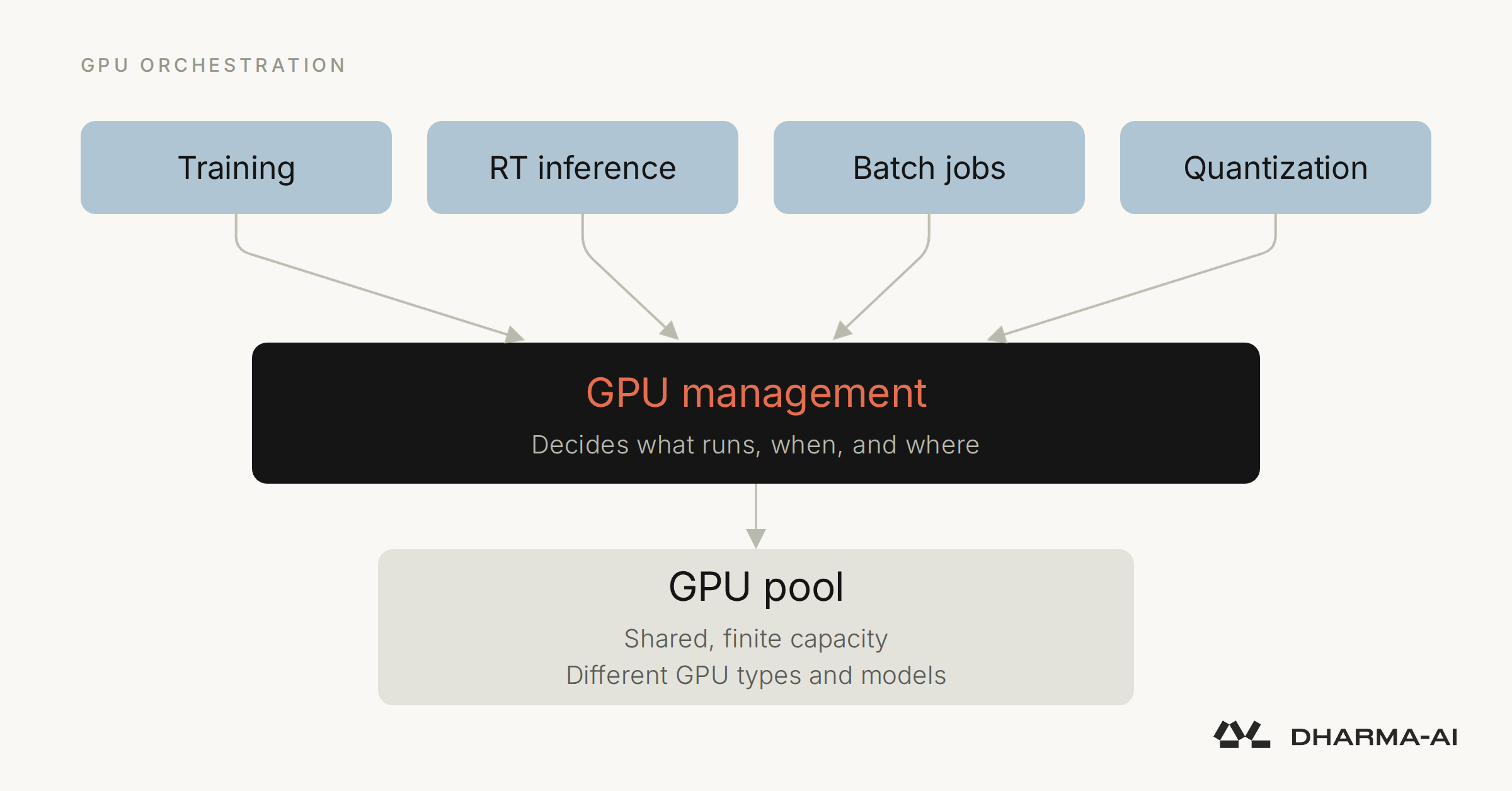
3. Your workloads are different, and that’s actually the problem. A typical Malaysian SME running AI operates several kinds of jobs: real-time customer service in a WhatsApp chatbot, batch invoice processing overnight, weekly retraining of a recommendation model, and one-off data analysis for a grant application. Each of these wants different things from the hardware. The article is blunt about the mismatch: real-time inference needs low latency above nearly everything else; batch work cares about throughput and tolerates delay; training can occupy a GPU continuously for hours. Run all of these on one machine without scheduling rules, and they’ll fight each other. Your night batch job will run at noon, slow down the chatbot your customers are using, and make your dashboard lie about being busy.
This is where the Malaysian context matters most. Hardware lead times in this region are long, power reliability varies, and you can’t just “add another GPU” when suppliers quote months of backlog. So the winning move is utilization — the same move that separates profitable airlines from struggling ones. Two companies with comparable GPU access diverge based on how much of that hardware is doing something useful, not on how much either one owns.
“A GPU accrues cost by the calendar hour, whether or not it’s doing anything useful in a given moment. Its output only accrues by the compute hour. Utilization, not intelligence, is where the next real constraint is forming.”
The Workload Mix Most Malaysian SMEs Actually Run
| Workload | What it needs | When you usually run it | Smarter approach |
|---|---|---|---|
| Customer-service chatbot | Low latency (fast replies) | 9am–6pm, Monday–Friday | Reserve capacity; push everything else to night |
| Invoice processing / OCR | Throughput; tolerates delay | End of month, all week | Batch it into nightly windows |
| Model retraining | Continuous hours of full GPU use | Weekly, whenever it fits | Schedule weekends or off-peak nights |
| Data analysis / reporting | Big burst of capacity, brief | Monday morning | Queue for off-peak; don’t run mid-day against the chatbot |
Practical Takeaways for Your Business
- Measure before you add anything. Look at your current AI dashboards — most platforms show utilization. If you’re under 60% busy, the problem is scheduling, not capacity.
- Separate urgent from non-urgent work. Real-time tasks (chatbot, live queries) get priority. Everything else — reports, retraining, data jobs — gets a scheduled slot.
- Match the tool to the job. Don’t run batch processing on your low-latency system, and don’t retrain models during business hours on hardware your live systems depend on.
- Keep a backup AI provider. The bottleneck has moved from models to compute. One vendor can get congested regardless of your subscription tier.
- Treat night hours as a resource. Shift model training, embedding generation, and large data jobs to off-peak windows where capacity is plentiful.
The Bigger Picture
The era of “bigger models automatically win” is over. The article’s central claim — utilization, not intelligence, is the next real constraint in AI — changes how you should think about every AI investment you make from here. The businesses that win won’t be the ones with the most GPUs, the most tokens, or the most subscriptions. They’ll be the ones that wring a useful hour out of the infrastructure they already have.
For Malaysia, with national digital-adoption programs pushing SMEs toward AI, and data centers multiplying across Johor and Selangor, the temptation will be to equate AI success with acquiring more compute. It doesn’t work that way. Airlines with bigger fleets still go out of business. It’s the airline that keeps its planes flying that survives. Your AI fleet — whether that’s one local GPU, a cloud cluster, or a set of API subscriptions — is only as good as its utilization rate.
Start treating your AI capacity like a fleet manager treats aircraft. Measure the idle hours. Plan the rotations. Match the right plane to the right route. The AI will do its part. The question is whether you’ll keep it off the ground.
Ready to Streamline Your Operations?
Your business should run itself. AutoRunBiz deploys AI agents to automate your daily operations — WhatsApp orders, invoicing, customer follow-ups, and accounting. Book a free 15-min ops audit to see where automation fits your business →