
Why Your Business Needs AI That Knows What to Keep Private
You may want an AI assistant to search documents, prepare reports, compare customer records, or summarise internal conversations. But the most useful information is often the information you should not casually send to an external cloud service: identity-card details, bank information, employee records, client contracts, supplier terms, and confidential business plans.
This creates a practical problem for Malaysian SME owners. If you keep everything away from AI, your team misses out on useful automation. If you send everything to a cloud model, you may create privacy, confidentiality, and compliance concerns. The new hybrid compute approach from Perplexity offers a useful way to think about solving that problem.
TL;DR: Hybrid compute lets a cloud AI handle planning and online research while a local model on your Mac handles sensitive steps. An on-device privacy classifier can keep data local, mask it, refuse the action, or request your approval.
For SMEs, the important lesson is not whether you should immediately adopt this specific product. It is that AI systems should be designed with a clear boundary between information that may leave your business and information that must remain under your control.
What This Means
Traditional cloud AI sends your request and relevant information to remote servers. This can work well for general questions, public research, and non-sensitive writing. However, it becomes more complicated when an AI agent needs access to private folders, customer databases, invoices, contracts, or employee files.
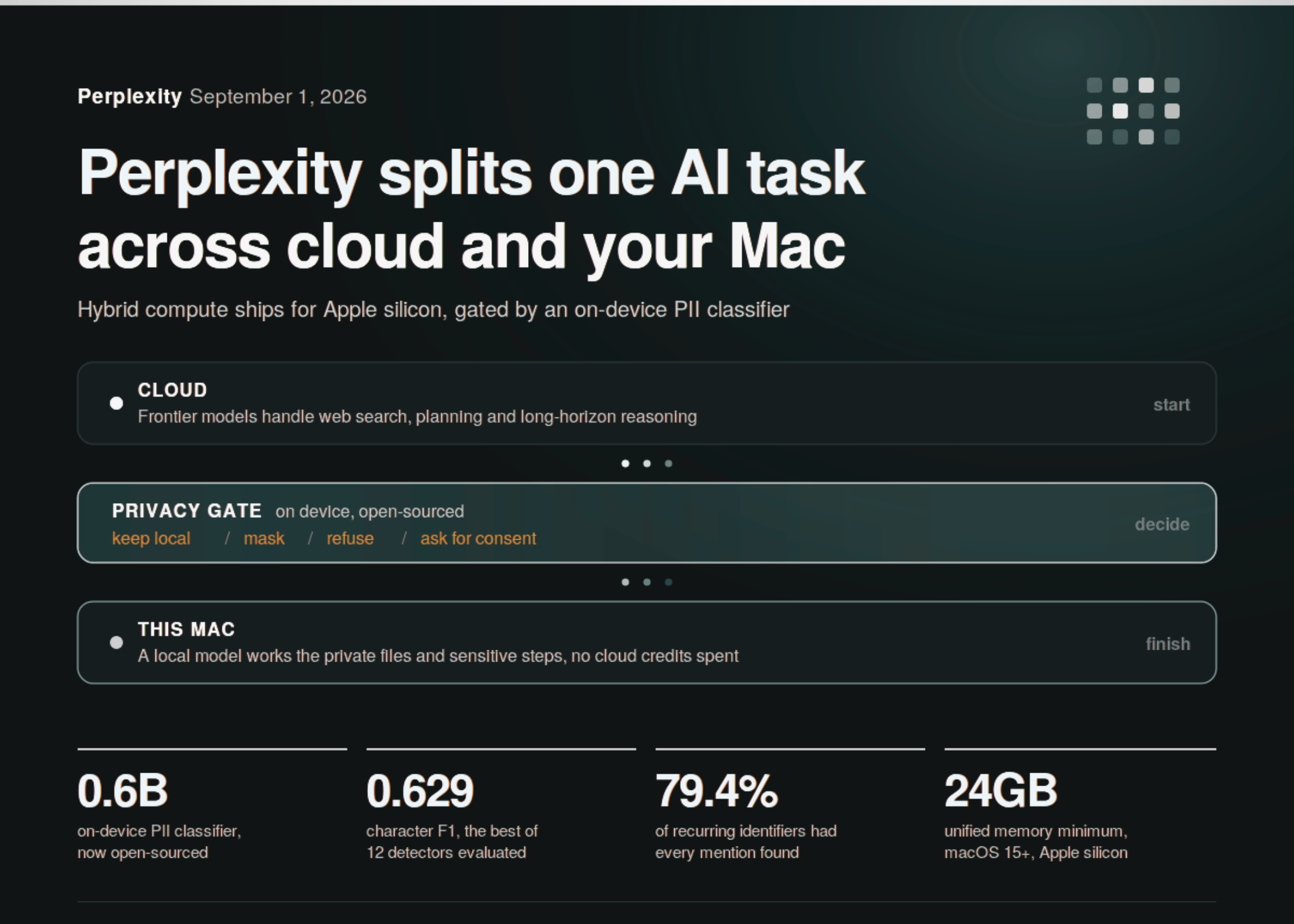
Hybrid compute divides one AI task between cloud and local processing. According to the source article, Perplexity Computer begins a task in the cloud, where larger models manage web searches, planning, and extended reasoning. When the task reaches sensitive information on the Mac, the relevant step is passed to a local model instead of being sent outside the device.
The task does not need to restart. The local result is returned to the broader workflow, and the system combines both parts. In simple terms, the cloud model acts as the organiser, while the local model acts as a controlled assistant for private material.
The privacy gate is central to this design. Before protected content crosses the boundary, an on-device classifier checks it and selects one of four actions: keep the information local, mask sensitive sections, refuse the request, or ask the user for consent. The system identifies categories such as credentials, payment-card information, and government identification details, according to the reported product details.
The practical principle is simple: use cloud AI for broad reasoning and local AI for information your business has a duty to protect.
What the Technical Results Tell You
Perplexity has also released PII-Tracer, a small model intended to detect personally identifiable information. The model reportedly contains 0.6 billion parameters, identifies 37 labels across nine PII types, and was trained on approximately 714,000 samples, based on the source article.
Ready to Streamline Your Operations?
Your business should run itself. AutoRunBiz deploys AI agents to automate your daily operations — WhatsApp orders, invoicing, customer follow-ups, and accounting. Book a free 15-min ops audit to see where automation fits your business →