
Why Your Business Conversations Are Harder to Manage
When your team spends the day handling customer calls, site discussions, sales enquiries, internal briefings, and voice messages, important information can disappear quickly. Someone takes notes while listening. Another person tries to identify who said what. A manager later asks when the conversation actually ended. These small gaps create follow-up work and missed details.
For a Malaysian SME, this problem appears in many forms: a sales representative recording customer requirements in a noisy shop, a contractor discussing changes during a site visit, or a support team switching between Bahasa Malaysia and English during a call. The issue is not simply converting speech into text. You also need to know who spoke, when they spoke, and when the conversation finished.
Meta’s Muse Voice Transcribe shows how voice technology is moving towards handling these jobs together. While you may not need to adopt this specific service immediately, its design offers useful lessons for improving how your business captures and processes spoken information.
TL;DR
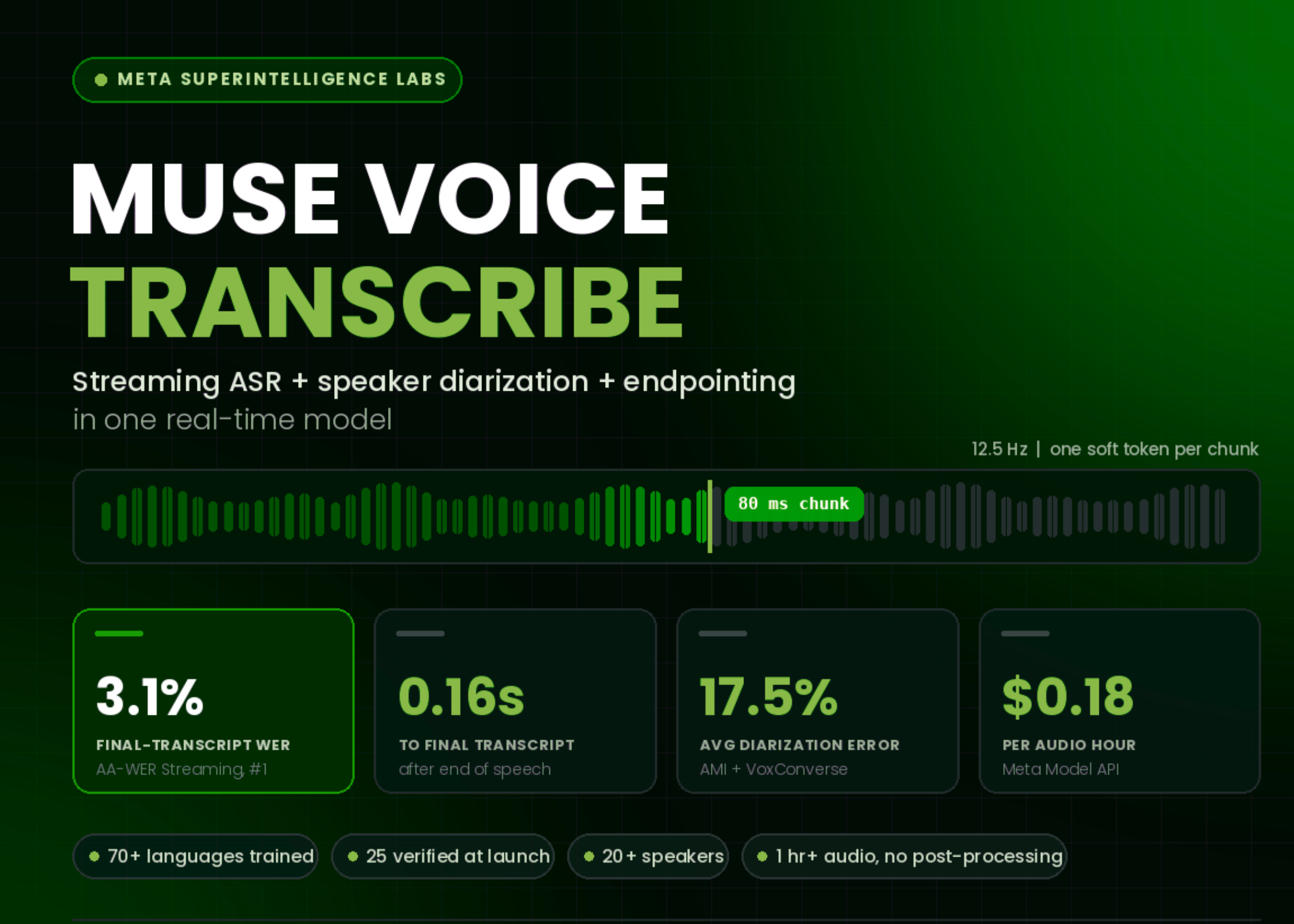
A new Meta model combines real-time transcription, speaker identification, and detection of when someone has stopped speaking in one streaming system. It supports more than 70 languages in training, with 25 languages extensively verified at launch, according to the source article.
For your business, the practical lesson is simple: voice automation becomes more useful when it produces organised, usable conversation records rather than a plain block of text.
What This Means
Most voice applications traditionally use separate systems for three tasks. Automatic speech recognition, or ASR, converts audio into words. Diarization identifies different speakers. Endpointing detects when a person has finished talking so the system can respond at the right moment.
When these systems are connected together, information must pass from one model to another. That hand-off can introduce delays or mistakes. For example, a transcription system may record the words correctly but assign them to the wrong person. A voice assistant may also interrupt because it thinks you have finished speaking when you are only pausing.
Muse Voice Transcribe combines these functions in one autoregressive model. It processes audio in small streaming chunks, continuing to listen or producing text as needed. Special internal markers indicate a possible speaker change, a new speech segment, or the end of a response. The result is intended to be a live transcript with speaker labels and clearer conversation boundaries.
The model also uses what Meta describes as adaptive delay. Instead of waiting the same amount of time for every word, it can wait longer when a phrase is difficult and respond sooner when the speech is clear. This reflects a useful business principle: speed and accuracy should be balanced according to the situation, not treated as fixed settings.
The practical insight: A useful voice system should not only hear words. It should understand the structure of the conversation well enough to support the next business action.
What the reported results show
Meta reports a 3.1% final-transcript word error rate at 0.16 seconds after speech ends on the Artificial Analysis AA-WER Streaming benchmark. The same report lists 3.4% for Cartesia Ink-2 with semantic endpoints and 3.6% for ElevenLabs Scribe v2 Realtime. These figures are benchmark results reported by Meta and should be tested against your own accents, background noise, terminology, and languages before adoption.
| Reported capability | Figure | Why it matters to you |
|---|---|---|
| Languages trained | 70+ | Useful for multilingual teams and customer conversations |
| Languages extensively verified at launch | 25 | Shows why language testing matters before relying on transcripts |
| Speaker handling | 20+ speakers | Relevant to meetings, briefings, and group discussions |
| Reported final-transcript WER | 3.1% at 0.16 seconds | Indicates fast transcript completion in a benchmark |
| Reported diarization error rate | 17.5% | Shows that speaker labels can still require review |
All figures in this table come from Meta’s reported results in the source article. Benchmark performance is not a guarantee of identical results in your workplace.
How This Applies to Malaysian SMEs
Customer service teams can respond more consistently. Suppose your team receives enquiries through phone calls or voice messages on WhatsApp. A real-time transcription system could turn the conversation into searchable text while separating the customer’s words from the staff member’s reply. After the call, your workflow could identify the product requested, promised follow-up, delivery location, or unresolved complaint. This reduces the chance that a busy employee relies on memory or leaves a voice message untouched.
Language switching is especially relevant in Malaysia. A customer may begin in Bahasa Malaysia, use English product terms, and include a Mandarin or Tamil phrase depending on the team and context. The source article says Muse Voice Transcribe supports native code-switching and can be improved with language, keyword, and context biasing. You should still run your own pilot using local accents, industry vocabulary, names, and noisy environments before treating automated transcripts as final records.
Sales teams can capture requirements during visits. A salesperson meeting a customer at a showroom, warehouse, restaurant, or construction site may not be able to write complete notes. A structured transcript can record who requested what, which specification changed, and what action was promised. This is valuable when several people participate in the discussion. Speaker labels can help distinguish the customer’s requirement from your employee’s suggestion, although a manager should review important details before they enter a quotation or order.
Operations teams can improve meeting follow-through. In a small business, one meeting may include an owner, supervisor, technician, administrator, and external supplier. A transcript that identifies speakers and detects the end of each turn can make it easier to create an action list. For example, the system could identify that the warehouse supervisor will check stock, the installer will confirm a site date, and the administrator will send documents. The benefit comes from connecting the transcript to your existing task process, not from storing long recordings that nobody reads.
Field-service businesses can record technical discussions. Air-conditioning contractors, renovation firms, maintenance providers, and equipment distributors often work in places with background noise and multiple speakers. Real-time voice capture may help document fault descriptions, agreed changes, and customer instructions. However, you should not assume that a transcript is proof of approval. Important changes still need written confirmation through your normal quotation, purchase order, or approval process.
Practical Takeaways
- Start with one workflow: Choose a repeated process such as sales-call summaries, support calls, or meeting action items.
- Measure business usefulness: Track whether staff save time finding requirements, completing follow-ups, or checking previous conversations.
- Test Malaysian speech patterns: Include Bahasa Malaysia-English code-switching, local names, product terms, accents, and background noise.
- Check speaker accuracy: Speaker diarization is helpful, but review labels before using transcripts for disputes, approvals, or formal records.
- Create a keyword list: Add your company names, product codes, locations, staff names, and technical terms to improve recognition where the service supports context biasing.
- Define consent clearly: Tell participants when calls or meetings are recorded and explain how the transcript will be used.
- Control access: Limit transcripts to employees who need them, especially when they contain customer details, internal plans, or employee information.
- Keep a human review step: Use automation for drafts, summaries, and routing; retain human approval for commitments and sensitive decisions.
- Check deployment requirements: Muse Voice Transcribe is described as a hosted API with no released model weights, so your technical provider must assess data handling and integration requirements.
- Connect outputs to action: A transcript should create a task, update a customer record, or flag a follow-up rather than simply sit in a folder.
Questions to Ask Before You Adopt Voice AI
- Which conversations create the most repeated note-taking work?
- Do you need live captions, a post-call transcript, speaker labels, or all three?
- How will your team correct names, product terms, and misunderstood phrases?
- Who is allowed to view recordings and transcripts?
- What happens when the system is uncertain or assigns the wrong speaker?
- Can the output connect to your CRM, helpdesk, project tracker, or internal approval process?
- Will your customers and employees understand when their voices are being processed?
The Bigger Picture
The longer-term direction is clear: voice systems are becoming less like simple dictation tools and more like conversation interfaces for business software. The important capability is not merely producing text quickly. It is recognising conversational structure so that systems can decide when to listen, when to respond, who is speaking, and what should happen next.
For SMEs, this means you do not need to begin by building a sophisticated voice platform. Begin by identifying where spoken information is regularly lost. Then test whether transcription, speaker separation, and endpoint detection improve that one process. If the pilot works, you can connect it to customer records, task assignments, quality checks, or management reporting.
There are also limits. The reported model is hosted through Meta’s Model API, and the source article states that no weights have been released for self-hosting. That makes provider assessment important. You should review retention policies, access controls, supported languages, integration options, and how the service handles sensitive business information.
Voice AI will be most useful when it fits the way your employees already work. If staff must copy transcripts manually between systems, adoption may be weak. If a conversation automatically becomes a reviewed summary, assigned task, or searchable customer history, the value becomes much clearer.
As a Malaysian business owner, your first step is practical: choose one conversation-heavy workflow, test it with real local speech, and judge the result by completed follow-ups rather than impressive technical claims. That approach helps you adopt voice automation carefully while keeping people responsible for decisions that matter.
Ready to Streamline Your Operations?
Your business should run itself. AutoRunBiz deploys AI agents to automate your daily operations — WhatsApp orders, invoicing, customer follow-ups, and accounting. Book a free 15-min ops audit to see where automation fits your business →