
When a consultation is more than words
Think about the last time you visited a clinic with a family member. The doctor did not just listen to the complaint. She noticed how your father’s hands trembled slightly, heard the faint wheeze beneath his voice, and saw the way he winced when he sat down. Those observations were not a side detail of the consultation — they were the consultation. According to Google Research, “when you visit a doctor, a consultation extends far beyond words — a physician notices a cough, observes gait, or registers visible signs of discomfort” (source). That simple truth is about to collide with how Malaysian SMEs deliver services.
Because if you run a business in Malaysia — whether it is a private clinic, a dental practice, a physiotherapy centre, or even a consultancy — you know that the physical presence of a customer changes everything. A client who walks into your office gives you information they will never type into a form. The question is: what happens when that information can be captured without either of you being in the same room?
What happened
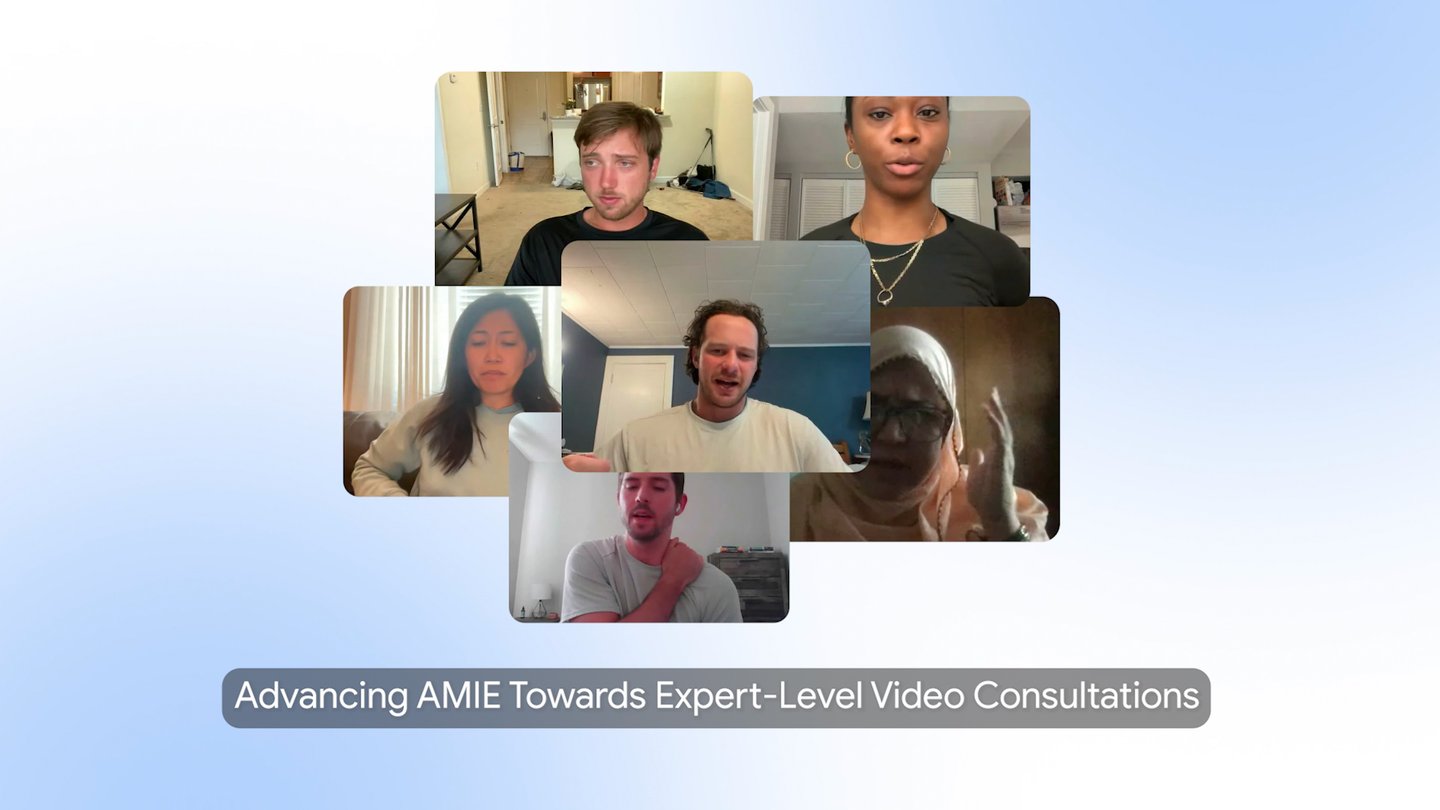
On 11 August 2026, Google Research and Google DeepMind announced a first-of-its-kind demonstration of AMIE, their research medical AI system, conducting real-time clinical video consultations (source). AMIE is built on Gemini and Project Astra using a multi-agent architecture, which means it coordinates multiple specialised models working together rather than relying on one monolithic system (source). In practice, this allows the system to interpret visual and auditory cues, guide virtual physical exams, and reason diagnostically in real time (source).
The study itself was a randomised simulation using patient actors and a group of primary care physicians. Clinical evaluators assessed AMIE favourably across core clinical competencies, including history-taking thoroughness, diagnostic accuracy, management appropriateness, and communication quality (source). Notably, the patient actors preferred the video experience over text chat (source). AMIE remains a research system — Google explicitly states that more research is needed before responsible real-world clinical deployment (source). But the direction is unmistakable: AI is moving from reading text to seeing people.
“When you visit a doctor, a consultation extends far beyond words — a physician notices a cough, observes gait, or registers visible signs of discomfort.” — Google Research, on the motivation for AMIE’s video capabilities (source)
Why this matters for Malaysian SMEs
Healthcare in Malaysia is a small business economy. Beyond the big hospital groups, the backbone of primary care is a network of thousands of private clinics, dental surgeries, optical shops, physiotherapy practices, and wellness centres — most of them with fewer than 50 employees, often family-run. If you are one of those owners, consider what a system like AMIE points toward: a video consultation where the AI assists the clinician by noticing the things in a frame that a human might miss at the end of a 12-hour shift. The study specifically found that the system was assessed favourably on history-taking thoroughness and communication quality (source) — two pillars of a small clinic’s reputation.
But this is not just a healthcare story, and it is not just a future story. Think about your own customer interactions. You run an automotive workshop, a bridal boutique, an interior design firm. A remote video call with a client today is a crude tool — you are literally blind to half the information. The AMIE demonstration suggests that AI can now watch, listen, and reason simultaneously in real time (source). Imagine an e-commerce business doing a live “virtual fitting” for a boutique client in Penang, or a mechanic guiding a Klang Valley customer through a video inspection where the AI flags the visible dent the customer overlooked. The underlying capability — interpreting visual and auditory cues in a live conversation — is transferable far beyond clinical medicine (source).
| What AMIE demonstrated | What the study showed | What it could mean for your SME |
|---|---|---|
| Real-time video consultation | AI interprets visual and auditory cues in a live conversation (source) | Your after-sales video support could “see” the problem instead of guessing |
| Virtual physical exam guidance | System guides patients through structured checks on camera (source) | A fitness coach or rehab centre could run guided assessments remotely at scale |
| Diagnostic reasoning | Evaluators rated the system favourably on diagnostic accuracy (source) | Decision-support layers on live video could reduce human error in inspections and reviews |
| Communication quality | Patient actors preferred the video experience over text chat (source) | Your customers already want interaction beyond typing; video is the next baseline |
The bigger picture
The AMIE announcement sits inside a broader shift in AI: from text-based tools that read your messages to multimodal systems that observe your surroundings. Malaysia is a naturally relationship-driven economy — customers choose a clinic, a workshop, or a designer based on trust, and trust is built by being seen and understood. Video-based AI, of the kind AMIE demonstrates, attacks the one major weakness of digital services: the loss of physical nuance. If a machine can now assess whether a patient’s breathing looks laboured or whether a customer’s posture suggests discomfort (source), the practical distance between “online” and “in person” shrinks dramatically.
For you as an SME owner, the strategic takeaway is not to rush out and build a medical AI — it is to understand what your customers actually want from you. The patient actors in this study preferred the video experience over text chat (source). That is a reminder that people are asking for richer, more human interactions, not fewer of them. The tools to deliver that — efficiently, consistently, and in real time — are arriving faster than most annual business plans anticipate. AMIE is research today, but the pattern is clear: the competitive edge in the next few years will belong to Malaysian SMEs that figure out how to see their customers, not just serve them.
Ready to Streamline Your Operations?
Technology moves fast. Your operations should keep up. AutoRunBiz builds AI systems that run your daily workflows — from WhatsApp order capture to accounting. Book a free 15-min ops audit →