
Why This AI Update Matters to Your Business
If you run a Malaysian SME, you probably do not need another impressive AI announcement. You need to know whether a new model can help your team reply to customers faster, process documents more reliably, or reduce repetitive work without creating new technical problems.
That is the practical question behind Anthropic’s release of Claude Fable 5.1 and Claude Mythos 5.1. The models are designed for longer, tool-using workflows, including research, coding, document handling, and business process automation. For you, the important issue is not the model’s name. It is whether your current automation can become more dependable, especially when the same instructions and business documents are reused repeatedly.
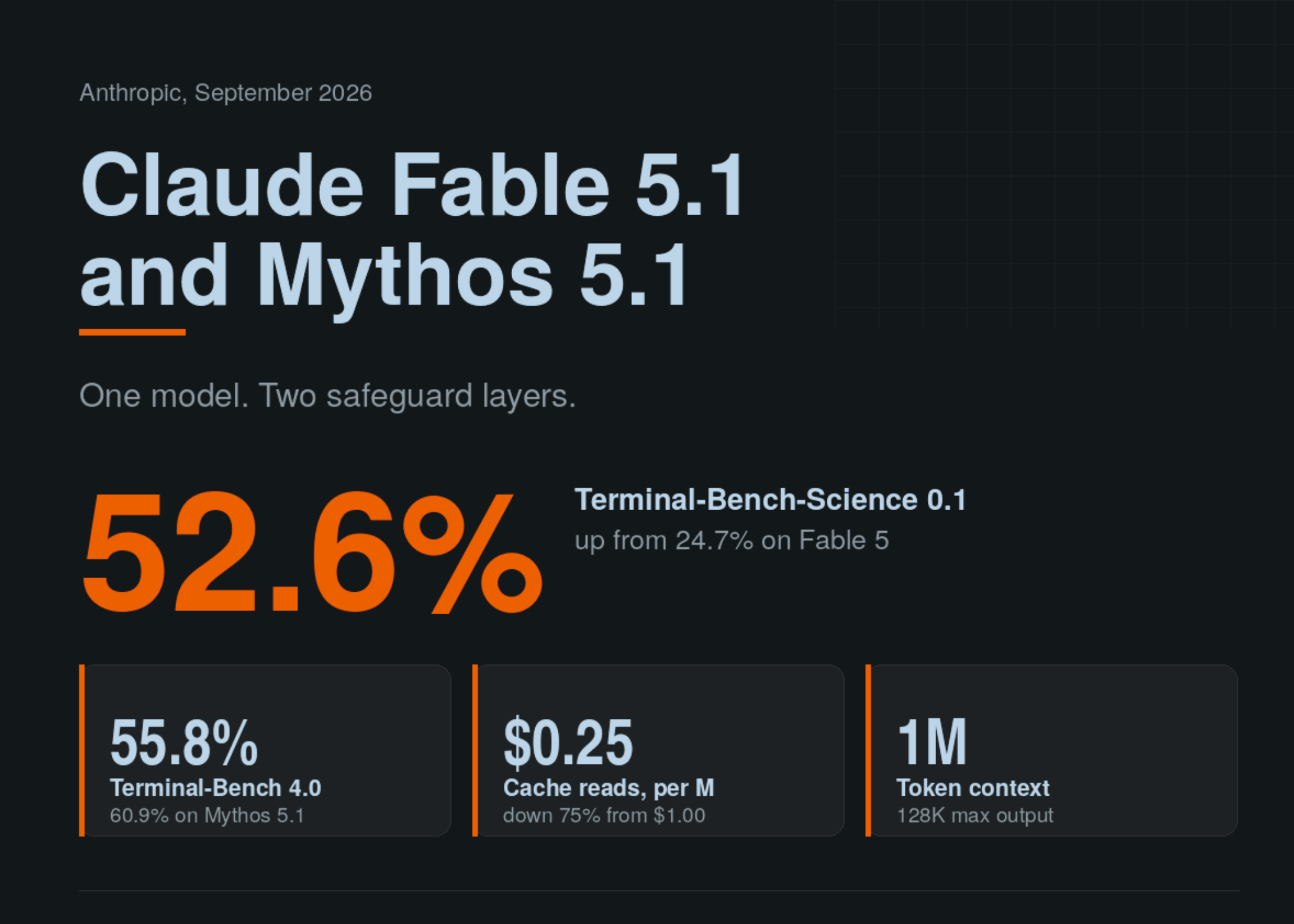
TL;DR: Claude Fable 5.1 is generally available, while Claude Mythos 5.1 is restricted to vetted US organisations. Fable 5.1 reports 52.6% on Terminal-Bench-Science 0.1, compared with 24.7% for Fable 5, and cache-read rates fall from $1.00 to $0.25 per million tokens, according to MarkTechPost.
The release also introduces integration changes. If your automation edits conversation history, forces tools directly, or switches between models, your developer or automation partner should test it before making the change in production.
What This Means
Claude Fable 5.1 and Claude Mythos 5.1 use the same underlying model but apply different safeguard layers. Fable 5.1 is available through the Claude API and cloud platforms including Amazon Bedrock, Google Cloud, and Microsoft Foundry. Mythos 5.1 remains limited to selected organisations under Project Glasswing, as reported by MarkTechPost.
The model has a one-million-token context window and a maximum output of 128,000 tokens, according to the same source. In plain language, it can work with a very large amount of background material in one session. That could include a collection of standard operating procedures, customer policies, product catalogues, past tickets, or project files.
However, a large context window does not mean you should send every document to the model every time. Good automation still needs clear document selection, access controls, structured prompts, and human review for important decisions.
The headline benchmark is Terminal-Bench-Science 0.1, where Fable 5.1 scored 52.6%, compared with 24.7% for Fable 5 and 29.0% for Opus 5. The source also reports a standard error of 3.5 to 4.5 percentage points per model, so you should treat the result as an indication of capability rather than a guarantee for your own workflow.
The useful lesson is not that a benchmark doubled. It is that long-running AI workflows are becoming more capable, while integration details matter more than ever.
How This Applies to Malaysian SMEs
Customer service teams can use longer context more carefully. A Malaysian online retailer, distributor, or service provider may need an assistant that understands product specifications, return rules, delivery information, and customer history. Fable 5.1 could help draft replies that follow your internal policies instead of producing generic answers. You can also configure the workflow to escalate uncertain cases to a staff member, rather than allowing the assistant to make unsupported promises.
Document-heavy operations are another practical fit. Construction firms, wholesalers, accounting practices, and logistics businesses often manage quotations, purchase orders, invoices, delivery notes, and compliance documents. A model with a large context window can compare information across related files, identify missing fields, and prepare a checklist for approval. You should still require a person to confirm tax treatment, contractual obligations, payment details, and other sensitive information before anything is sent or recorded.
Internal knowledge assistants can reduce repeated questions. If your staff regularly ask how to handle a refund, create a quotation, onboard a customer, or respond to a specific complaint, you can connect an assistant to approved procedures. This is particularly useful when a business has between one and 50 employees and the owner or manager is still the person everyone depends on. The assistant should quote the relevant procedure and show the document source, so your team can verify the answer.
Agentic workflows need tighter testing. An AI agent is not simply a chatbot. It may call a spreadsheet, create a task, check an order system, or prepare an email. Anthropic reports that parallel tool calling is more variable in the new release, meaning an agent may make one tool call per turn where an earlier version made several. That could affect workflows such as stock checks, lead qualification, or appointment scheduling.
For a Malaysian SME, this means you should not change the model inside a live workflow without testing the complete sequence. A small difference in tool calling can cause delays, duplicate actions, incomplete records, or an email being prepared before the required information is available.
Key figures to understand
Ready to Streamline Your Operations?
Your business should run itself. AutoRunBiz deploys AI agents to automate your daily operations — WhatsApp orders, invoicing, customer follow-ups, and accounting. Book a free 15-min ops audit to see where automation fits your business →