
Why Claude Fable 5.1 Matters to Your Business
Anthropic has released Claude Fable 5.1, a new AI model designed for longer, more complex tasks involving software tools, documents and multi-step workflows. For a Malaysian SME, the important question is not whether the model achieved an impressive benchmark result. It is whether the release can help you automate repetitive work without creating new operational, security or integration problems.
Fable 5.1 is generally available through Anthropic’s API and several major cloud platforms, while Claude Mythos 5.1 remains restricted to vetted organisations in the United States. The two models use the same underlying system but apply different safeguard layers, according to MarkTechPost’s report.
What Happened
Anthropic released Claude Fable 5.1 and Claude Mythos 5.1 three months after the Fable 5 family launched in June 2026. Fable 5.1 is available under the model identifier claude-fable-5-1 through the Claude API, Amazon Bedrock, Claude Platform on AWS, Google Cloud and Microsoft Foundry. Mythos 5.1 is limited to vetted US organisations participating in Project Glasswing, as reported by MarkTechPost.
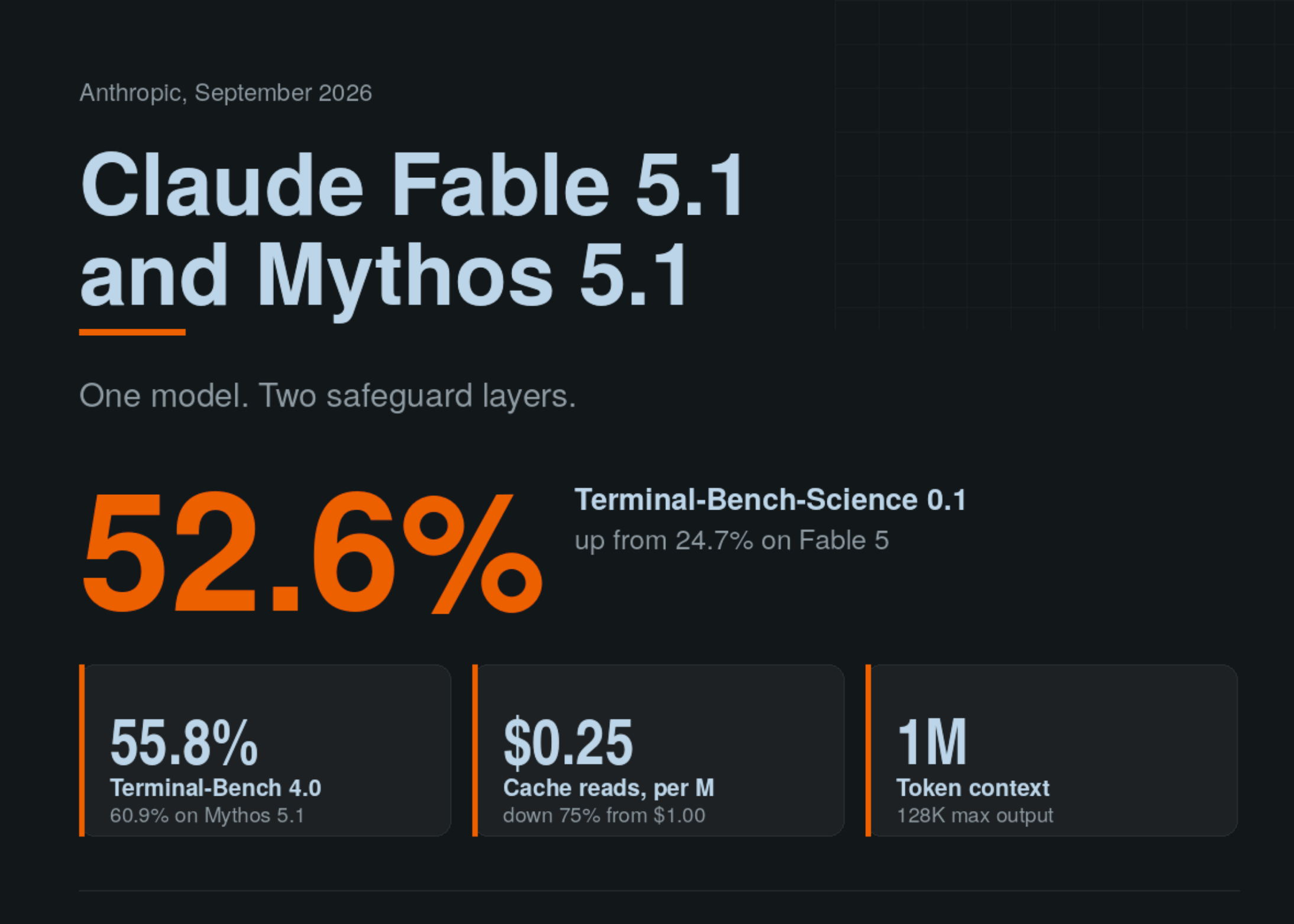
Both models have a one-million-token context window and a maximum output of 128,000 tokens. They also use adaptive thinking by default. On Terminal-Bench-Science 0.1, an agentic scientific research test, Fable 5.1 achieved 52.6%, compared with 24.7% for Fable 5, 29.0% for Opus 5 and 22.4% for GPT-5.6 Sol. These figures come with a reported standard error of 3.5 to 4.5 percentage points per model, so you should treat the results as an indication rather than a guarantee for your own workflow, according to the source article.
The release also changes how cached input is handled. Cache reads fall from $1.00 to $0.25 per million tokens, a 75% reduction. Anthropic says this may produce approximately 25% lower costs on typical workloads and up to 45% lower costs for context-heavy agentic workloads. Base input and output rates remain at $10 and $50 per million tokens, while batch processing is listed at $5 and $25 per million tokens in the source report. These figures are included for technical comparison; you should validate current terms directly with your selected platform before deployment.
Why This Matters for Malaysian SMEs
Many Malaysian SMEs do not need an AI system to answer one-off questions. You need systems that can work through recurring processes: checking purchase orders, comparing supplier quotations, preparing customer replies, updating stock records, summarising sales conversations and escalating unusual cases. The model’s large context window could be useful when a workflow needs to examine several documents, policies or previous messages in one session.
For example, a distributor in Shah Alam could connect an internal assistant to product specifications, delivery rules and customer service procedures. A renovation company in Johor could use an agent to review a client brief, identify missing measurements, draft a quotation checklist and prepare follow-up questions. A professional services firm in Penang could ask an assistant to compare contract clauses against an internal playbook before a human reviews the result.
However, the benchmark result does not mean Fable 5.1 can independently run your business. Terminal-based tests measure specific capabilities under controlled conditions. Your own workflow may contain incomplete records, Bahasa Malaysia and English mixed together, local tax terminology, supplier exceptions and informal WhatsApp instructions. You should test the model against real but anonymised examples before connecting it to live systems.
The cache-read change is particularly relevant when an agent repeatedly uses the same long instructions, product catalogue or company policy. An agent that revisits a large knowledge base during many turns may benefit from the new cache treatment. Still, your technical team should measure actual usage rather than assume a fixed reduction. Anthropic’s reported savings are workload-dependent, and the base input and output rates have not changed, as documented by MarkTechPost.
Key Points for Your Implementation
| Area | What the release says | What you should do |
|---|---|---|
| Availability | Fable 5.1 is generally available; Mythos 5.1 is restricted. | Plan around Fable 5.1 unless you qualify for a separate programme. |
| Context | Up to one million tokens. | Use long context selectively and remove irrelevant documents. |
| Cache reads | Reduced from $1.00 to $0.25 per million tokens. | Measure repeated-context workloads before changing architecture. |
| Tool calls | Forced tool use with tool_choice set to any or tool returns an error. |
Use auto with strict tools or structured outputs. |
| Conversation editing | Changing earlier turns, system instructions or tools can invalidate thinking blocks. | Use turn-scoped system messages and server-side context editing. |
| Output provenance | Text watermarking and C2PA credentials for files are included. | Keep a review record for customer-facing and regulated material. |
API Changes You Should Not Ignore
The release includes breaking changes that may affect existing agent integrations. Forced tool use is no longer supported when tool_choice is set to any or tool. Anthropic recommends using auto together with strict tool use or structured outputs, according to the source article.
Thinking blocks are also model-bound. Fable 5.1 can read earlier models’ thinking, but an earlier model cannot read Fable 5.1’s thinking if a router switches models. This matters if you use a fallback arrangement that moves between models during an outage or based on task complexity.
Editing earlier conversation turns may now create errors. This includes injecting or deleting reminders for previous turns, or rebuilding the system or tools array in the middle of a conversation. The check applies to accounts created on or after August 31, 2026, as reported by MarkTechPost. If your SME uses an agent framework, ask your developer to test conversation updates, fallback routing and tool schemas before migration.
Do not upgrade an AI agent because a benchmark looks strong. Upgrade only after the model passes your real business tests, preserves your approval controls and behaves safely when information is missing.
The Bigger Picture
Fable 5.1 shows that AI providers are competing on more than chatbot fluency. They are improving agentic performance: the ability to inspect files, call tools, maintain context and complete technical sequences. Anthropic reported 55.8% for Fable 5.1 and 60.9% for Mythos 5.1 on Terminal-Bench 4.0. It also reported 73.4% on CursorBench 3.2.0, 41.7% on OSWorld 2.0 under a strict setting and 31.4% on AutomationBench, according to the source article.
At the same time, the release highlights why human controls remain necessary. Anthropic reports that parallel tool calling is more variable, meaning an agent may issue one call per turn instead of batching several. The model may also narrate less, rely on memory more at low effort and prefer rewriting whole files instead of making targeted edits. These behaviours could create problems if your system updates inventory, sends messages or modifies records automatically.
The practical path for you is a controlled pilot. Start with a read-only workflow such as document classification, internal search or draft generation. Add Malaysian business context, including your approval rules, customer language preferences and escalation contacts. Log every tool call, require human approval for external messages and financial records, and test failure cases such as missing stock data, conflicting instructions and incorrect customer details.
Claude Fable 5.1 may become useful for SMEs that need longer-context automation and more capable technical agents. Its strongest value will come from disciplined integration, not from simply selecting a newer model. If you treat it as a component inside a well-designed process—with access limits, audit logs and human review—you can explore practical automation while keeping your business decisions under control.
Ready to Streamline Your Operations?
Technology moves fast. Your operations should keep up. AutoRunBiz builds AI systems that run your daily workflows — from WhatsApp order capture to accounting. Book a free 15-min ops audit →