
AI Search Is Changing How Customers Find Your Business
If your business depends on people discovering your website through Google, you may already be noticing a difficult pattern: customers read an answer in a search result or AI summary, then never visit your site. Your content may influence the customer’s decision, but your business does not receive the visit, enquiry, or opportunity to build a relationship.
This matters when you run a Malaysian SME with a small team. You may not have a dedicated marketing department monitoring every search change. Yet your website still needs to attract customers, explain your services, and generate enquiries while search engines increasingly answer questions directly.
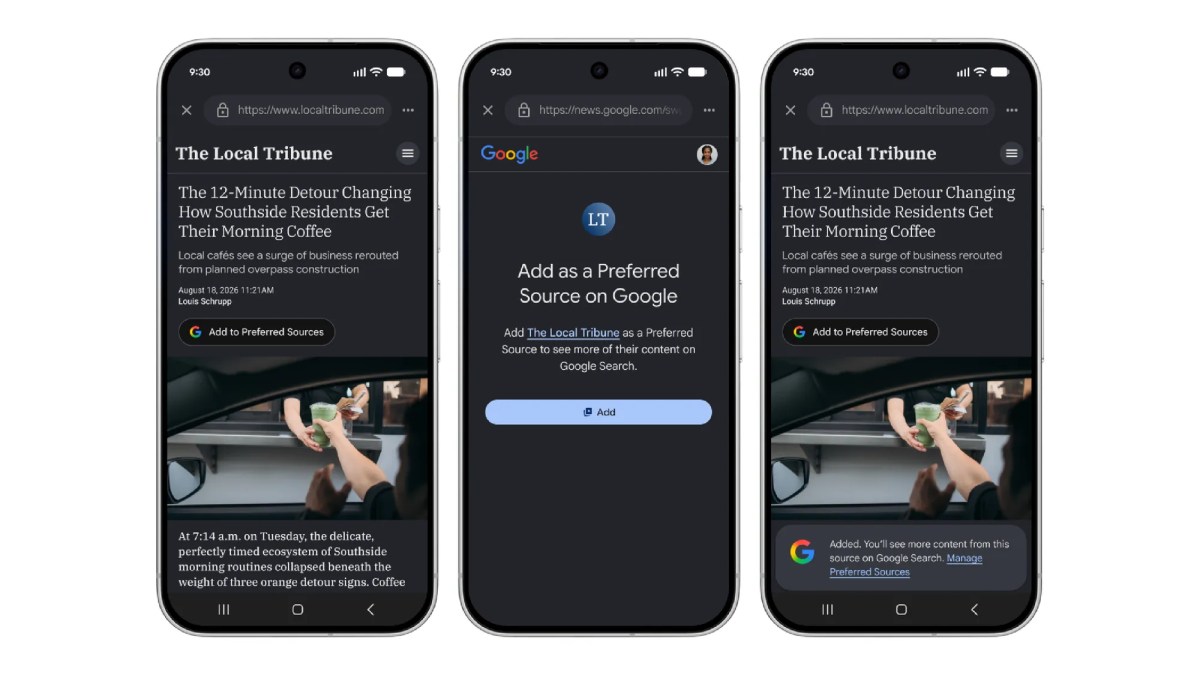
Google is now giving publishers a way to ask readers to mark their site as a “preferred source”. Readers can select sources they trust, and Google says preferred sources are more likely to receive click-throughs when available. The feature is part of a wider move to let users control what appears in Google Search, Discover, Google News, and AI-powered search experiences. Source: TechCrunch
TL;DR
Google’s Preferred Sources button lets readers signal that they want to see more content from a publisher they trust.
For your SME, the lesson is simple: build a website customers want to return to, make your expertise easy to recognise, and track enquiries rather than page views alone.
What This Means
Google’s Preferred Sources feature is a user preference tool. A reader can indicate that a particular publisher should appear more often across selected Google services. Google first introduced the preference option for features such as AI Mode and AI Overviews, and has now made a button available for publishers to place on their own websites. Source: TechCrunch
Think of it as a digital version of a customer saying, “Show me this business again.” It does not guarantee that every visitor will see your content, and it is not a replacement for strong search optimisation. However, it gives trusted publishers another way to encourage repeat visibility when search results and AI answers become more personalised.
Google reported that users had already selected more than 345,000 unique sources through its preference system by May 2026. It also said earlier studies found people were twice as likely to click a preferred source when it was available. Source: TechCrunch
The important point is not the button alone. The bigger change is that trust and preference are becoming stronger signals in online discovery. A generic article may answer a question once. A trusted local business can become the source a customer repeatedly chooses.
When search engines give customers more control, your job is not simply to appear once. Your job is to become a source they deliberately want to see again.
How This Applies to Malaysian SMEs
For a local service business, visibility must lead to confidence. Suppose you operate an air-conditioning service in Shah Alam, a renovation company in Johor Bahru, or an accounting practice serving SMEs in Penang. A customer may search for advice before contacting anyone. They may ask about maintenance schedules, renovation permits, payroll processes, or tax documentation. If your website only displays a list of services, it gives customers little reason to trust you or return.
You can instead publish practical answers based on the questions your customers ask every week. Explain how often an office air conditioner should be serviced, what information a renovation quotation should contain, or which records an SME should organise before handing documents to an accountant. Keep the language clear and relevant to Malaysian businesses. Helpful, specific content gives customers a reason to treat your website as a reference rather than a one-time advertisement.
For retailers and product businesses, use content to support repeat decisions. A bakery, furniture seller, skincare brand, hardware supplier, or specialty food business can publish buying guides, comparison pages, usage instructions, and maintenance tips. If a customer is deciding between two products, your explanation may be more useful than a short product listing. Include details such as suitable use cases, delivery areas, care instructions, and common mistakes. These pages can support search visibility while helping customers make decisions without waiting for a staff member to reply.
For B2B companies, demonstrate your working knowledge. Malaysian SMEs often sell to other businesses, where trust can matter as much as the initial enquiry. A logistics provider can explain how to prepare documents for cross-border shipments. An HR consultancy can outline a practical onboarding checklist. A software integrator can show how a small company should map approval steps before automating them. This type of content helps potential customers recognise that you understand their daily operations, not just the product you sell.
You should also make your business identity consistent. Use the same company name, service descriptions, contact details, locations, and expertise across your website and important business profiles. If your brand is unclear, customers may not know whether the information belongs to a real Malaysian operator or an unrelated content site. Clear authorship, updated dates, customer FAQs, and direct contact options all support credibility.
A Simple Data View for Your Website
| Signal | What to monitor | Useful action |
|---|---|---|
| Discovery | Search impressions and enquiries by topic | Publish more answers around questions that produce relevant leads |
| Engagement | Returning visitors and time spent on key pages | Improve internal links and add clearer next steps |
| Trust | Brand-name searches, reviews, and direct visits | Make your company information consistent across channels |
| Conversion | Calls, WhatsApp messages, forms, and appointments | Measure business outcomes instead of relying only on traffic |
Google’s earlier study indicated that preferred sources could receive twice the click-through rate when available. Source: TechCrunch Your own results may differ, so treat this as a reason to test and measure, not as a guaranteed outcome.
Practical Takeaways
- Review your website’s top five pages and ask whether each one answers a real customer question.
- Add a clear explanation of who you serve, where you operate, and what problems you solve.
- Create useful local content for Malaysian customers instead of copying broad, generic articles.
- Invite satisfied readers and customers to follow or mark your business as a preferred source where the option is available to them.
- Use clear author names, company information, updated content dates, and contact details.
- Connect related articles so visitors can move from an answer to a service page or enquiry form.
- Track phone calls, WhatsApp conversations, forms, and bookings, not just website visits.
- Review which pages are being quoted or summarised in AI search results and improve their accuracy.
- Keep your Google Business Profile and other business listings consistent with your website.
- Set aside a regular monthly review to update outdated advice, service areas, and customer questions.
The Bigger Picture
Google is also allowing users to customise their Discover feeds using natural-language instructions, such as asking to see more or less of certain topics. Android users are expected to receive similar controls for audio briefings in Google News. Source: TechCrunch These developments show a wider direction: customers are gaining more influence over what information reaches them.
That creates both pressure and opportunity for Malaysian SMEs. Pressure comes from the fact that publishing content alone will not guarantee attention. Opportunity comes from the fact that a focused, trusted business can stand out when customers actively choose useful sources.
Your long-term aim should be to build several ways for customers to recognise and return to your business: a helpful website, accurate local listings, clear social profiles, useful email or messaging updates, and reliable service. Search visibility remains valuable, but it should support a broader customer relationship.
Start with one practical question: What does my customer need to understand before they feel ready to contact me? Publish that answer clearly, keep it accurate, and make the next step easy. That is the foundation for earning preference in a search environment where customers—not only algorithms—decide which businesses deserve their attention.
Ready to Streamline Your Operations?
Your business should run itself. AutoRunBiz deploys AI agents to automate your daily operations — WhatsApp orders, invoicing, customer follow-ups, and accounting. Book a free 15-min ops audit to see where automation fits your business →