
You have built your business by being smart with resources. You know a small team has to out-think, not just out-spend. But what if your most powerful digital tool—your AI—is wildly overqualified for most of its daily work? A new platform from Fireworks AI exposes this massive inefficiency and offers a smarter path forward for your SME in Malaysia.
Relying on the absolute top-tier AI model for every single task is like using a Formula 1 engine to deliver nasi lemak. It works, but you are burning capacity you simply don’t have to spare. Fireworks AI just released Fireworks Nexus, a drop-in layer that solves this exact problem. Here is what happened, and why it matters for your business workflow.
What Happened?
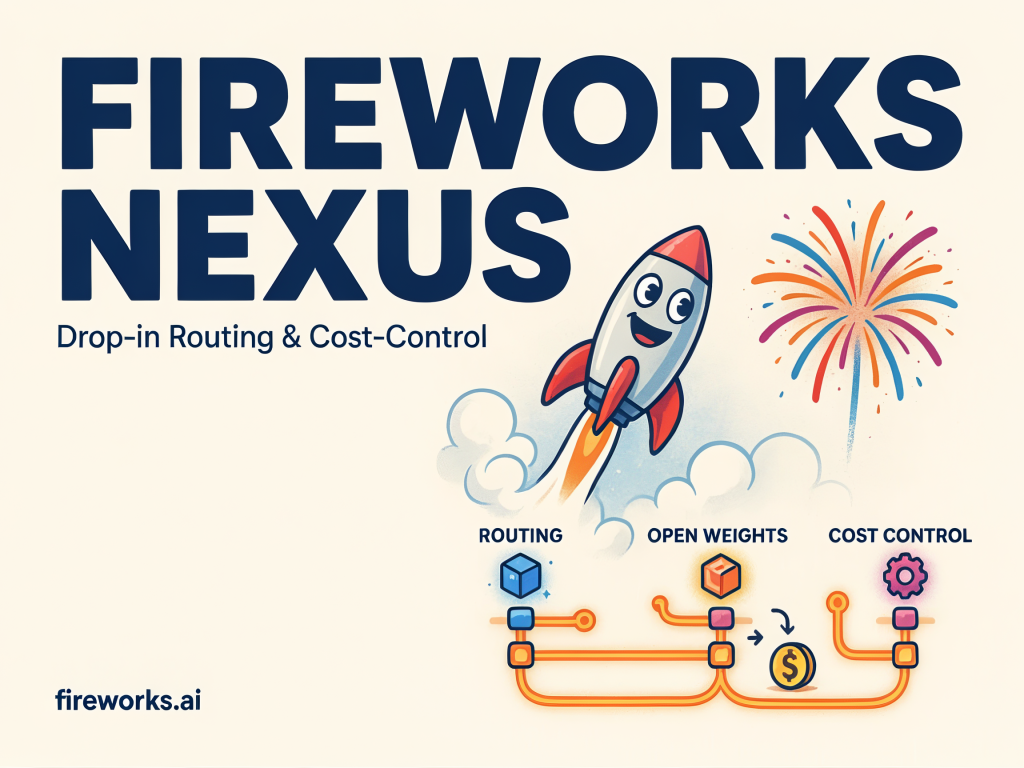
Fireworks AI announced Fireworks Nexus, a management and routing layer for AI tools. It sits between your team and the various AI models they use—like Claude or GPT-powered tools—and intelligently routes each task to the most suitable model.
The problem it addresses is well documented. The source article highlights how major teams like Uber exhausted their entire annual AI capacity in just four months. The cause was not overspending, but a fundamental mismatch. They were running simple, routine work on the most powerful, resource-intensive models available simply because it was too complicated to switch to lighter alternatives.
Nexus is built around three parts: enterprise controls that give you full visibility, a tool called FireConnect that installs in a single line, and an intelligent traffic manager. This manager uses a specially trained model to score every request for difficulty. Simple requests are automatically routed to efficient open-weight models (like GLM-5.2), while complex, high-value tasks escalate to premium frontier models (like Claude Opus). It is a simple concept called intelligence routing, and it redefines how your business can automate.
Why This Matters for Malaysian SMEs
You might not be coding a massive app, but the principle of routing by difficulty is directly applicable to your daily operations. Let’s look at what this means for your team in Malaysia.
Consider your customer service workflow. Your team handles dozens of WhatsApp messages, Facebook comments, and calls every day. A huge portion are simple, repeatable queries: “What are your hours?”, “Where is your location?”, “Do you have this in stock?”. These are the easy tasks. Sending these heavy questions to a massive AI model is like asking a senior manager to sort the mail. A smart routing system handles these simple requests instantly with a light, fast model. This saves your team’s human attention and your system’s bandwidth for the complex complaints, negotiations, and sensitive issues that truly require your best judgment.
Think about your content and marketing. Drafting a simple daily social media caption for a product launch is a very different job than analyzing your quarterly market performance in a competitive market like KL or Penang. The independent evaluations cited by Fireworks prove that for easy tasks, the most advanced models provide zero extra value over a well-tuned mid-tier model. By adopting this routing mindset with any automation tool you use, you maximize your overall output without needing to rely on the “best” model for absolutely everything. Your entire operation becomes leaner and more responsive.
The Bigger Picture
This development signals a major shift in how we use AI. The era of using one single “magic” model for everything is ending. We are entering the era of the AI router.
The research from independent evaluators Faros AI and Arize supports this perfectly. They ran thousands of tasks testing different strategies. A deliberate “escalation ladder”—starting with a light model and only moving up when genuinely needed—was vastly more efficient than using the single best model for everything. On easy tasks, the top-tier models didn’t offer an advantage. The magic was in the system design, not just the model size.
As the independent evaluators from Arize discovered, the gap in intelligence on straightforward tasks is often non-existent. An efficient, task-specific model can match a much larger frontier model. The difference only appears on the hardest problems. This is the core insight for your business: route your work by difficulty, not by brand.
For your SME, this means the tools you use every day are about to get much smarter about how they use their own capacity. You won’t have to choose between a cheap, limited system and an expensive, powerful one. Instead, the system itself will dynamically give you the best of both worlds for each specific job. This lets a small team in Malaysia punch far above its weight.
Key Takeaways for Malaysian Business Owners
- Match the Task to the Tool: Do not use your most powerful engine for light lifting. The studies from Faros and Arize prove mid-tier models match top-tier models on straightforward jobs. (Source)
- Intelligent Routing is the Future: A smart system that delegates tasks efficiently beats a single brilliant system trying to do everything. The “escalation ladder” model was the most effective strategy. (Source)
- Focus on Throughput, Not Just Capability: The goal is getting more good work done reliably. By freeing up your heavy assets for complex work, your entire operational flow becomes more stable and scalable.
- Your Tools are About to Get Smarter: Platforms like Nexus are a sign of AI maturity. The automation tools you use for your SME will soon automatically optimize themselves to save you time and effort.
This is not just a technical update for developers. It is a blueprint for building a smarter, more efficient business in Malaysia. Stop asking your AI to be a genius at everything. Start asking it to be smart about what it chooses to do.
Ready to Streamline Your Operations?
Technology moves fast. Your operations should keep up. AutoRunBiz builds AI systems that run your daily workflows — from WhatsApp order capture to accounting. Book a free 15-min ops audit →