
Your business just got a new digital guard dog
You lock your physical store at night. You have an alarm system. You probably run a standard antivirus on your office laptops. But the threats facing modern Malaysian SMEs don’t break down the physical door. They slip through digital cracks—a borrowed password, an outdated plugin on your company website, a misconfiguration in your cloud accounting software.
The unfortunate reality is that most small business owners only think about cybersecurity after something goes wrong. A customer reports a scam from your hacked WhatsApp Business account. Your WooCommerce site starts redirecting visitors to a phishing page. Your files get locked by ransomware. It’s a reactive cycle that drains your time, your trust, and your focus on growing the business.
What if you could flip that script? What if you could have a tireless digital inspector who does nothing but walk the perimeter of your operations, looking for weaknesses before a criminal finds them? That possibility just got a lot more grounded in reality.
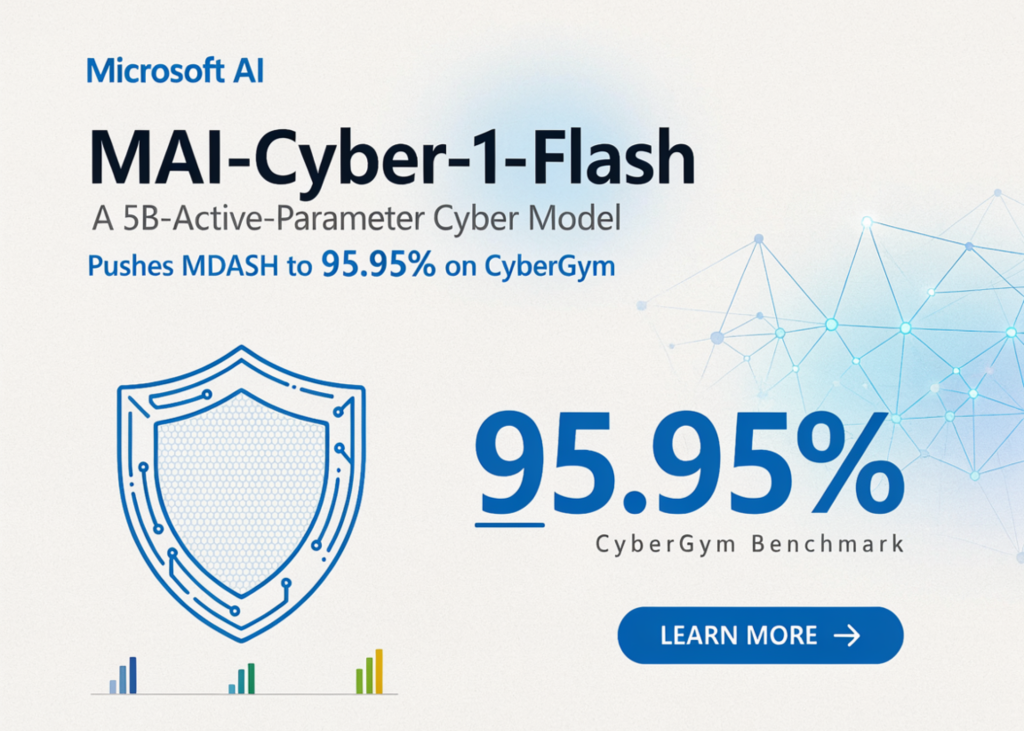
Microsoft recently released the details of MAI-Cyber-1-Flash, a new AI model built specifically to find software security vulnerabilities. It is not a generalist chatbot. It is a pure specialist built for defense. For Malaysian business owners, the architecture of this tool is more instructive than the tool itself.
TL;DR: Instead of using one massive AI brain for everything, this system uses a small, fast specialist to handle most of the security scanning. Only the hardest problems (about 10%) get escalated to a larger, slower general AI. This perfectly mirrors the ideal SME automation strategy: simple tasks handled instantly, complex tasks handled by the best available resource.
“A 5B-active model that cannot generate exploits but can drive a 95.95% discovery pipeline is exactly the artifact a defender-only product needs.” — Microsoft Research, on the deliberate architecture of their new model.
What This Means in Plain Language
The core innovation here is a concept called a “Mixture-of-Experts” architecture. Imagine your own business. You have a general manager who handles strategy, but you also have a plumber, an electrician, and a cashier. It would be a massive waste for your GM to be the one fixing the toilet.
This AI has a total “brain capacity” of 137 billion parameters. However, it only uses 5 billion of them for any single task. This makes it incredibly fast and efficient at finding bugs, because it doesn’t have to “wake up” the whole brain just to check a simple line of code.
It runs inside a system called MDASH. Think of MDASH as a highly organized team coordinator. It sends out agents to scan your digital assets. One agent finds a potential hole. A second agent argues against it (“That bug isn’t actually exploitable”). If they disagree, an auditor agent flags the issue for a deeper look. This disagreement mechanism is a brilliant way to filter out noise and zero in on genuine risks. In standardized testing (CyberGym, 1,507 real-world bugs) the system scored 95.95%. The next best competitor sat below 86%. This isn’t a small step forward; it is a leap.
How This Applies to Malaysian SMEs
1. Your IT Provider Just Got a Superpower
Most SMEs in Malaysia rely on a single outsourced IT person or a small firm. They handle printer issues, password resets, and basic network troubleshooting. Continuous, proactive security scanning is a luxury they rarely have time for. This AI allows your IT provider to offer a new level of service: automated vulnerability screening. Imagine them running a monthly AI audit of your systems and handing you a prioritized list of exactly what needs patching. You stop relying on luck and start relying on data.
2. The Operational Drain Disappears
The number one reason SMEs don’t run deep security checks is that they are incredibly labor-intensive. MDASH solves this through smart routing. The small, fast model handles the bulk of common scanning tasks. Only the hardest problems—those requiring complex reasoning—get handed to the most powerful AIs. This 90/10 split is critical for small teams. It means you are not wasting your limited computing power or human attention scanning routine logs. The system efficiently scales the effort to the difficulty of the problem.
3. Zero Exploit Capability
This is the most reassuring detail for a business owner. The model explicitly scores zero on ExploitGym, a benchmark for writing attack code. This was intentional. The model cannot and will not write malware. It is a pure defensive tool. This removes the risk of your security tool becoming a liability. It finds holes so you can patch them. It is fully on your side.
4. What the Numbers Actually Mean
| Benchmark | Score | Simple Explanation |
|---|---|---|
| CyberGym (System) | 95.95% | Finds nearly all bugs in a standard real-world test set. |
| CVEBench | 0.314 | Strong at identifying known, documented vulnerabilities. |
| CyberSecEval4 (Threat Intel) | 0.553 | Understands the patterns and strategies attackers use. |
| ExploitGym | 0 / 0 / 0 | Cannot generate attack code. This is a deliberate feature to ensure safety. |
Practical Takeaways for Your Business
You do not need to buy Microsoft’s Azure services to benefit from this shift. The architecture is the lesson. Here is what you can do this week:
- Map your digital footprint. Write down every single app, login, website, and cloud service your business uses. This is your attack surface.
- Question your security approach. Are you just reacting to problems, or are you proactively scanning for them? Ask your IT provider if they can run automated vulnerability scans. If they don’t understand the question, they are behind the curve.
- Adopt the 90/10 rule in your automation. Don’t use your most powerful tools for every simple task. Let a specialist handle the routine work, and save the big brain for the hard problems. Apply this logic to customer service, data entry, or social media management.
- Prioritize patching. The biggest win from AI scanning is knowing exactly what to fix first. When you get a list of potential issues, focus on the ones flagged as actively exploitable, not just the easiest to fix.
The Bigger Picture
Microsoft’s MDASH system is a blueprint for the future of business software. We are moving quickly from “one AI to rule them all” to “teams of specialized AI agents.” In the coming years, having an automated security agent scanning your digital perimeter will be as normal as having an email spam filter.
For an SME owner in Malaysia, this trend represents a huge opportunity. Enterprise-level security auditing, the type previously reserved for banks and telecommunications companies, is becoming accessible. The labor required for high-level security checks is dropping to a point where a consultancy in Ipoh or a retailer in Kota Kinabalu can implement it.
The key is to stop thinking of AI as a single magic box. Start thinking of it as a department you can build. Your business needs a guard dog. Microsoft just showed the world how to build one efficiently, effectively, and safely. The only question left is whether you will start looking for yours today, or wait until you get a digital break-in.
Ready to Streamline Your Operations?
Your business should run itself. AutoRunBiz deploys AI agents to automate your daily operations — WhatsApp orders, invoicing, customer follow-ups, and accounting. Book a free 15-min ops audit to see where automation fits your business →