
Why an Airport Charging Upgrade Should Matter to Your Business
Electric vehicles are moving beyond early adopters and into everyday business operations. The latest example comes from Portland International Airport in Oregon, where a new overhead fast-charging system can charge up to 20 rental electric vehicles without taking up valuable floor space. The installation was reported by Electrek.
For a Malaysian SME owner, this is not simply an airport technology story. It is a practical lesson in how to use limited space more intelligently. Whether you operate a delivery fleet, car rental business, workshop, logistics yard, hotel, property site or service company, charging infrastructure must fit into your existing workflow. The question is no longer only where to install chargers. It is how to charge vehicles without creating congestion, safety risks or unnecessary disruption.
Portland’s approach shows that automation and thoughtful physical design can work together. Instead of allowing charging equipment to occupy the ground around vehicles, the system moves the equipment overhead and combines it with fleet software. That idea could become increasingly relevant as Malaysian businesses test electric vans, cars and two-wheelers in their daily operations.
What Happened at Portland International Airport?
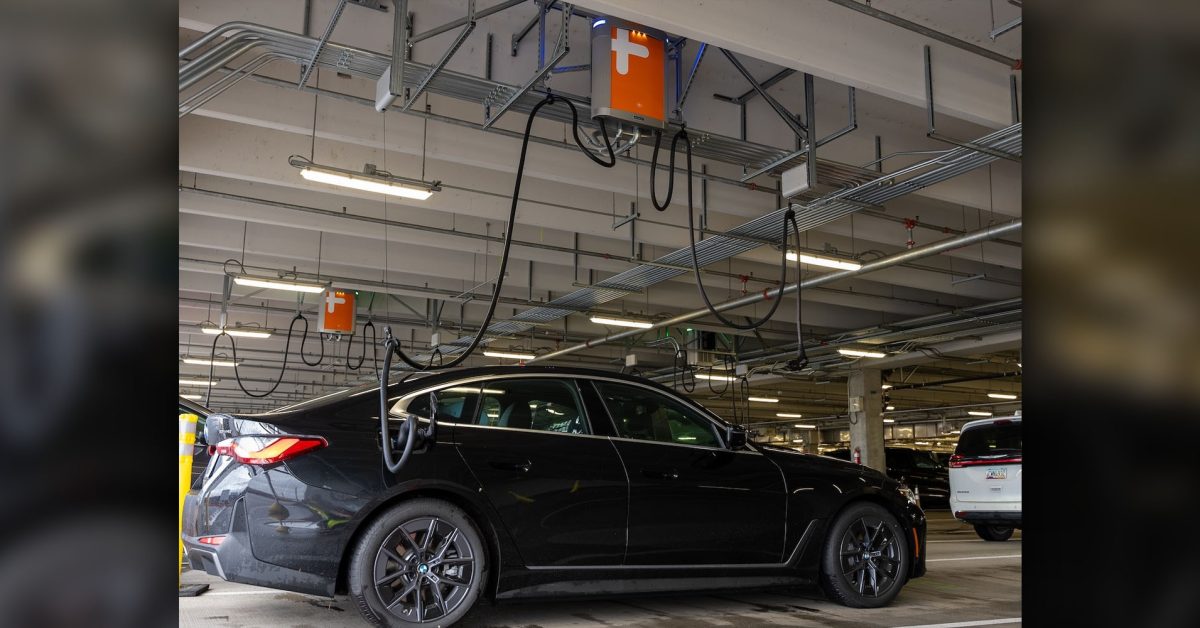
Portland International Airport installed 10 dual-port fast chargers at its Quick Turnaround Facility, where rental vehicles are cleaned, serviced and prepared between customers. According to Electrek, the system can serve 20 rental EVs at the same time.
Each charger is rated at 200 kilowatts and mounted above the vehicles. Retractable cables can be pulled down by operators when charging is required. Once charging is complete, the cables can be moved out of the way, keeping the working area clearer for vehicle movement and staff activities.
The airport’s rental car manager said the overhead design reduced the amount of conduit and wiring required during installation and helped protect the equipment from possible vehicle damage. The system also supports fast charging during the short period between one rental customer returning a vehicle and another collecting it.
ChargePoint’s fleet software adds another layer of automation. Operators can remotely monitor chargers, troubleshoot issues and manage charging according to when vehicles are needed. The source article notes that the system is designed for the operational challenges of rental fleets, including high power demand, quick vehicle turnaround and limited space.
| Feature | Business value | Possible SME application |
|---|---|---|
| Overhead charger placement | Keeps floors and driving paths clearer | Workshops, warehouses and fleet yards |
| Retractable charging cables | Reduces cable clutter when vehicles are moving | Delivery depots and service centres |
| Dual-port charging | Allows more vehicles to use fewer charger units | Small fleets with limited installation space |
| Remote monitoring | Helps identify faults without checking every charger manually | Businesses with multiple sites or shifts |
| Charging based on vehicle needs | Supports better dispatch planning | Scheduled deliveries and customer bookings |
Why This Matters for Malaysian SMEs
Malaysian businesses often operate from compact premises. A workshop may need to fit customer vehicles, tools, spare parts and staff movement into one site. A logistics operator may have to manage loading bays, delivery vehicles and pedestrian access in the same yard. A hotel or property operator may have limited parking space but still want to support EV users.
Traditional charging equipment can create obstacles if it is installed beside narrow vehicle lanes or in areas exposed to reversing vehicles. Cables may cross walkways, charging posts can be struck, and staff may need to rearrange vehicles simply to access a charger. An overhead design offers an alternative: place the hardware where it does not interfere with the main workflow, while keeping the cable accessible when needed.
This could be useful for a Malaysian SME running a small delivery fleet in Kuala Lumpur, Shah Alam, Johor Bahru or Penang. Vehicles might return at different times during the day, and some may need to leave again within a fixed delivery window. A charging system connected to fleet scheduling software could help you prioritise vehicles assigned to urgent routes, monitor charging status remotely and reduce manual checking.
It may also suit car rental operators, airport transfer companies and tourism businesses. Vehicles often have predictable booking schedules, making it easier to plan charging around customer collections. Instead of treating every vehicle equally, you can establish rules based on the next booking, expected distance and current battery level.
The main lesson is not that every SME needs a 200-kilowatt charger. The lesson is that charging infrastructure should be designed around your workflow, space limitations and vehicle schedules.
For smaller operators, the same principle can apply at a different scale. A motorcycle delivery business may explore wall-mounted or overhead cable management. A service company may install charging points above designated parking bays. A warehouse may use smart charging controls to avoid charging every vehicle simultaneously when the site has other electrical loads.
How Automation Changes Fleet Operations
Charging becomes more useful when it is connected to operational data. A charger that simply supplies electricity still requires someone to remember which vehicle is plugged in, whether it is ready and whether a fault has occurred. Fleet software can turn those tasks into a managed process.
You can begin with a simple digital register that records vehicle location, battery status, driver assignment and next departure time. From there, charging rules can be added. For example, vehicles departing first can receive priority, while vehicles scheduled for later can charge during quieter periods. Alerts can notify a supervisor if a vehicle is not charging, reaches a target level or remains connected beyond the planned window.
This type of automation is particularly relevant when your business operates in shifts. A morning team may plug in vehicles at the end of the day, while the next team checks readiness before dispatch. A shared dashboard can provide continuity between shifts and reduce reliance on verbal updates or handwritten notes.
The Bigger Picture
The Portland installation points to a broader change in how businesses think about infrastructure. Space is becoming a productivity issue. Every square metre used by a charging cabinet, cable or protective barrier is space that cannot be used for vehicle movement, storage or customer service. By moving equipment overhead and managing it digitally, businesses can combine physical efficiency with operational visibility.
The example also shows why EV adoption is closely linked to software. More vehicles do not automatically create a better fleet. You need charging schedules, maintenance records, route planning and clear responsibilities. Without those systems, drivers may arrive to find vehicles unavailable, chargers occupied or equipment offline.
Malaysian SMEs should therefore avoid selecting charging hardware in isolation. Before installation, map your daily vehicle movements, peak operating periods, parking layout, electrical capacity and future fleet plans. Check whether the proposed equipment can be monitored remotely and whether it can integrate with the tools you already use.
Safety and compliance also require attention. A qualified electrical contractor should assess the site, cable routing, load requirements and protection against impact or water exposure. Your team should receive clear instructions on connecting and disconnecting vehicles, reporting faults and keeping charging areas free from obstructions.
Practical Steps for Your Business
- Record your current vehicle routine. Track arrival times, departure times, daily distance and periods when vehicles are idle.
- Identify space conflicts. Note where conventional chargers, cables or protective barriers could obstruct vehicles, staff or customers.
- Start with priority vehicles. Test charging automation on the vehicles with the most predictable routes or highest daily usage.
- Ask about remote monitoring. Confirm whether your team can view charger status and receive fault notifications without visiting the site.
- Connect charging to scheduling. Use departure times and bookings to decide which vehicles receive charging priority.
- Review the process after a pilot. Measure vehicle readiness, staff time, charger availability and operational interruptions before expanding.
The overhead charging system at Portland International Airport is a global example, but its business principle is local and practical: make technology fit the way your people work. For Malaysian SMEs, the winning approach may not be the biggest charger or the most advanced fleet. It may be a carefully planned system that keeps your site organised, gives your team better information and helps every vehicle return to work at the right time.
Ready to Streamline Your Operations?
Technology moves fast. Your operations should keep up. AutoRunBiz builds AI systems that run your daily workflows — from WhatsApp order capture to accounting. Book a free 15-min ops audit →