
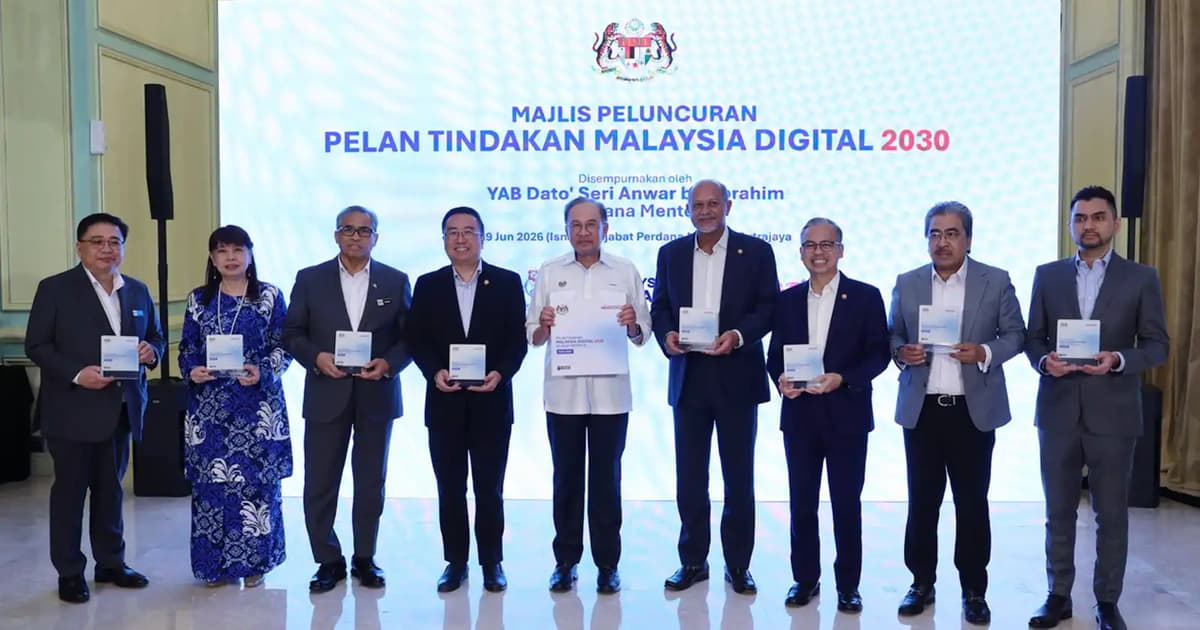
Malaysia has an AI plan. The hard part is making it work for businesses like yours.
Malaysia’s AI ambition is bold, timely, and necessary. Last week, Prime Minister Anwar Ibrahim urged faster action to prepare Malaysians for an AI-driven future, warning that rapid technological advancements are reshaping industries and creating new demands on the workforce.
But the real question — whether you run a small business or work in policy — is not whether Malaysia can write a good digital plan. It’s whether we can turn that plan into better services, stronger institutions, and fairer opportunities for the 1.07 million SMEs that make up our economy.
As FMT columnist Murugason R Thangaratnam put it: “Malaysia has often been strong at announcing digital aspirations, but weaker at ensuring those ambitions are delivered consistently across ministries, agencies and sectors.”
MD2030: The right diagnosis
The Malaysia Digital 2030 (MD2030) action plan aims to steer the country towards becoming an AI nation by 2030. It starts from the right place: AI is not a replacement for people, but a tool that should improve public life, economic performance, and social inclusion.
The plan acknowledges that AI is already shaping how people pay bills, access services, learn new skills, run businesses, and interact with the government. This is not a future technology — it’s a present reality.
The execution gap
Here’s where it gets hard. Malaysia has a track record of strong digital announcements and weaker delivery. The MD2030 document itself warns against this: isolated pilots, disconnected systems, and one-off experiments won’t create real national value.
“Too many digital initiatives fail because they remain trapped in silos, never scaling into a coherent system that citizens can actually feel in their daily lives.” — Murugason R Thangaratnam, FMT
For SME owners reading this, the implication is direct. If the national AI push succeeds, you’ll get better access to digital grants, more affordable AI tools, streamlined compliance (like e-invoicing), and a workforce that’s being trained in AI skills. If it stalls, the gap between big businesses and small ones will keep widening.
What this means for your business this year
While the government figures out execution at the national level, here’s what’s happening on the ground in 2026:
| Trend | Why it matters for your SME |
|---|---|
| AI tools getting cheaper | Google AI Ultra dropped to RM 429.99/month. OpenAI is lowering API costs. Small businesses can now access enterprise-grade AI for under RM 500/month. |
| AI PCs arriving in Malaysia | Qualcomm’s Snapdragon X2 series brings on-device AI. You don’t need cloud subscriptions for tasks like document summarisation. |
| Grant and tax incentives | Budget 2026 offers 50% tax deduction for AI training. SME Digitalisation Grants are still active. Money is available if you act. |
| E-invoicing mandate | LHDN’s e-invoicing rollout is creating a natural entry point for automation. SMEs already digitising invoices are one step away from full workflow automation. |
The bottom line
National AI plans take years to materialise. But the tools to automate your business are available today — and they’re more affordable than ever. You don’t need to wait for MD2030 to improve your operations.
The businesses that will benefit most from Malaysia’s AI push aren’t the ones waiting for government programmes. They’re the ones already using AI to handle invoices, respond to customers, and manage leads — so when the national infrastructure catches up, they’re ready to scale.
Sources: Malaysia now has an AI plan, herein comes the hard part — FMT, July 3, 2026 | Anwar urges swifter action to prepare Malaysians for AI-driven future — The Malaysian Reserve, July 1, 2026
Book a free 15-min call to see how automation applies to your business → https://autorunbiz.com