
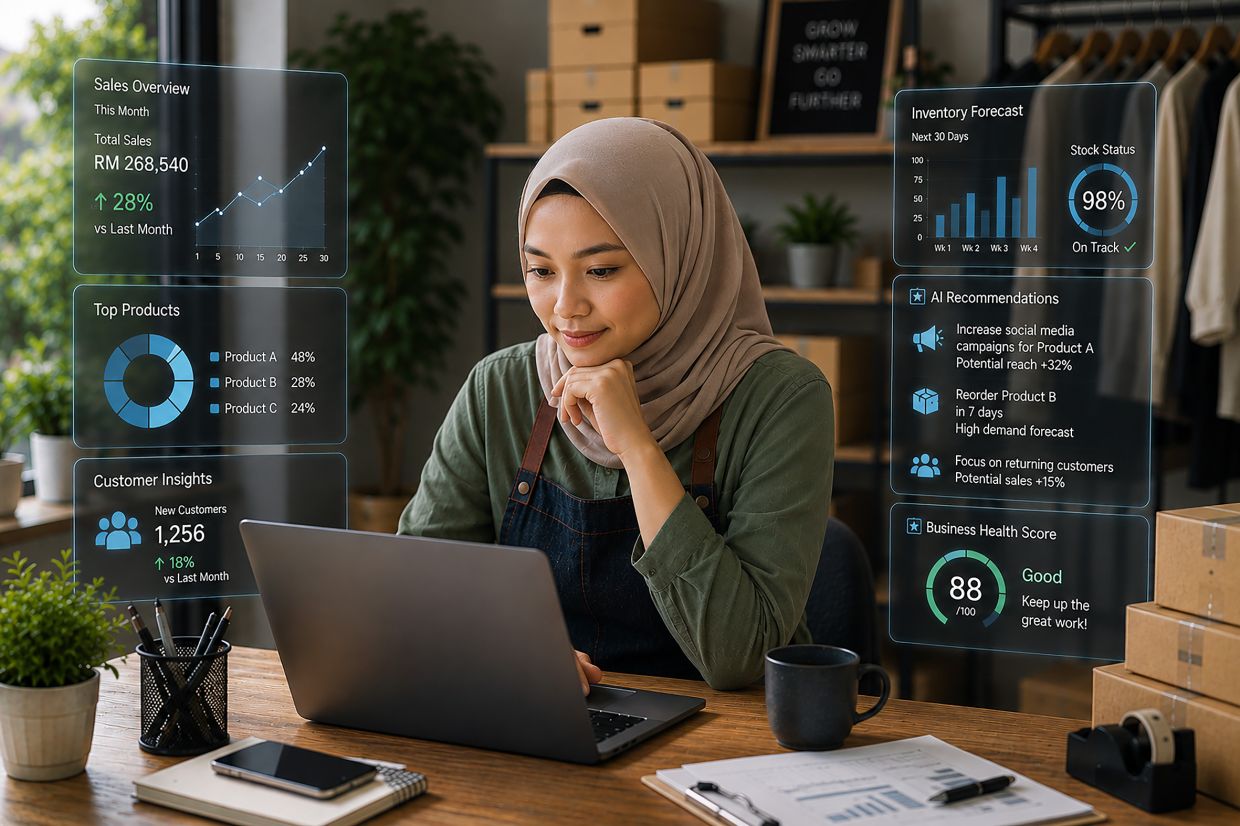
AI is rewriting the rules for Malaysian SMEs — and the window to act is narrowing
Malaysia is home to over 1.07 million micro, small and medium enterprises (MSMEs). They’re the backbone of our economy, driving employment and national output. But for decades, SME growth followed a punishing formula: more customers meant more staff, which meant higher costs and operational complexity. You couldn’t grow without bleeding more on headcount.
That equation is breaking. And the businesses that understand how now have an edge that didn’t exist two years ago.
A Xerox survey of 1,033 SMEs cited by The Star found that 81% have already adopted AI, with 48% planning to expand its use within a year. AI has moved beyond isolated pilot projects into core business capabilities. The strategic question is no longer whether AI will create or destroy jobs — it’s whether SMEs can decouple growth from headcount.
The old SME growth trap
Before AI, scaling a service business meant hiring more people. More customers = more invoices to process = more admin staff. More leads = more salespeople needed. More support tickets = bigger customer service team. Each hire added RM 24,000–RM 48,000/year in salary costs in Malaysia, plus EPF, SOCSO, and overhead.
This made growth expensive and risky. One wrong hire or a slow quarter could wipe out months of profit. SMEs couldn’t experiment because the cost of failure was too high.
What AI changes for SMEs
For the first time, SMEs can scale not by adding headcount, but by embedding intelligence into their operations. Here’s what that looks like in practice:
Customer service. A small team can now deliver 24/7 customer engagement using AI chatbots. AutoRunBiz clients, for example, handle WhatsApp enquiries, appointment bookings, and invoice follow-ups without hiring a dedicated support person.
Marketing. A tiny SME team can generate marketing campaigns at enterprise scale with a few clicks — personalised emails, social posts, ad copy — all driven by AI tools that cost RM 100–RM 500/month.
Operations. Founders can access real-time business insights without dedicated analytics units. Cash flow reports, invoice ageing, lead conversion rates — surfaced automatically, not manually compiled.
“Today, a small SME team can generate marketing campaigns at enterprise scale with a few clicks, deliver 24/7 customer engagement using chatbots and agentic agents, and founders can access real-time insights without dedicated analytics units.” — Dr Sharlene Thiagarajah, The Star
Why SMEs are actually better positioned than big companies
Here’s the counterintuitive part: SMEs are better positioned than large organisations to adopt AI. They’re more agile, less constrained by legacy systems, and faster at making decisions and implementing changes.
A multinational needs 18 months of vendor evaluation, security audits, and board approvals to roll out a new tool. An SME can sign up, test, and deploy in a week. That speed advantage is real — and it’s the reason AI adoption is accelerating faster among smaller businesses.
The risk: the digital divide could widen
The flip side is real. SMEs that don’t act risk falling further behind. As competitors automate quoting, invoicing, and follow-ups, the manual business looks slow and expensive by comparison.
The companies that are most vulnerable? Service businesses that rely on manual processes — phone-based booking, paper invoices, WhatsApp messages typed by hand, manual lead tracking in spreadsheets. These are exactly the businesses where automation produces the fastest ROI.
Where to start
If you’re an SME owner in Malaysia looking at AI and feeling overwhelmed, here’s a practical starting point:
- Pick one repetitive task — invoicing, lead follow-up, customer enquiries. Measure how many hours it takes per week.
- Find a tool that automates it — WhatsApp automation for customer service, AI invoicing for billing, chatbot for lead qualification.
- Test for two weeks — most AI tools have free trials. The ROI becomes obvious fast.
- Scale what works — add the next process once the first is running smoothly.
The businesses that win in 2026 won’t be the ones with the biggest teams. They’ll be the ones whose owners understood that AI lets them compete with companies ten times their size — and they started before the competition did.
Source: Can AI level the playing field for SMEs? — The Star, July 4, 2026
Book a free 15-min call to see how automation applies to your business → https://autorunbiz.com