
If Your SME Relies on AI for Customer Replies or Document Work, This Changes the Game
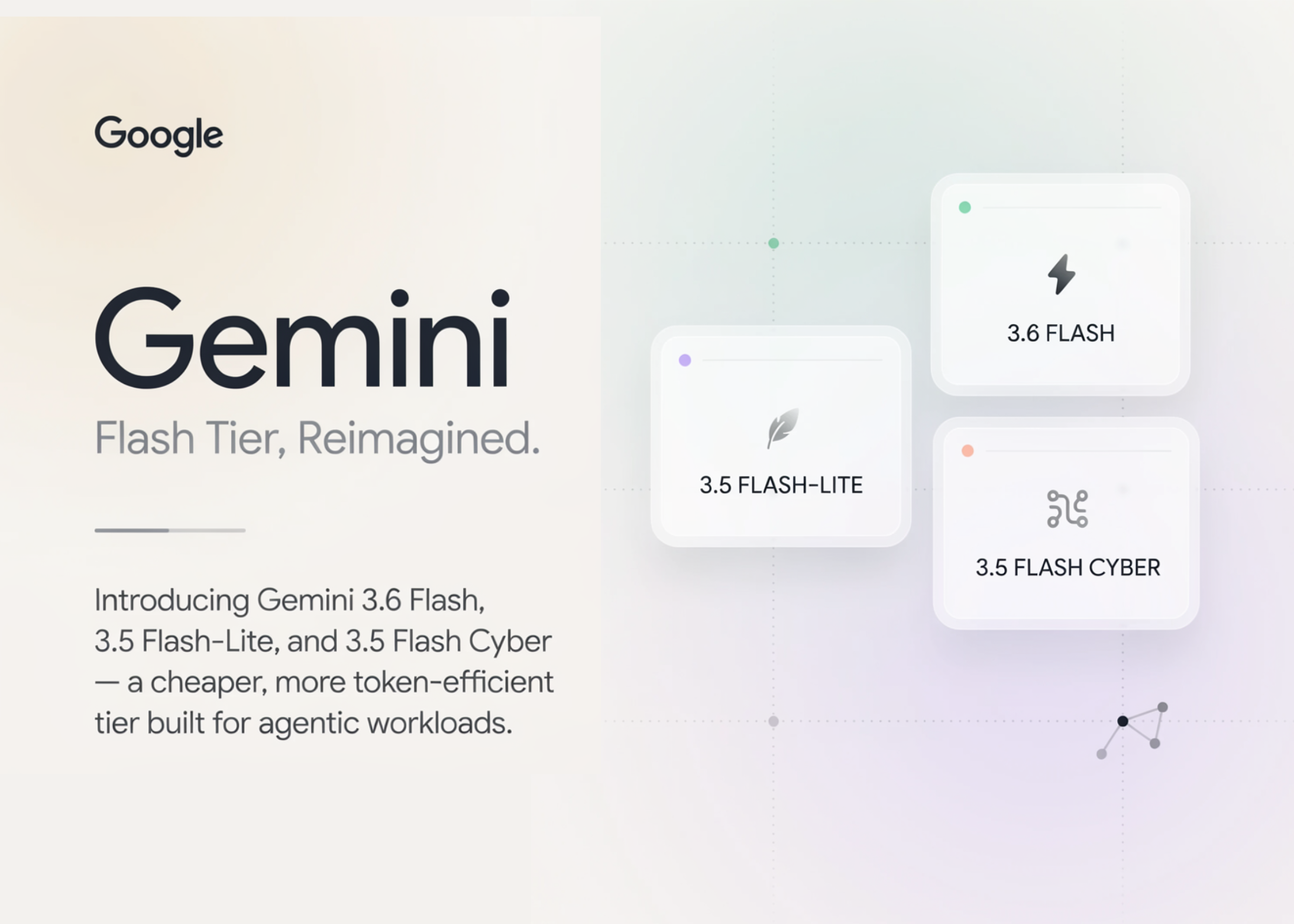
You’re a Malaysian business owner. Every day, you juggle customer queries on WhatsApp, process invoices, generate social media captions, and maybe even review a line of code for your e‑commerce store. The promise of AI has been “do more with less”, but the reality has often been that the fastest models were expensive, and the cheap ones were frustratingly slow. Google just released three new Gemini models—3.6 Flash, 3.5 Flash‑Lite, and 3.5 Flash Cyber—designed exactly for agentic workloads: the kind of high‑volume, multi‑step tasks that small teams handle day in, day out. This isn’t a theoretical lab announcement; it directly affects how much you can automate for your SME without breaking the bank.
In Malaysia, where the cost of hiring skilled staff is rising and customer expectations are high, any tool that cuts token usage and speeds up responses is a direct productivity win. Let’s break down what happened and why it matters for your business right now.
What Happened
Google introduced three Flash‑tier models on July 21, 2026 (source). The Flash tier is explicitly built for speed and token efficiency—not for maximum reasoning depth, but for production workloads where a model needs to be called many times in parallel or in sequences.
- Gemini 3.6 Flash: The new default workhorse. It uses 17% fewer output tokens than its predecessor (and up to 65% fewer on deep software‑engineering benchmarks). On the Artificial Analysis Index, the model demonstrates a significant reduction in verbosity while improving quality across coding, knowledge work, and multimodal tasks. It achieved a 49% score on DeepSWE (up from 37%), 63.9% on MLE Bench, and 83% on OSWorld‑Verified.
- Gemini 3.5 Flash‑Lite: At 350 output tokens per second, this is the fastest model in the 3.5 line. It’s designed for low‑latency, high‑throughput jobs like agentic search and document processing. Despite being “Lite,” it beats the older Gemini 3 Flash on SWE‑Bench Pro (54.2% vs 49.6%) and OSWorld‑Verified (74% vs 65.1%).
- Gemini 3.5 Flash Cyber: A specialized fine‑tune for code security. Inside Google’s CodeMender agent, multiple Flash‑Cyber instances run in parallel, exploring a vast search space to find and patch vulnerabilities. On Google’s Big Sleep evaluation, it found 55 unique confirmed issues in the V8 JavaScript engine, beating both mainline 3.5 Flash (47) and Claude Opus 4.6 (36).
All three models are available through the Gemini API, with Flash‑Lite and 3.6 Flash rolling out widely (Google AI Studio, Android Studio, GitHub Copilot, and the Gemini Enterprise app). Flash Cyber is gated under a limited‑access pilot due to dual‑use concerns (source).
Why This Matters for Malaysian SMEs
If you run a small team in Malaysia, your daily AI tasks are rarely single‑question‑single‑answer. They involve cycles: a customer asks about stock – your bot checks inventory – formats a reply – updates a spreadsheet. Or your marketing assistant asks the AI to generate 10 captions, then refine them into a consistent brand voice. Each cycle burns tokens and takes time. According to a 2025 study by the Malaysian Digital Economy Corporation (MDEC), over 60% of SMEs cite “time to get results” as a barrier to adopting AI. These new models directly attack that barrier.
Consider a typical Malaysian SME that runs an online store on Shopee or Lazada. Every day, hundreds of customers message about delivery status, product compatibility, and return policies. A customer‑service agent powered by a model like 3.5 Flash‑Lite can handle each query in milliseconds—and because its token output is leaner, you can afford to let the AI double‑check facts or cross‑reference a product database without worrying about ballooning costs. One early customer, Hebbia, reported “gains in document parsing, chart and data analysis, and report drafting” (source). For a Malaysian accounting firm or legal boutique with 1‑50 staff, that means automatically extracting key data from scanned invoices and generating summary reports faster than a junior associate can.
For the small number of technical SMEs building internal tools or even simple web apps, the Flash Cyber model could be a game‑changer. Security is often an afterthought for early‑stage Malaysian startups—yet a single vulnerability in a public API can sink customer trust. Google’s own Cloud Vulnerability Research team used Flash Cyber to find remote‑code‑execution flaws in public APIs within two hours (source). While the model is gated today, the principle is clear: cheap, massively parallel AI can now do security scanning that previously required expensive human experts.
The Bigger Picture
Behind this release is a strategic shift: AI is moving from “one big brain” to “many cheap, fast agents that collaborate.” For years, models like GPT‑4 or Gemini Ultra were the default, but their high latency and token consumption made them unsuitable for high‑volume operations. The Flash tier is a philosophical change—optimise for throughput and total cost per task, not just raw intelligence. As Google stated, these models are “built for agentic workloads” (source). That means you can now chain multiple model calls without running up a monstrous compute bill.
“The answer is a cheap model called many times.” — Google on the design of Gemini 3.5 Flash Cyber (source)
For Malaysian SMEs, this signals that advanced automation is no longer reserved for enterprises with six‑figure budgets. You can run a customer‑onboarding agent that follows a 10‑step flow, each step calling a Flash model, and pay nearly 40% less in output tokens compared to the previous generation. The table below summarises the key improvements you should care about.
| Model | Key Strength | Real‑World Gain for SMEs |
|---|---|---|
| Gemini 3.6 Flash | 17% fewer output tokens, better quality | More document summaries, support tickets, and code reviews per dollar |
| Gemini 3.5 Flash‑Lite | 350 tokens/sec, configurable thinking | Blazing‑fast chatbots and search agents that don’t keep customers waiting |
| Gemini 3.5 Flash Cyber | Parallel vulnerability discovery | Automated security audits for your Shopify app or API endpoints |
The community reaction, as reported on Hacker News, highlighted concerns about reliability under high load and the ethical questions around automated hacking tools. As a responsible SME owner, you should always test any AI in your own environment and keep a human in the loop—especially for code‑security tasks. But the handwriting is on the wall: the barrier to entry for multi‑step agentic AI just dropped significantly.
Your Next Steps
You don’t need to wait for an enterprise license. Start today by exploring Gemini 3.6 Flash and 3.5 Flash‑Lite through Google AI Studio or the Gemini API Developer Guide. If you have a developer on your team, test the new models on a single workflow—such as automatic invoice data extraction or a multi‑turn customer support bot—and measure the improvement in response time and token usage. For the brave, apply for the limited Flash Cyber pilot if your SME handles sensitive code.
In a market where every minute and every ringgit counts, Google’s latest Flash family gives you a genuine competitive advantage: speed without the waste. The future of your SME’s automation isn’t a single massive model; it’s a swarm of lean, efficient AI agents working in parallel—and they’re ready for you to use today.
Ready to Streamline Your Operations?
Technology moves fast. Your operations should keep up. AutoRunBiz builds AI systems that run your daily workflows — from WhatsApp order capture to accounting. Book a free 15-min ops audit →