
Google’s New Gemini Release Changes the AI Deployment Conversation
Google DeepMind has released Gemini 3.8 Flash and Gemini 3.8 Flash Cyber, presenting two versions built on the same underlying intelligence but separated by access rules and safety controls. For a Malaysian SME, this matters because the decision is no longer simply “Which AI model is smartest?” You also need to ask which model can be deployed, what business process it fits, how much human oversight it needs, and whether your data handling arrangements are appropriate.
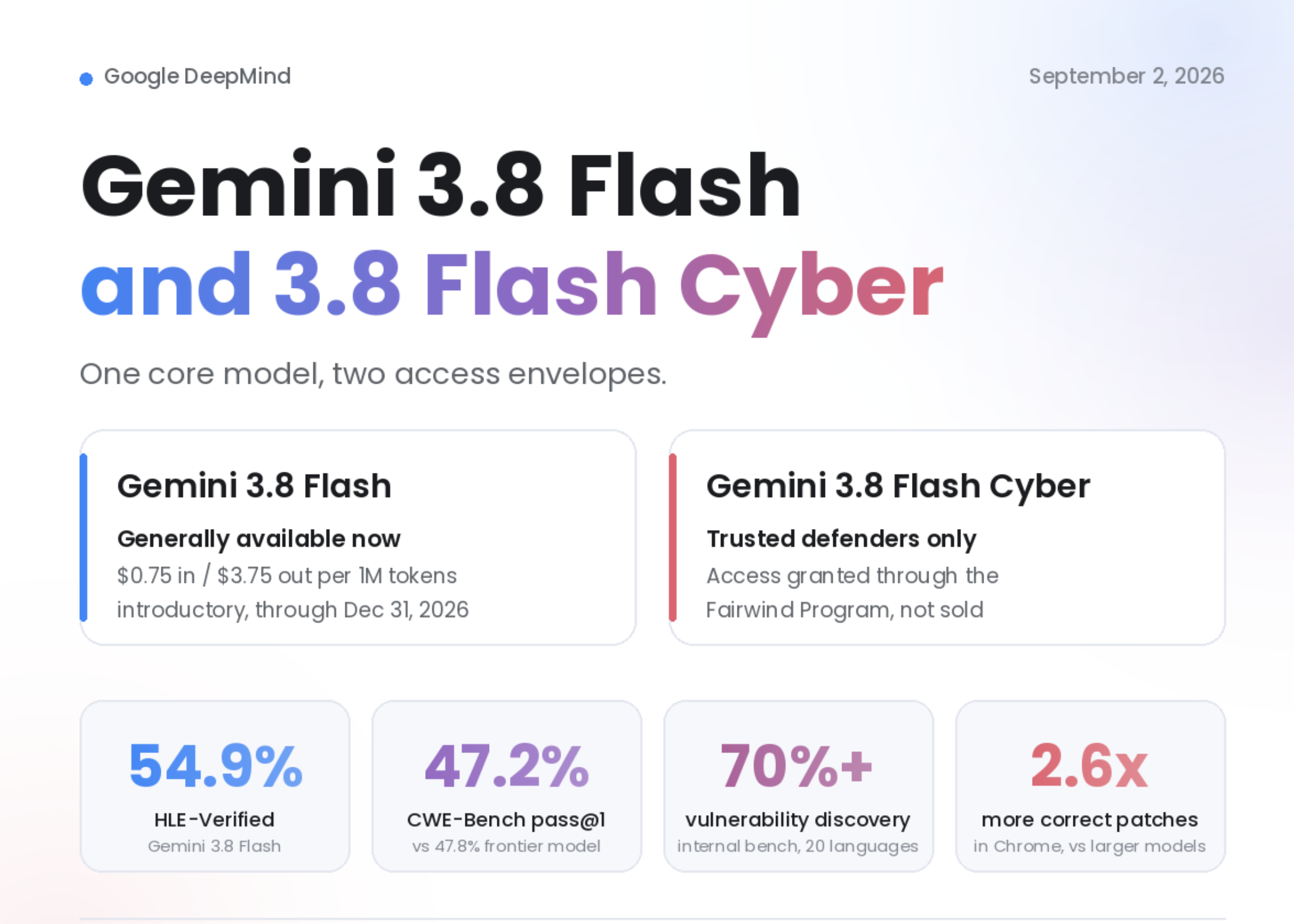
Gemini 3.8 Flash is available through the Gemini API, Google AI Studio, Antigravity, Android Studio and Gemini Enterprise, while Gemini 3.8 Flash Cyber is restricted through Google’s Fairwind Program. The models are closed-weight, meaning you cannot download them for self-hosting or run them on your own on-premises server. Source: MarkTechPost
What Happened
Google describes Gemini 3.8 Flash as an evolution of Gemini 3.7 Flash rather than a completely new architecture. The core specifications remain a context window of 1,048,576 tokens, a maximum output of 65,536 tokens, and support for text, image, audio and video inputs, with text output. It continues to offer LOW, MEDIUM and HIGH thinking levels, with MEDIUM as the default. Source: Google DeepMind
The important change is behavioural. On difficult tasks, Gemini 3.8 Flash can perform more reasoning steps and call tools repeatedly before producing an answer. That can improve performance, but it can also consume more tokens. Google’s developer guidance reportedly recommends remaining on Gemini 3.7 Flash when compute efficiency is the main constraint. Businesses migrating from the previous model should also note that the MINIMAL thinking level is not supported on Gemini 3.8 Flash, and using it can trigger an API validation error. Source: MarkTechPost
The second release, Gemini 3.8 Flash Cyber, is aimed at cybersecurity defenders. Google reports results across vulnerability discovery and patching tests, including a 47.2% pass@1 result on CWE-Bench compared with 47.8% for a leading frontier model. Google also reports an internal discovery success rate above 70% across 20 programming languages, although these figures are company-reported and should not be treated as an independent guarantee. Source: MarkTechPost
The practical lesson is simple: the more capable model is not automatically the right default. Your best choice depends on the task, the data involved, the required controls and the amount of human review available.
Why This Matters for Malaysian SMEs
For a Malaysian business with one to 50 employees, Gemini 3.8 Flash could be useful in workflows that combine documents, customer messages and internal systems. A wholesaler could use it to read purchase orders, compare them with inventory records and prepare a draft response for approval. A professional services firm could organise meeting recordings, extract action items and prepare a follow-up email. A property agency could analyse listing images, draft descriptions in English or Bahasa Malaysia, and route enquiries to the correct salesperson.
The model’s ability to accept text, images, audio and video is relevant to real operating conditions. You might receive a photographed delivery order through WhatsApp, an audio message from a customer, and a spreadsheet from a supplier. Instead of asking staff to manually re-enter every detail, you could design an assisted workflow that extracts information and sends exceptions to a human. The model should not be allowed to approve payments, change bank details or send legally significant messages without review.
Retailers, restaurants and service businesses can also consider it for customer-support triage. A system could classify enquiries about delivery status, product availability, returns or appointment changes before sending them to your team. To make this reliable, you need clear business rules: which questions can be answered automatically, which require staff intervention, and which personal information must be removed or protected before processing.
Cybersecurity is another area where the announcement deserves attention, even though most SMEs will not qualify for direct access to Flash Cyber. You can still benefit indirectly through managed security providers, software vendors and cloud platforms that adopt stronger automated testing. If your website, point-of-sale system or accounting integration is connected to the internet, ask your technology provider how vulnerabilities are identified, prioritised and patched.
Key Points for Your Business
| Area | What it means for you |
|---|---|
| Availability | Gemini 3.8 Flash is available through Google’s listed developer and enterprise channels; Flash Cyber is restricted through Fairwind. Source |
| Deployment | The models are closed-weight, so you cannot download and run them independently on your own server. Source |
| Reasoning | Higher effort can improve complex task performance while using more tokens, so test real workflows rather than assuming the newest model is always best. Source |
| Migration | MINIMAL thinking is not supported on Gemini 3.8 Flash and may return an API validation error. Source |
| Security | Flash Cyber is designed for vetted defenders rather than unrestricted public access. Source |
How You Should Evaluate It
Start with one repetitive workflow, not an organisation-wide rollout. For example, collect 50 anonymised customer enquiries and test whether the model can classify them accurately. Then measure how often staff need to correct the output, how long review takes, and whether the system handles Bahasa Malaysia, English, abbreviations and local business terminology properly.
Next, create an approval boundary. AI can draft, classify, summarise and recommend, while a named employee remains responsible for decisions involving refunds, contracts, employment matters, customer complaints or financial records. Keep an audit trail showing the original input, the generated output, the reviewer and the final action.
You should also review data access before connecting an AI model to your CRM, shared drive or accounting software. Use role-based permissions, remove unnecessary personal information, and confirm how your provider stores and processes submitted data. Your staff should know that uploading a customer’s identity document, bank information or confidential supplier agreement into an unapproved tool is not acceptable.
The Bigger Picture
Gemini 3.8 Flash shows that AI progress is moving towards models that spend more effort on selected tasks rather than responding with the same level of processing every time. This creates an operational choice for you: use a lighter approach for routine work and reserve deeper reasoning for exceptions, complex analysis and multi-step tasks.
The split between Flash and Flash Cyber also shows that capability and access are increasingly being managed separately. A model may be powerful enough to discover software weaknesses, but that does not mean every user should receive unrestricted access. For your business, this reinforces the importance of governance. Decide who can use AI, which systems it may connect to, what it may do automatically and when a person must intervene.
Do not adopt Gemini 3.8 Flash because it is the latest release. Adopt it when a controlled test shows that it improves a specific workflow without weakening privacy, accuracy or accountability. For a Malaysian SME, a well-designed process with clear approvals will usually create more value than giving an advanced model access to everything at once.
Ready to Streamline Your Operations?
Technology moves fast. Your operations should keep up. AutoRunBiz builds AI systems that run your daily workflows — from WhatsApp order capture to accounting. Book a free 15-min ops audit →