
Why This AI Update Matters to Your Business
If you run a Malaysian SME, you probably do not need another AI announcement telling you that everything is changing. You need to know whether a new tool can help your team reply to customers faster, review documents more accurately, or reduce repetitive work without creating security problems.
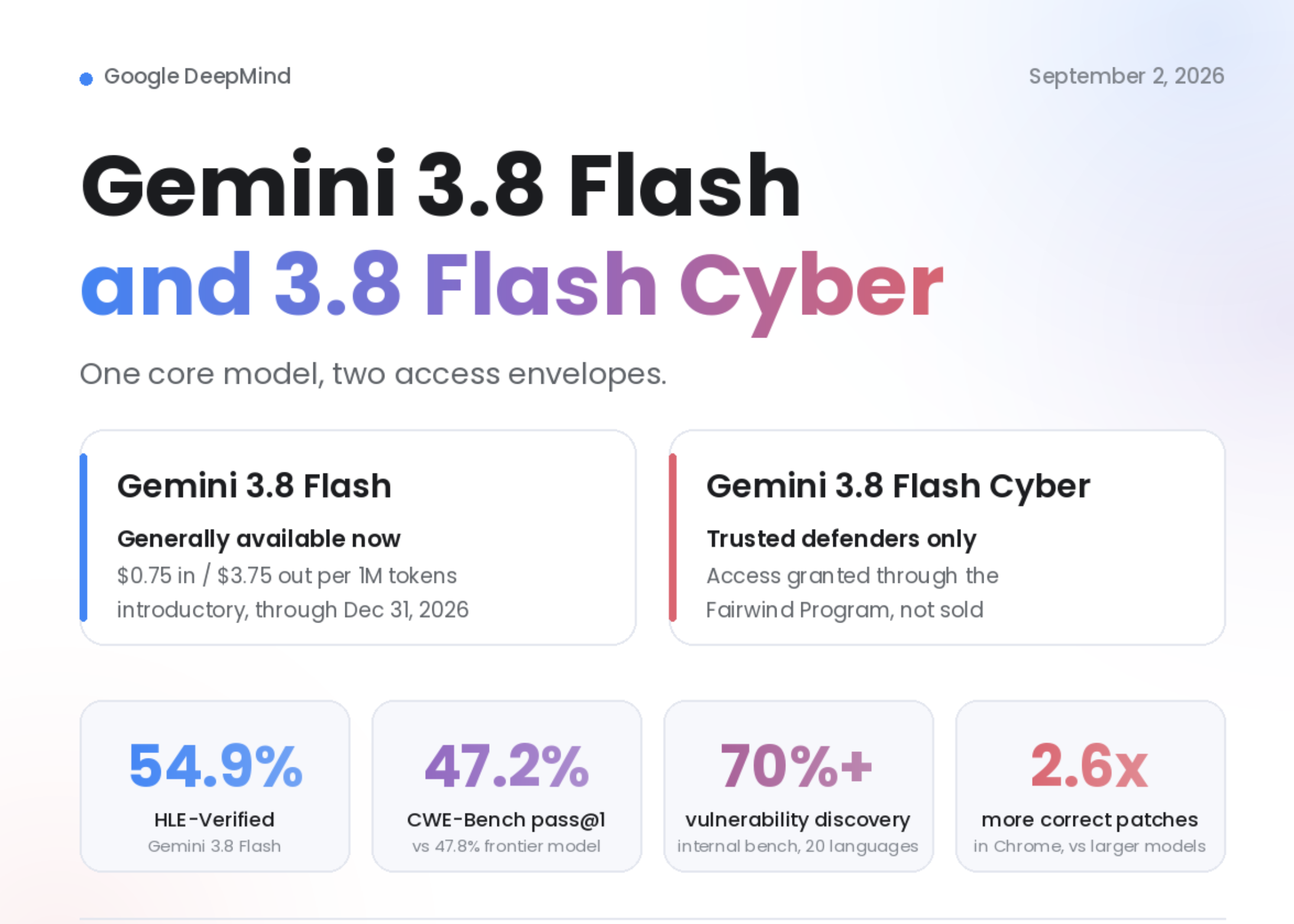
That is the practical question behind Google DeepMind’s release of Gemini 3.8 Flash and Gemini 3.8 Flash Cyber. The two models use the same foundational intelligence, but they are available under different safety controls. One is generally available for business applications. The other is restricted to approved cybersecurity defenders.
This distinction matters because AI capability is only one part of a safe deployment. You also need to consider what the model can access, which tasks it is allowed to perform, how much human review is required, and whether your team can monitor its actions.
TL;DR
Gemini 3.8 Flash is designed for general business use and can handle more complex tasks by reasoning for longer and calling tools repeatedly. Gemini 3.8 Flash Cyber is a restricted cybersecurity version for vetted defenders.
For your SME, the useful lesson is not simply “choose the newest model”. Test where deeper reasoning improves results, keep human approval for sensitive actions, and match the model’s permissions to the job.
What This Means
Google describes Gemini 3.8 Flash as an updated version of Gemini 3.7 Flash. The basic specifications remain unchanged: it supports a context window of 1,048,576 tokens, a maximum output of 65,536 tokens, and text, image, audio, and video inputs, with text output. Source
In plain language, the model can work with a large amount of business information in one task. That could include a long customer email thread, product catalogues, standard operating procedures, scanned documents, or recorded meeting material. However, supporting a large context window does not mean you should automatically send every company document into an AI system. Access rules and data handling still matter.
The more important change is behavioural. Gemini 3.8 Flash may take extra reasoning steps and call connected tools iteratively when handling a complicated request. This can improve accuracy, but it can also consume more tokens than a simpler response. Google’s developer guidance recommends staying with Gemini 3.7 Flash when compute efficiency is the main constraint. Source
The release also has a migration detail you should not ignore. Gemini 3.8 Flash does not support the MINIMAL thinking level, and using that setting causes an API validation error. If a software vendor or internal developer changes models, they must test configuration settings rather than assuming compatibility.
| Area | Gemini 3.8 Flash | Gemini 3.8 Flash Cyber |
|---|---|---|
| Primary use | General business and software applications | Cybersecurity defence and vulnerability work |
| Access | Gemini API, Google AI Studio, Antigravity, Android Studio and Gemini Enterprise | Case-by-case access through the Fairwind Program |
| Deployment | Cloud-based; model weights are closed | Restricted cloud access for approved defenders |
| Reasoning levels | LOW, MEDIUM and HIGH; MEDIUM is the default | Designed for more permissive cyber defence mitigations |
| Important limitation | MINIMAL is not supported | Not openly deployable by ordinary businesses |
The availability and configuration details above are reported in the source article. Source
How This Applies to Malaysian SMEs
Customer service: You could use a general-purpose model to classify incoming enquiries, draft replies in English or Bahasa Malaysia, summarise long conversations, and suggest the next action for your staff. A more capable reasoning mode may be helpful when a customer’s issue involves several orders, delivery updates, warranty conditions, or multiple company policies. You should still require staff approval before sending messages that promise refunds, replacement items, or special treatment.
Operations and administration: Many SME teams spend hours checking purchase orders, delivery notes, invoices, quotations, and internal forms. Gemini 3.8 Flash’s ability to process text, images, and longer information could support document extraction and comparison. For example, it could flag differences between a supplier quotation and your purchase order, identify missing fields, or prepare a summary for approval. Treat the output as a checking aid, not the final accounting record. Your staff should verify supplier details, tax information, quantities, and payment instructions before anything is posted or approved.
Sales and marketing: If you manage a growing customer database, the model could help turn call notes into follow-up tasks, group enquiries by product interest, and prepare tailored drafts based on your approved product information. The value comes from connecting the model to your existing workflow, not from asking it to write random content. Keep a controlled source of truth for prices, product specifications, delivery areas, return policies, and campaign dates so that generated drafts do not use outdated information.
Software and internal systems: If your company has a developer or works with an automation partner, Gemini 3.8 Flash may assist with code explanations, test generation, error analysis, and documentation. Long-running tasks can benefit from iterative tool calls, but you need limits. Do not allow an AI agent to change production systems, delete records, or alter customer permissions without approval. Use a test environment, maintain backups, and record which changes the agent proposed and which changes a person accepted.
Cybersecurity: Gemini 3.8 Flash Cyber is not a normal business feature that you can simply switch on. Google says access is gated through the Fairwind Program for trusted defenders, including government authorities, critical infrastructure operators, and software maintainers. Source For your business, the practical lesson is to work through a qualified cybersecurity provider rather than trying to obtain offensive security capability independently. Ask your provider to focus on vulnerability discovery, patching, access reviews, backups, and incident response.
The safest AI deployment gives the model enough access to complete one useful job, but not enough access to control your whole business.
What the Reported Results Tell You
The announcement reports results on software engineering, finance, legal, vulnerability discovery, and patching benchmarks. Gemini 3.8 Flash recorded 54.9% on HLE-Verified, while Gemini 3.8 Flash Cyber recorded 47.2% pass@1 on CWE-Bench compared with 47.8% for a leading frontier model. Source
These numbers can be useful for understanding capability, but they are not a guarantee that the model will work perfectly with your invoices, customers, products, or Malaysian compliance processes. Benchmark performance should lead to a controlled pilot, not an immediate full rollout.
Practical Takeaways for Your Business
- Choose one repetitive workflow first, such as enquiry classification, document summarisation, or internal knowledge search.
- Define what the AI may read, what it may produce, and which actions require human approval.
- Test both simple and complex tasks. Deeper reasoning may improve difficult cases but may not be necessary for routine requests.
- Keep sensitive personal, financial, and business information out of unapproved tools.
- Ask your automation provider how data is stored, retained, accessed, and deleted.
- Record model outputs during the pilot and measure accuracy using your own business examples.
- Check integrations carefully if moving from another Gemini version, especially settings related to thinking levels.
- Use separate permissions for customer service, finance, operations, and technical systems.
- Require approval before an AI sends external messages, changes records, issues credits, or edits live software.
- Review the workflow monthly because product information, policies, and staff responsibilities change.
The Bigger Picture
The most important development here is not just a faster or more capable model. It is the separation between a shared AI core and different access envelopes. A general business assistant can be broadly available, while a cybersecurity model with stronger offensive potential can be restricted to vetted users.
This approach is likely to influence how businesses buy and manage AI. Instead of asking only, “Which model is smartest?”, you will need to ask, “Which model is suitable for this task, with which permissions, under whose supervision?” That is a much more useful question for an SME.
It also means your internal processes will become more important. A reliable approval step, clear document ownership, good customer data, and strong access controls can make an ordinary model useful. Without those foundations, even a highly capable model can produce confusion, expose information, or automate the wrong decision.
For a Malaysian SME, the sensible path is steady adoption. Start with a narrow workflow, keep a person accountable, measure the result, and expand only when the controls work. Gemini 3.8 Flash may be suitable for more demanding business tasks, while Gemini 3.8 Flash Cyber is a reminder that capability must be matched with responsibility. Your advantage will come from applying AI carefully to real work—not from using the newest model everywhere.
Ready to Streamline Your Operations?
Your business should run itself. AutoRunBiz deploys AI agents to automate your daily operations — WhatsApp orders, invoicing, customer follow-ups, and accounting. Book a free 15-min ops audit to see where automation fits your business →