
Why AI infrastructure choices matter to your business
If you are running a Malaysian SME, you may not be comparing five global GPU cloud providers today. You may be deciding something more practical: whether your team should use an AI application, build an internal tool, or run your own model at all.
That decision still depends on infrastructure. The provider behind your AI service affects response speed, reliability, data handling, technical support, and how easily your project can grow. Choosing based only on the lowest advertised hourly rate can create problems later, especially when your workload becomes more demanding or your data needs tighter controls.
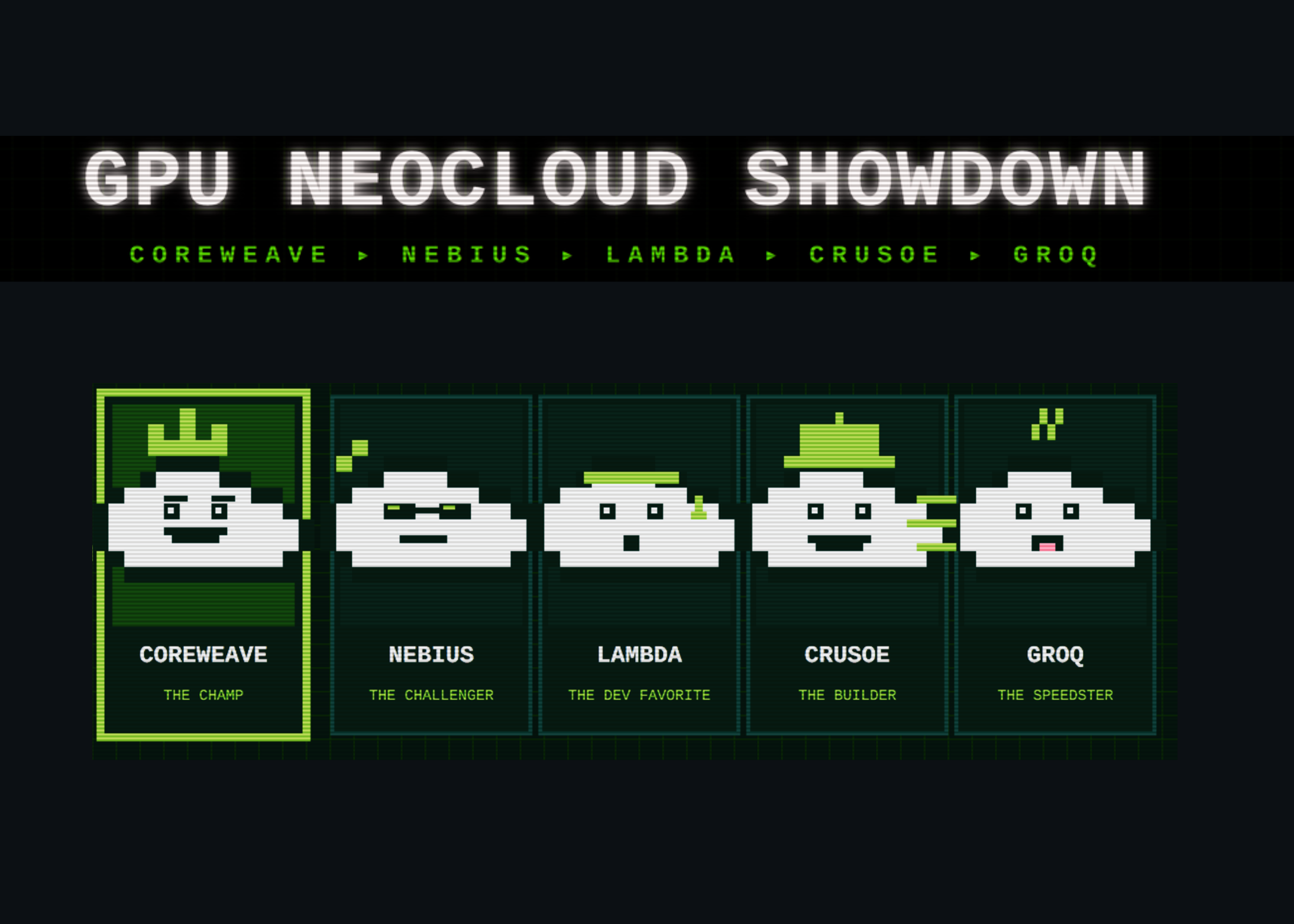
The 2026 comparison of CoreWeave, Nebius, Lambda, Crusoe, and Groq shows that “GPU cloud” does not describe one standard product. These companies differ in hardware, pricing models, capacity, contracts, and whether they focus on training models or serving AI responses.
TL;DR: For most SMEs, the best provider is not automatically the cheapest provider. First identify whether you need occasional AI application usage, model training, or high-volume inference, then compare reliability, contract flexibility, data governance, and support.
Published GPU pricing can help you understand the market, but it is only one part of the buying decision. You should also ask what is included, where your data is processed, and how easily you can move your workload if your requirements change.
What This Means
A GPU cloud provider rents access to powerful computing hardware through the internet. GPUs are useful for AI workloads because they can process many calculations simultaneously. You may need them to train a model, fine-tune an existing model, generate images, analyse documents, or serve answers from an AI assistant to many users.
The five providers in the source article represent different approaches:
| Provider | What stands out | Published information | Practical relevance |
|---|---|---|---|
| CoreWeave | Large-scale NVIDIA GPU infrastructure and premium positioning | Reported Q2 2026 revenue of $2.575 billion and 1.5 GW active power source | Suitable for organisations needing substantial, managed AI capacity |
| Nebius | Broad published pricing and expanding AI cloud capacity | Reported $3.0 billion AI cloud annualised run-rate revenue source | Useful for comparing hardware options and on-demand access |
| Lambda | Published B200 on-demand rate and no spot tier | B200 listed at $6.69 per GPU-hour source | May appeal when predictable on-demand access matters |
| Crusoe | Offers AMD MI300X and MI355X alongside NVIDIA hardware | Reported 4.9 GW contracted and a pipeline above 40 GW source | Relevant if your software supports AMD accelerators |
| Groq | Focuses on inference using its LPU architecture | Reported 13 data centres and planned growth from 54 MW to more than 200 MW in 2027 source | Relevant for fast, repeated AI responses rather than model training |
In plain language, there are two important categories. Training infrastructure helps create or adapt models. Inference infrastructure runs a completed model and returns an answer, classification, prediction, or generated image. Your business may need only inference, and in many cases you may not need direct GPU access at all.
Key insight: Do not buy infrastructure before you define the business workflow. A reliable AI service connected to your existing systems is often more useful than owning direct access to powerful hardware.
How This Applies to Malaysian SMEs
Suppose you operate a Johor-based distributor with a small sales and admin team. Your immediate AI use case may be extracting information from supplier invoices, preparing quotations, or answering product questions from your sales catalogue. You probably need document processing and a controlled AI assistant, not a dedicated GPU cluster. A technology partner can connect these services to your accounting, inventory, or customer relationship systems while keeping the technical setup away from your staff.
If you run a Malaysian e-commerce brand, your needs may be different. You might want automated product descriptions, customer-service replies in Bahasa Malaysia and English, or demand forecasting from sales records. Response volume can rise sharply during campaigns and festive seasons. In that situation, you should ask whether your provider can scale temporarily, preserve your brand instructions, and prevent one busy period from slowing other business processes. The key question is not simply which GPU is used; it is whether your customer experience remains dependable.
For a manufacturer in Penang or Selangor, AI may support visual quality inspection, preventive maintenance, or production planning. These workloads can involve images, sensor data, and operational records. You should clarify whether processing occurs in the cloud, on-site, or through a combination. You also need clear rules for who can view factory data, how long records are retained, and what happens when an employee leaves.
A professional services firm, such as an accounting, legal, engineering, or recruitment practice, may use AI to search internal documents and draft first versions of client materials. Here, confidentiality is more important than access to the newest accelerator. Before adoption, check whether the system separates your information from other customers, supports user permissions, provides activity logs, and allows your team to review outputs before anything is sent externally.
Malaysian SMEs should also consider location and compliance requirements. The Personal Data Protection Act 2010 applies to personal data processing in commercial transactions, so you should understand how customer, employee, and supplier information is handled. Your technology provider should explain the data flow in straightforward terms, including subprocessors, storage locations, retention, and deletion procedures. Do not rely on a general statement that data is “secure”.
Practical Takeaways
- Start with one workflow: Choose a task with a clear owner, repeated manual effort, and an outcome you can measure.
- Classify your workload: Decide whether you need document analysis, text generation, image processing, model fine-tuning, or high-volume inference.
- Separate direct infrastructure from software: Ask whether you need GPU access or simply an AI feature integrated into your current business system.
- Test before committing: Use a controlled pilot with representative Malaysian documents, languages, customer questions, and operating conditions.
- Measure business results: Track processing time, error rates, approval time, response quality, and staff adoption rather than technical specifications alone.
- Check service limits: Confirm usage limits, service availability, support arrangements, data retention, export options, and contract exit terms.
- Protect sensitive information: Set rules for identity card details, payroll records, bank information, customer contacts, and confidential contracts.
- Keep human approval: Require a person to review customer-facing, financial, legal, employment, or safety-related outputs.
- Plan for language needs: Test Bahasa Malaysia, English, Chinese, Tamil, local product terms, abbreviations, and mixed-language messages where relevant.
- Ask about continuity: Find out what happens during an outage and whether your workflow can temporarily switch to another service.
A simple evaluation scorecard
| Area | Question to ask | What a good answer looks like |
|---|---|---|
| Use case fit | Can it handle our actual documents and questions? | Demonstrated results from a representative pilot |
| Reliability | How is availability monitored? | Clear service commitments and incident process |
| Security | Who can access our information? | Role-based access, logs, retention controls, and documented safeguards |
| Operations | Who supports us when something fails? | Named support channel and practical escalation process |
| Flexibility | Can we change providers or export our data? | Portable data and documented integration interfaces |
The Bigger Picture
The growth of neocloud providers signals that AI infrastructure is becoming more specialised. Some providers will focus on large training clusters, some on flexible access to newer chips, and others on fast inference. This specialisation may give businesses more choices, but it also makes procurement more complicated.
For an SME, that complexity is a reason to simplify your internal decision process. You do not need to follow every new chip announcement. You need a clear record of what your business process requires, what information it uses, how much staff time it consumes, and what quality level is acceptable.
Over time, AI services will likely become embedded in ordinary business software: sales systems, accounting platforms, help desks, warehouse tools, and document workflows. The provider selected behind the scenes may change without you noticing. That makes good integration and data governance more valuable than tying your business to one particular hardware brand.
The sensible approach is to build an adaptable foundation. Keep your business data organised, define access permissions, document your workflows, and avoid storing critical knowledge only inside one AI tool. When a better model or service appears, you should be able to evaluate it without rebuilding your entire operation.
For most Malaysian SME owners, the next step is not to rent a high-end GPU. It is to select one repetitive process, prepare a small test dataset, set approval rules, and measure whether the workflow improves. Once you understand the practical requirement, you can decide whether a managed AI application, an API, or specialised infrastructure is appropriate.
That order matters. Infrastructure should support a business decision, not become the business decision.
Ready to Streamline Your Operations?
Your business should run itself. AutoRunBiz deploys AI agents to automate your daily operations — WhatsApp orders, invoicing, customer follow-ups, and accounting. Book a free 15-min ops audit to see where automation fits your business →