
Your AI Editing Tools Are Getting Better — Here’s How You’ll Know
You’ve probably been there. You open your favourite editing app, point it at a product video, and ask it to remove a stray object — a price tag on a shirt, a passerby behind your shopfront, a cable snaking across your office floor. The tool does its thing. And the result looks… almost right. But not quite. There’s a ghosting shadow, a slight flicker, a spot where the background looks painted on. You can’t name the problem, but your customers will notice it.
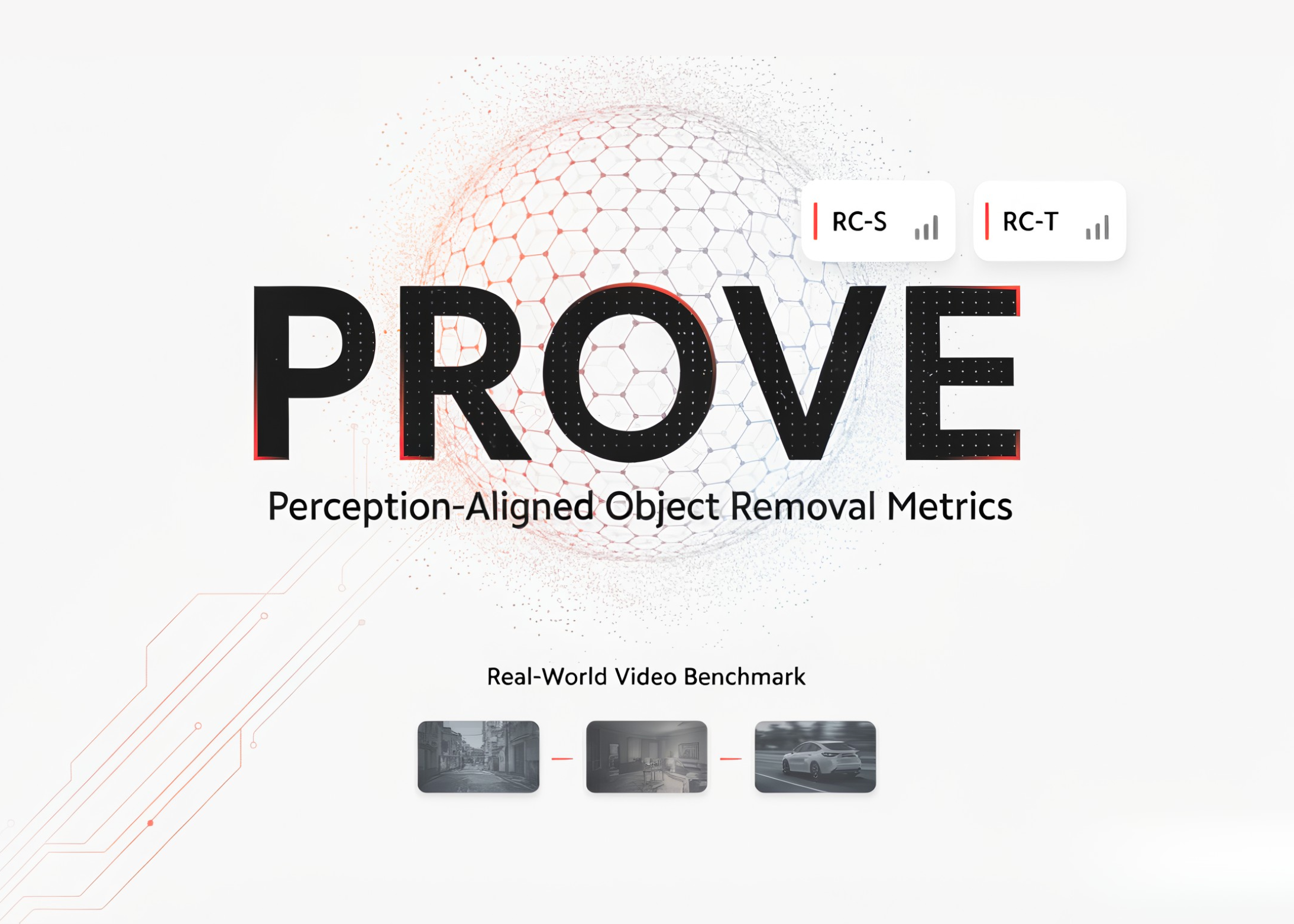
That vague unease is actually a known problem in artificial intelligence. Object removal tools have improved quickly, but the tests used to judge their output haven’t kept up. Xiaomi’s MiLM Plus research team has released something called PROVE — a new system that measures whether an AI edit is genuinely convincing to human eyes. It was accepted at the ACM MM 2026 conference, and it matters for anyone who relies on AI-edited images or videos in their business (source). Here’s what you need to know — without a single line of code.
“Object removal is an ill-posed, one-to-many task, so no single ground truth exists to compare against.” — Xiaomi MiLM Plus research team (source)
TL;DR:
- Xiaomi built two new quality checks — RC-S and RC-T — that judge whether an AI object removal edit matches human perception.
- The old checks (PSNR, SSIM, LPIPS) could rank a blurry, broken edit higher than a clean one. The new checks match human rankings far more closely.
- For you, this means AI editing tools should get noticeably better at producing clean, believable results in your product photos, property videos, and marketing clips.
What This Means
When an AI removes an object from a video frame, there is no “perfect” answer to compare against. Remove a person from a street scene, and the background behind them could plausibly be filled in many ways. But old quality measures assume a single correct version exists. So they often reward the wrong things.
For example, the researchers found that cutting diffusion inference steps improves PSNR and SSIM scores while visual quality collapses — the metric literally prefers mush (source). Worse, when they progressively blurred an edited region, existing metrics called ReMOVE and CFD never scored worse — sometimes they scored better (source). The ruler was broken.
PROVE replaces that ruler. RC-S (for spatial consistency) and RC-T (for temporal consistency) score the edited region locally by comparing it to its own surroundings using deep-learning features. No reference video is needed. In tests against human rankings from 20 participants, RC-S reached 0.59 average Kendall’s τ — versus just 0.26 for ReMOVE and 0.16 for CFD (source). And it’s fast: 134.6 ms per frame on a single RTX 4090 GPU, which is practical even for small teams (source).
| Quality Check | Old approach (PSNR / SSIM / ReMOVE) | New approach (RC-S / RC-T) |
|---|---|---|
| Needs a “perfect” reference | Yes — usually impossible for removal tasks | No — compares edited area to its own surroundings |
| Rewards blur or copy-paste? | Yes — blur often scores higher | No — degrades monotonically when quality drops |
| Matches human rankings | 0.26 (ReMOVE), 0.16 (CFD) | 0.59 average Kendall’s τ |
| Useful on real messy videos | Limited — fails on flicker and ghosting | Built for real-world clips, including “hard” scenes |
How This Applies to Malaysian SMEs
If you sell online, this affects your product content. Whether you’re on Shopee, Lazada, or TikTok Shop, you spend time making product photos and videos look clean. AI tools already remove background clutter, logos, or reflections. But here’s the catch: if the quality checks inside those tools are flawed, the tools were being optimised for the wrong target. This research changes the target — and the editing tools you already use will improve because of it. When a tool’s internal “score” finally matches what your eyes see, you’ll spend less time re-shooting and re-editing.
Property agents and developers, this one is for you. Malaysian real estate runs on video walkthroughs. AI can now remove furniture, people, or unsightly objects from these clips. But a bad removal leaves ghosting — and buyers notice immediately. The PROVE benchmark includes a tier of 100 “hard” videos featuring crowds, flowing water, flames, textured terrain, and multi-puddle reflections (source). Those are exactly the messy real-world scenes you’d find in a Malaysian home during a viewing — ceiling fans spinning, curtains moving, reflective marble floors. Tools that score well here are tools you can actually trust with a listing video.
Short-video marketing teams, pay attention. Malaysian SMEs compete for attention on Facebook, Instagram, and TikTok with short-form video. Agencies and in-house marketers lean on AI-assisted editing to keep up with demand. The practical point: when you brief an editor or choose a tool, you can now ask tougher questions. Is the output quality measured against human perception, or against an arbitrary mathematical score? That’s a fair question — and the answer predicts how much rework you’ll be paying for later.
And when you’re choosing vendors, you don’t need to understand sliding-window Maximum Mean Discrepancy or DINOv2 features. You do need to understand this: a vendor whose AI was developed using honest, perception-aligned evaluations will deliver edits your customers won’t second-guess. When a service provider tells you their AI “passed quality checks,” ask what checks. The good ones now have a straight answer.
Practical Takeaways
- Test AI editing tools on your own messy footage — not the polished demo clips vendors show you. Use a real video with moving shadows or reflective surfaces.
- Ask vendors how they measure output quality. A vague answer is a red flag. “We compare against human perception” is a green one.
- If a tool cites perception-aligned benchmarks, it’s more likely to match what your eyes see. Look for references to RC-S or similar evaluation methods.
- Spot-check frame-by-frame on high-stakes edits — hero product shots, property walkthroughs, client ads. One bad frame can undo a whole video.
- Watch for tools that publish their benchmark numbers. Transparency signals confidence in the actual quality of the output.
The Bigger Picture
What’s happening here is bigger than one research paper. AI quality measurement is shifting from pure mathematics toward human perception. When tools are judged the way humans actually judge them, they improve in the ways that matter to businesses — fewer retakes, fewer artefacts, less time fixing AI’s mistakes.
For Malaysian SMEs, that’s a future worth paying attention to. The tools you use every day — for product photos, property videos, social content — will get better at the invisible parts: natural shadows, consistent lighting, stable frames across cuts. And you won’t need to know how it works. You’ll just notice that the edits finally look right. And that’s the kind of upgrade you can take to the bank — or at least, to your next customer.
Ready to Streamline Your Operations?
Your business should run itself. AutoRunBiz deploys AI agents to automate your daily operations — WhatsApp orders, invoicing, customer follow-ups, and accounting. Book a free 15-min ops audit to see where automation fits your business →