
Why Two New AI Models Matter to Your Business
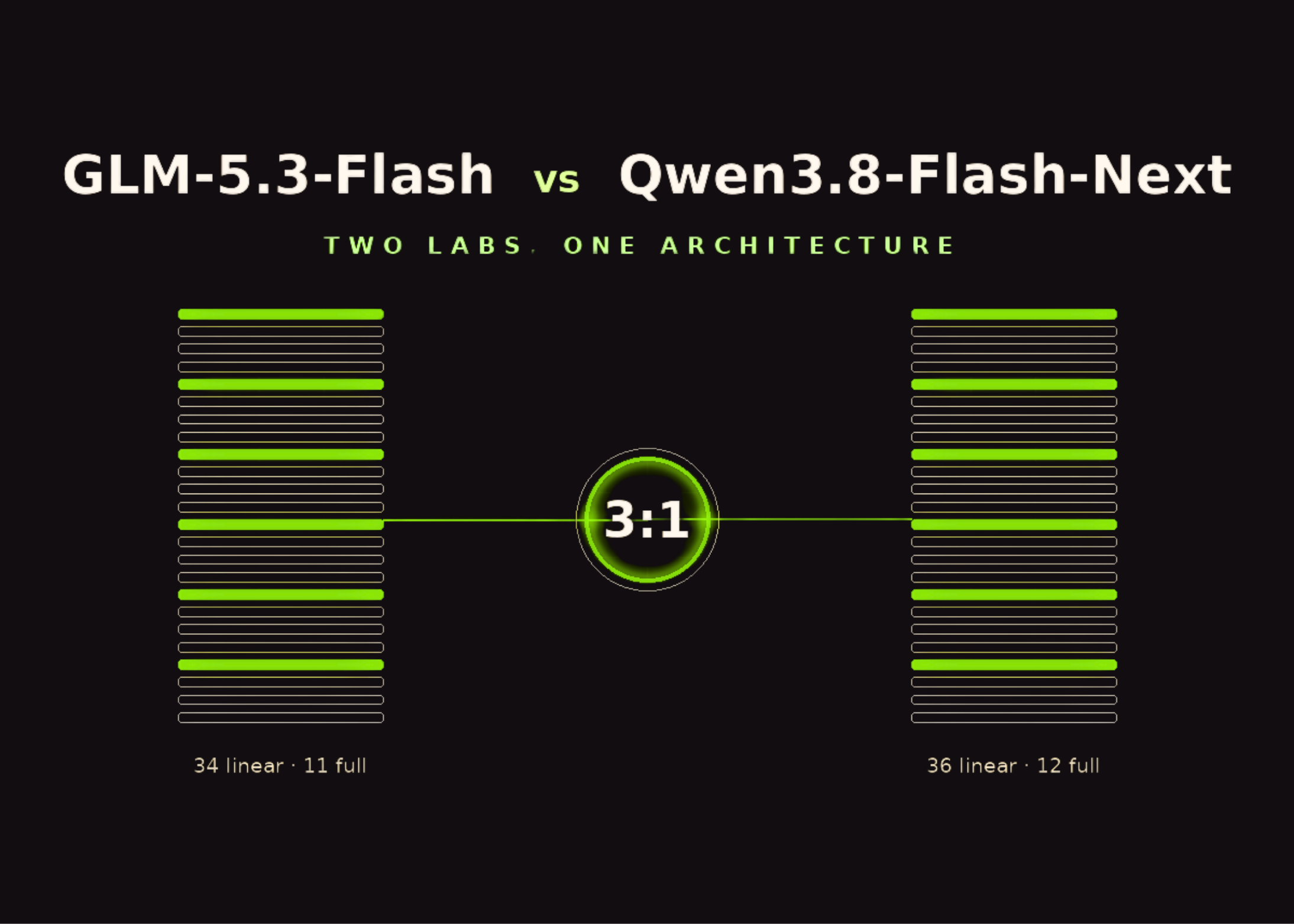
Two Chinese AI laboratories have released advanced open-weight models with remarkably similar designs. Z.ai launched GLM-5.3-Flash, while Alibaba’s Qwen team introduced Qwen3.8-Flash-Next within roughly a day of each other. Although the teams developed them independently, both arrived at many of the same engineering decisions: combine linear and full attention, compress long context before searching it, use four gated residual streams, and train with a modern optimiser. Source
For you as a Malaysian SME owner, this is more than an interesting contest between AI labs. It points towards a practical direction for business software: AI that can process long customer histories, documents, product catalogues and internal procedures with less computing pressure. Whether you run a trading company in Shah Alam, a clinic in Johor Bahru, a logistics operation in Penang or a professional-services firm in Kuala Lumpur, the next generation of AI tools may handle larger amounts of business information while staying responsive.
What Happened
GLM-5.3-Flash is a 320-billion-parameter multimodal mixture-of-experts model, with 18 billion active parameters per token. It was trained on a 30-trillion-token multimodal corpus and supports a one-million-token context window. Z.ai released it under the MIT licence on Hugging Face, which makes it particularly relevant to organisations exploring self-hosted or customised AI applications. Source
Qwen3.8-Flash-Next has a 125-billion-parameter main model, a 51-billion-parameter n-gram embedding table and six billion active parameters per token. Its native context is 262,144 tokens and can be extended to one million tokens using YaRN. The Qwen team reported that training used about one-ninth of the compute required by Qwen3.7-Plus. Source
The striking point is that both models independently use a three-to-one mixture of linear-attention and full-attention layers. GLM-5.3-Flash contains 34 linear-attention layers and 11 full-attention layers across 45 layers. Qwen3.8-Flash-Next uses a repeating pattern of three Gated DeltaNet layers followed by one Qwen Sparse Attention layer across 48 layers. Source
Both models also compress their context before deciding which information deserves detailed attention. Each uses a four-times compression step and keeps a maximum of 2,048 tokens for sparse attention. Qwen reported up to 7.6-times faster prefill and 4.9-times faster decoding than full attention at one million tokens in its testing. Source
Why This Matters for Malaysian SMEs
Long context is useful when your AI assistant must work with more than a short question and answer. Imagine asking an internal assistant to compare a customer’s previous quotations, delivery notes, support conversations and warranty terms before drafting a reply. In a construction or engineering business, the same system could review tender requirements, technical specifications, meeting notes and variation orders. The model architecture described in the source article is designed to manage long histories without treating every token as equally important at every stage. Source
This could also support Malaysian businesses dealing with mixed formats and languages. GLM-5.3-Flash is described as natively multimodal, meaning it is built to work across more than plain text. A future business workflow could combine photographed delivery documents, scanned forms, spreadsheets and messages in one process. For example, a distributor could extract information from a signed delivery order, check it against an inventory record and flag a mismatch for a staff member. You should still verify important outputs, but the architecture direction makes these workflows more realistic. Source
| Model or feature | What it could mean for your business | Reported detail |
|---|---|---|
| GLM-5.3-Flash | Useful for multimodal document and workflow experiments | 320B total parameters; 18B active parameters; one-million-token context Source |
| Qwen3.8-Flash-Next | Useful for testing long-document and agent workflows | 125B main model; 6B active parameters; 262,144-token native context Source |
| Hybrid attention | Balances long-history processing with precise retrieval | Both models use a three-to-one linear-to-full attention ratio Source |
| Sparse context selection | Helps an AI focus on relevant sections of large records | Both compress context four times and select 2,048 tokens Source |
There is an important operational lesson here: a larger context window does not automatically mean better business answers. The models still need mechanisms to identify relevant information. If you connect an AI system to your CRM, accounting records or shared drive, you should organise documents with clear names, dates, customer identifiers and access permissions. Better data structure will help whichever model you choose.
For an SME, the practical question is not “Which model has the biggest number?” It is “Can this model reliably find the right information, follow our process and show a staff member why it reached an answer?”
What You Can Test in Your Business
Start with a contained workflow rather than giving an AI system control over every business process. A useful pilot could be an internal document assistant that answers questions about standard operating procedures, onboarding material, product specifications or service policies. Ask it to cite the document and section used for every answer. This gives you a simple way to detect missing information, outdated procedures and unsupported responses.
You can also test a customer-service drafting assistant. Feed it a limited set of approved product information and previous support scenarios, then ask it to prepare replies in English, Bahasa Malaysia or another language used by your customers. Keep a staff member responsible for approval, especially when the response involves delivery commitments, refunds, regulatory matters or technical safety.
Before selecting a model, measure practical results:
- Can it retrieve the correct clause from a long document?
- Does it preserve customer names, order numbers and dates accurately?
- Can it distinguish between an internal instruction and a customer-facing promise?
- Does it handle images, scanned documents and tables consistently?
- Can your team monitor access, corrections and failed answers?
- Does it continue operating sensibly when the required information is missing?
The Bigger Picture
The similarity between GLM-5.3-Flash and Qwen3.8-Flash-Next suggests that AI architecture is becoming more focused on efficiency and selective attention. Rather than processing every part of a very long input in the same expensive way, these systems use cheaper recurrent-style layers for most processing and reserve detailed attention for selected sections. Both also replace one residual stream with four gated branches, although GLM uses Manifold-Constrained Hyper-Connections while Qwen uses its own Gated Residual design. Source
However, the industry has not reached a final answer. MiniMax tested linear and sliding-window attention and reported serious multi-hop reasoning weaknesses beyond 32,000 tokens after supervised fine-tuning. Its M2 model shipped with full softmax attention in every layer, while its M3 design used sparse softmax attention without linear-attention layers. Source
Qwen also found a warning around positional encoding. Its tests suggested that removing rotary position embeddings made little difference during pre-training, but a NoPE version sometimes failed to stop generating after post-training. That result shows why you should evaluate an AI system on your actual business tasks instead of relying only on benchmark scores or a vendor’s context-window claim. Source
For Malaysian SMEs, the immediate takeaway is to prepare your data and workflows now. Document your approval rules, separate confidential records, define who can access customer information and create a test set based on real business questions. When efficient long-context models become available through your software providers or internal systems, you will be ready to test them against measurable outcomes rather than adopting them simply because they are new.
Ready to Streamline Your Operations?
Technology moves fast. Your operations should keep up. AutoRunBiz builds AI systems that run your daily workflows — from WhatsApp order capture to accounting. Book a free 15-min ops audit →