
Robotics Data Is Becoming Easier to Collect and Improve
If you run a Malaysian SME, robotics may sound like a concern for factories with large engineering teams. Yet many businesses already face the same practical problems that robotics researchers are trying to solve: repetitive work, inconsistent processes, limited training data and difficulty improving automation once it is installed.
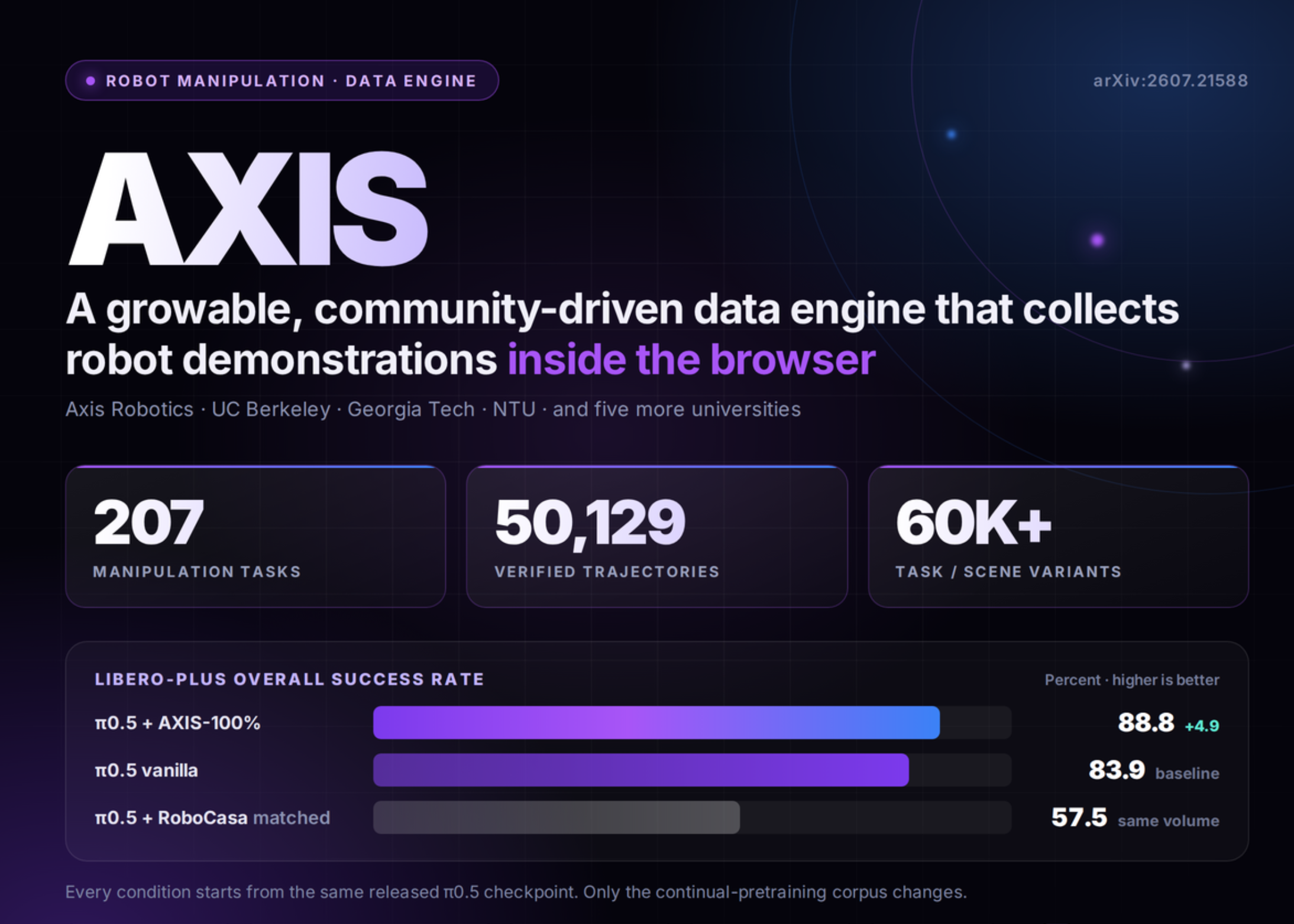
A new project called AXIS offers a useful lesson. Instead of collecting every robot demonstration inside a specialised laboratory, it allows people to control simulated robots through a web browser while backend computers handle the demanding processing. The project includes 207 tasks and 50,129 trajectories, giving researchers a large body of examples for training robot systems. Source
You may not need a robot today. However, the underlying idea matters: useful automation improves when more people can contribute reliable examples without needing specialised equipment at every location.
TL;DR
AXIS shows how browser access, centralised computing and structured data can make complex automation easier to develop.
For your SME, the practical lesson is to capture work processes consistently now, so future software, machines and AI tools can learn from them.
What This Means
Traditional robot training often depends on expert operators, laboratory equipment and offline data processing. A specialist demonstrates a task, such as picking up an object, placing it correctly and repeating the movement. The resulting dataset is then cleaned and used to train a model. Once released, that dataset may remain fixed.
AXIS takes a different approach. Contributors operate a simulated Franka Research 3 robot through a browser using a keyboard, mouse, virtual joystick or gamepad. The browser displays the simulation, while backend GPUs perform heavier work such as rendering, training and evaluation. The system uses MuJoCo WebAssembly in the browser and sends demanding workloads to remote computing infrastructure. Source
This separation is important. A user does not need a local robot, a powerful graphics card or a complex installation just to contribute a demonstration. The browser becomes the working interface, while the central platform manages the technical machinery behind it.
The project also generates tasks and scenes rather than relying only on manually designed examples. Its system creates task, scene and object configurations, checks whether the arrangement is valid, and assigns a structured success condition. The backend then verifies whether the task was completed instead of simply trusting what the frontend reports. Source
Key insight: Automation becomes more dependable when every completed task produces structured, checked data rather than an informal instruction or an unverified result.
How This Applies to Malaysian SMEs
1. Your process knowledge should not stay in one employee’s head. A small bakery, workshop, warehouse or logistics company may depend heavily on one experienced worker. That person knows how to inspect a product, arrange stock, prepare an order or handle an exception. If the process is not documented, training a replacement becomes slower and inconsistent. The AXIS approach suggests recording actions, conditions and outcomes in a structured format. For your business, this could begin with standard operating procedure checklists, annotated photos, short videos and digital forms that show what “correct” looks like.
For example, a Malaysian food distributor could record how staff inspect packaging, scan an item, place it into a delivery order and handle damaged stock. A workshop could record inspection steps for different product types. These records can later support workflow automation, computer vision checks or staff training systems. You do not need a robot to benefit from collecting clearer examples of work.
2. Browser-based tools reduce the burden on your team. Many SMEs avoid automation because they assume every employee needs technical training or every workstation needs special hardware. A browser-based model changes that assumption. If a tool works through a familiar browser and the complex processing happens remotely, your staff can participate using existing devices. This does not remove the need for good setup, but it can make pilots easier to organise across branches, warehouses or offices.
A furniture or homeware seller, for instance, could test a browser workflow for product categorisation. Staff could review images, confirm dimensions, select product attributes and flag uncertain cases. The system could use their verified decisions to improve future classification. A service company could use a similar process to label customer requests, identify urgency and route jobs to the right team.
3. Verification matters more than volume. AXIS contains 50,129 episodes, but the project also applies cleaning and replay checks. Samples with very little joint movement are removed, motion is smoothed, and trajectories are resampled. After refinement, replay success falls from 100% to 86.2%, showing that cleaning can reveal weaknesses that raw figures hide. Source
The same principle applies to your business data. Ten thousand inconsistent records may be less useful than one thousand well-labelled records. If your sales team uses different names for the same product, or your staff record customer complaints in different formats, an automation system will learn from that inconsistency. Before choosing a sophisticated tool, define the fields, acceptable values and approval checks that matter.
4. Simulation can help you test before changing live operations. AXIS uses simulated scenes and randomises elements such as cameras, backgrounds and object arrangements. Its training results improved from 83.9 to 88.8 overall on the LIBERO-Plus benchmark, a 4.9 percentage-point increase. Source
For your SME, a simulation does not have to mean a virtual factory. You can create a controlled test environment for order routing, appointment scheduling, stock alerts or invoice approval. Try unusual cases before allowing automation to act automatically. What happens when a product code is missing? What happens when two staff members update the same record? What happens when a customer sends an incomplete request?
A Simple Data Structure for Your Business
You can start by defining each process with five fields. The numbers below are a practical starting framework, not a requirement from the AXIS project.
| Process element | What to record | Example |
|---|---|---|
| 1. Trigger | What starts the task | New customer order received |
| 2. Input | Information or item required | Order number, product code and quantity |
| 3. Action | What the staff member or system does | Check availability and reserve stock |
| 4. Decision | Conditions that change the next step | Split shipment if an item is unavailable |
| 5. Outcome | How success is confirmed | Order status updated and customer notified |
This structure gives you a foundation for workflow automation, reporting and future AI projects. It also makes it easier to identify where mistakes happen.
Practical Takeaways
- Choose one repetitive process that affects customers or staff every week.
- Write down the trigger, input, action, decision and successful outcome.
- Use one consistent naming system for products, customers, tasks and statuses.
- Collect examples of both successful and unsuccessful cases.
- Ask a responsible staff member to verify important records before they enter your automation system.
- Test unusual situations before allowing software to take action without approval.
- Prefer tools that staff can access through a browser if your team works across locations.
- Review your process data regularly; a workflow can become inaccurate when your products or policies change.
The Bigger Picture
AXIS points towards a future where automation systems are built from continuously expanding examples rather than one fixed dataset. The project credits more than 70,000 community members with contributions, showing how distributed participation can support a large technical resource. Source
For Malaysian SMEs, this does not mean every business should buy a robot. It means the quality of your operational information will increasingly influence how much automation you can adopt. Businesses that clearly record procedures, exceptions and outcomes will be in a stronger position to introduce workflow tools, document processing, customer service automation and eventually physical automation.
There are also limits to keep in mind. The AXIS dataset is gated, approximately 2.36 TB and restricted to non-commercial academic use, while no policy checkpoints are released. Source That means you should not assume every research release is ready for direct business deployment.
The useful lesson is simpler: make your work visible, structured and verifiable. Start with one process, capture what happens, check the result and improve the record over time. When better automation becomes available, you will have the operational foundation needed to use it responsibly.
Ready to Streamline Your Operations?
Your business should run itself. AutoRunBiz deploys AI agents to automate your daily operations — WhatsApp orders, invoicing, customer follow-ups, and accounting. Book a free 15-min ops audit to see where automation fits your business →