
When Software Work Keeps Getting Stuck
If your business relies on a small internal technology team, a freelancer, or a software vendor, you may recognise this pattern: a simple change begins with one request, then turns into a chain of questions, revisions, testing issues, and follow-up messages. By the time the work is complete, you are spending more time explaining the requirement than reviewing the result.
That is the problem newer agentic coding models are designed to address. Instead of producing one answer and waiting for another instruction, the model can work through a longer task, inspect relevant information, use tools, ask for clarification, and report when it cannot proceed safely.
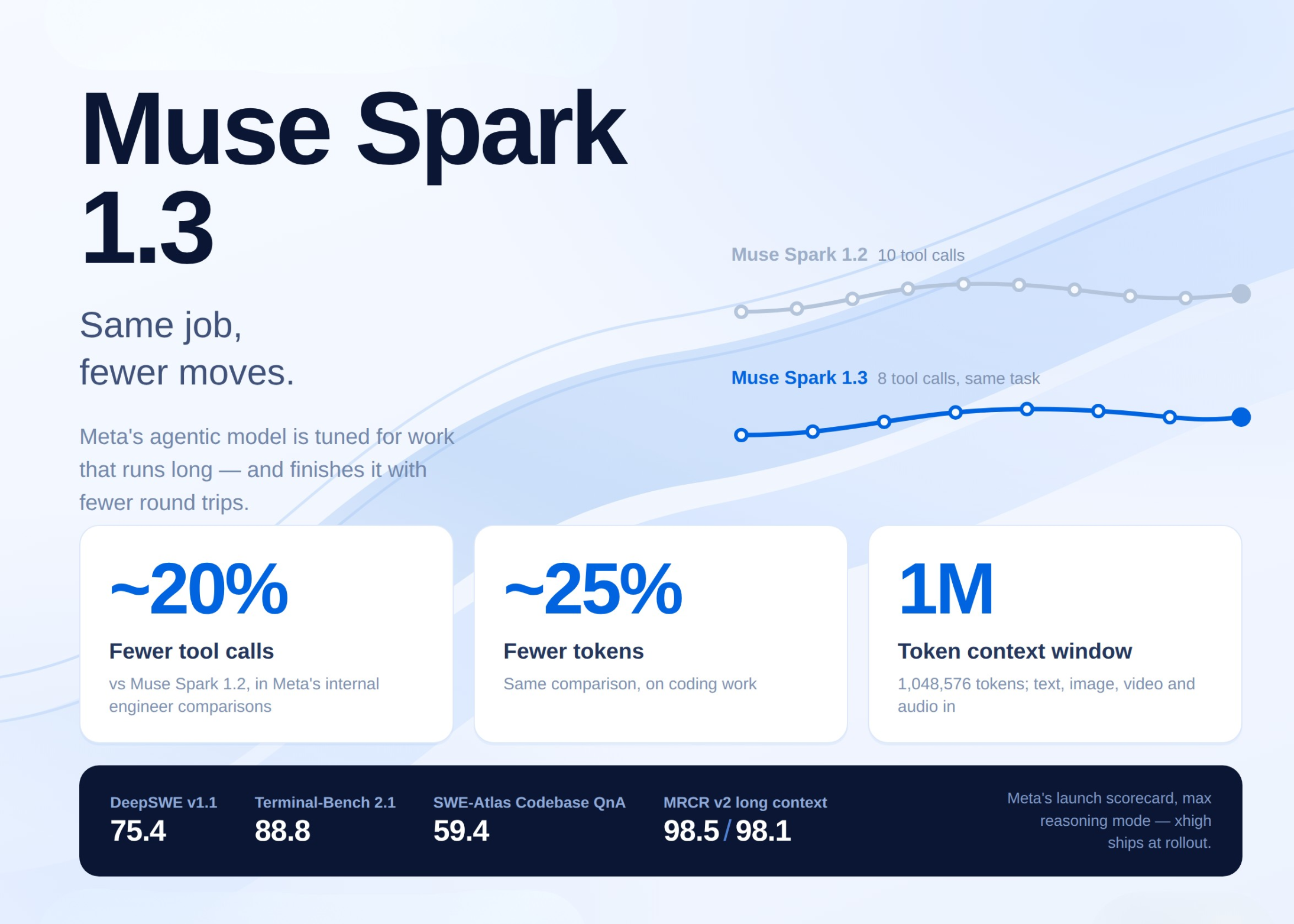
Meta’s Muse Spark 1.3 is an example of this direction. According to the source report, it is available through Muse Code and the Meta Model API, with a reported 1M-token context window. Source
TL;DR
Agentic coding AI is moving from answering coding questions to managing longer, multi-step software tasks.
For your SME, the practical value is better handovers, clearer clarification questions, faster internal automation, and fewer unnecessary back-and-forth steps—not replacing every developer or approving changes without supervision.
What This Means
A conventional coding assistant usually responds to the prompt in front of it. You ask for a report screen, a database query, or a bug fix, and it gives you code or instructions. You then test the result, discover missing details, and return with another prompt.
An agentic coding model works more like a junior technical collaborator. You give it an objective, such as “check why yesterday’s sales report is missing several branches and prepare a safe fix.” The model may inspect files, trace the data flow, compare records, identify possible causes, suggest a change, run tests, and pause when it needs your approval.
The important word is supervision. A capable agent should not quietly make consequential changes merely because the request was vague. Muse Spark 1.3 is described as asking clarifying questions, requesting user involvement when it stalls, and confirming before consequential actions. It also reportedly adapts to your preferred working style, such as frequent updates or quieter background execution. Source
The useful test is not “Can the AI write code?” It is “Can the AI complete a defined business task while showing you what it did and when it needs permission?”
Meta reports that Muse Spark 1.3 used approximately 20% fewer tool calls and approximately 25% fewer tokens than Muse Spark 1.2 in internal comparisons. Source These figures are not a guarantee for your workflow, but they point to a useful capability: completing a long task with fewer unnecessary turns.
How This Applies to Malaysian SMEs
1. Connecting everyday business systems. Many Malaysian SMEs operate with a mixture of accounting software, point-of-sale systems, spreadsheets, online forms, customer relationship tools, and messaging platforms. The issue is often not the absence of data; it is the manual movement between systems. An agentic coding assistant could help a developer inspect an existing integration, identify where fields do not match, and prepare a controlled update. For example, a wholesaler could use it to investigate why stock quantities in an internal dashboard differ from warehouse records.
You should still define exactly what the agent can access. A sensible first project is read-only investigation: let it inspect error logs, sample data, and integration documentation, but require a person to approve any change to live records or production systems. This gives you a useful test without handing over unrestricted control.
2. Improving internal reports. If you prepare weekly branch, sales, service, or inventory reports manually, the work may involve combining spreadsheets, removing duplicates, checking missing entries, and formatting summaries. A coding agent can help create repeatable scripts for these tasks. You could ask it to document the current process, identify assumptions, and prepare a test version using sample data. Your staff member can then compare the output against a known report before anything is adopted.
This is especially relevant when one employee is the only person who understands a recurring spreadsheet process. Ask the agent to explain the steps in plain language and produce a checklist. Even if you never allow autonomous execution, you gain clearer documentation and reduce dependence on one person’s memory.
3. Supporting customer and operations workflows. A service company might need a small portal for job status, a form that routes enquiries to the correct team, or an automated reminder for incomplete submissions. A coding agent can help turn a written process into a technical plan, create an initial implementation, and test common scenarios. For a Malaysian business, you might include requirements such as Bahasa Malaysia and English labels, mobile-friendly screens, branch-level access, and clear handling of incomplete customer details.
Do not start with a broad instruction such as “automate customer service.” Give the agent one narrow workflow: “When a service request is submitted, check whether the postcode belongs to an active service area, assign the request to the correct branch, and flag incomplete phone numbers for review.” Narrow tasks are easier to verify and safer to improve.
4. Reducing the burden on external developers. If you work with a software vendor, an agentic model can help prepare better issue reports before you contact them. It may inspect application logs, reproduce a problem in a test environment, summarise the steps, and list the files or functions involved. This can make the conversation more precise. However, the vendor should remain responsible for reviewing production changes, security implications, and compatibility with your existing setup.
What You Should Not Assume
The reported benchmark results are useful signals, but they are not a substitute for testing your own workflow. Meta reports scores including 75.4 on DeepSWE v1.1, 59.4 on SWE-Atlas Codebase QnA, and 88.8 on Terminal-Bench 2.1. Source These evaluations measure particular technical tasks. They do not tell you whether the model understands your approval process, staff roles, customer expectations, or undocumented business rules.
There is also a distinction between available and fully featured. The source states that Muse Spark 1.3 is available through Muse Code and the Meta Model API, while its maximum reasoning mode remains gated behind further safety testing. Its weights are closed, meaning you cannot self-host the model from the information provided. Source
For you, this means checking data handling, access controls, audit logs, service availability, and vendor terms before connecting business systems. Never paste sensitive customer, employee, or financial information into a tool without confirming how that information is processed and protected.
Practical Takeaways
- Choose one repeatable workflow, such as report preparation, error investigation, or form validation.
- Write the desired outcome clearly, including what the agent may inspect and what it must not change.
- Use sample or masked data first so testing does not expose unnecessary personal information.
- Require approval before live changes, data deletion, customer messages, access changes, or system configuration updates.
- Ask for an activity summary listing files inspected, tools used, assumptions made, tests completed, and unresolved issues.
- Measure completion quality, not just response speed. Check accuracy, rework, exceptions, and staff acceptance.
- Keep a human owner who understands the process and can reject an unsafe recommendation.
A simple pilot structure
| Stage | What you do | Success check |
|---|---|---|
| 1. Select | Pick one low-risk, repeatable task | Everyone agrees on the expected output |
| 2. Observe | Let the agent analyse without changing live systems | Its findings match known examples |
| 3. Test | Run proposed code against sample cases | Expected cases pass and exceptions are visible |
| 4. Approve | Have a responsible person review the change | Access, data, and rollback steps are documented |
| 5. Monitor | Use the workflow with human oversight | Errors are recorded and the process is improved |
The five stages above are a practical control framework, not figures reported by Meta. The source reports a 1M-token context window and the approximate reductions in tool calls and tokens described earlier. Source
The Bigger Picture
Long-term, agentic coding tools may change what you expect from a software project. Instead of asking only for a feature, you may ask for a complete, documented workflow: understand the requirement, inspect the existing process, propose an approach, build a test version, show the risks, and wait for approval before deployment.
That does not remove the need for technical judgement. It makes process clarity more important. If your instructions are inconsistent, your access rules are unclear, or your data is poorly organised, an agent will encounter the same problems—possibly at greater speed. The strongest advantage will go to SMEs that document their workflows, separate testing from live operations, and know which decisions require a person.
For your business, the right question is not whether you should adopt every new AI model. Ask whether one recurring task can be made easier to understand, test, and supervise. Start with a controlled workflow, record the result, and expand only when the evidence is clear. That practical approach lets you benefit from better software assistance without giving up responsibility for how your business operates.
Ready to Streamline Your Operations?
Your business should run itself. AutoRunBiz deploys AI agents to automate your daily operations — WhatsApp orders, invoicing, customer follow-ups, and accounting. Book a free 15-min ops audit to see where automation fits your business →