
Smarter Content Moderation Is Now Within Reach for SMEs
You probably did not wake up thinking about content moderation. But if your business runs a Facebook page with open comments, a chatbot that answers customer questions, or an online store where buyers can post reviews, this topic already costs you sleep. One offensive comment can make a customer walk away. One inappropriate AI response can end up copied and pasted across WhatsApp groups. And trying to keep things clean manually is a full-time job you do not have.
The old assumption was that good moderation tools were only for big tech companies and enterprises with dedicated safety teams. The pricing models and complexity made them impractical for a business with five employees. That assumption is now being challenged by a new open-source AI model from Mistral AI called Shieldstral 1.0 3B. It is small, practical, and designed so that you define what “safe” means for your specific business — not the other way around.
TL;DR
Shieldstral is a 3-billion-parameter AI classifier that checks whether a piece of content — a customer comment, a chatbot reply, or an image with caption — is acceptable under a policy you describe in plain language. It runs on a single GPU, is free to use commercially, and matches the safety performance of models seven times its size. For a Malaysian SME, this means self-serve content moderation is no longer a stretch.
What This Means
Most content moderation tools work like a fixed security checklist. They are trained to look for pre-defined categories such as violence, hate speech, or sexual content. The categories are baked into the model’s weights, so if you want to change the rules for your specific industry, platform, or community, you typically need to retrain the whole thing. The same comment might be acceptable on a cybersecurity research forum but harmful on a mental-health support page. That flexibility rarely existed in one affordable tool.
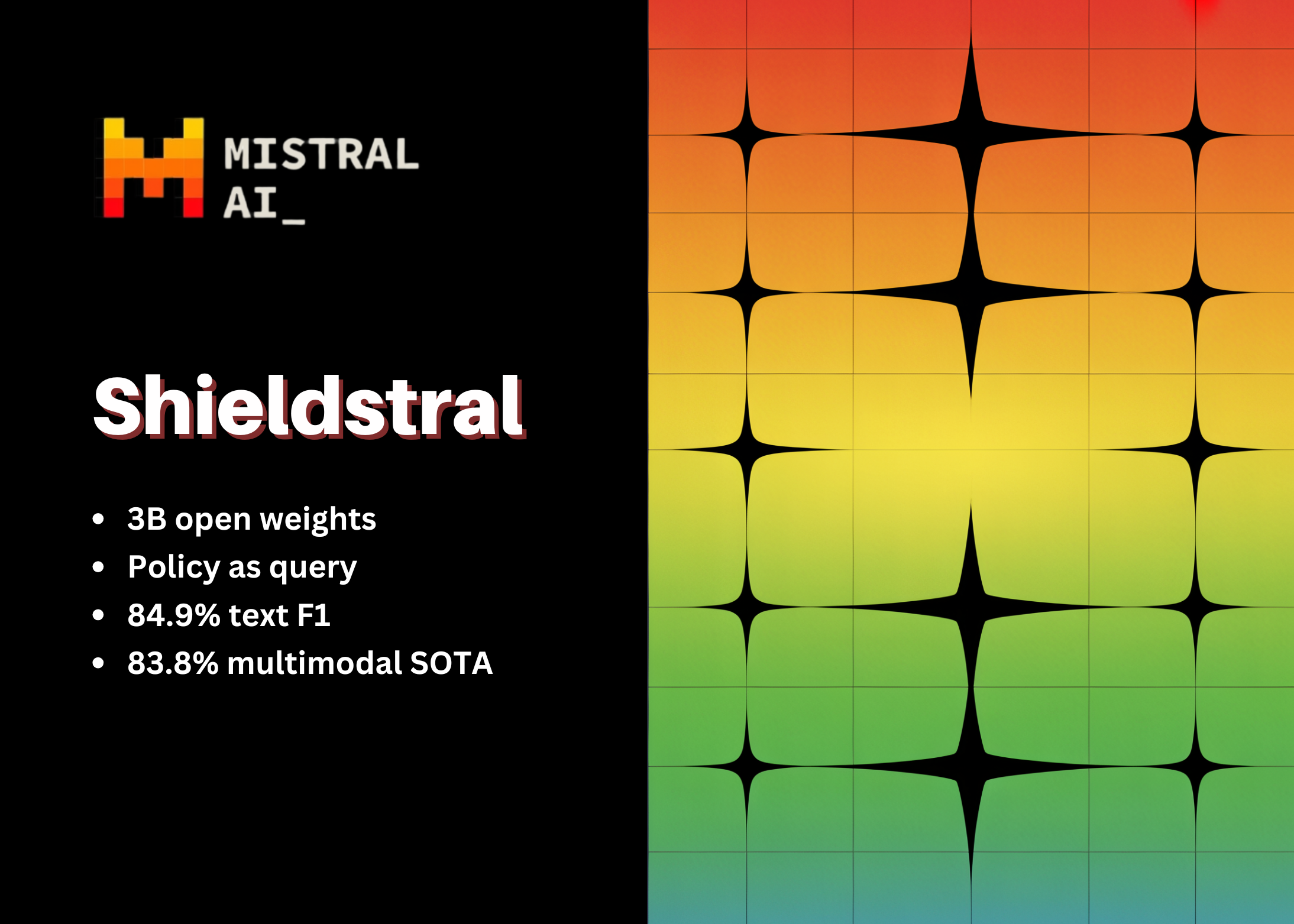
Shieldstral changes the approach. Instead of a fixed taxonomy, you write a single yes/no question — for example, “Does this content contain any attack on someone’s race or religion?” — and the model returns a safety score in a single pass. According to the release announcement, the policy lives entirely in the prompt, which means you can change your rules for a new context without retraining. It is built on Mistral’s Ministral-3B base model with a vision encoder, so it handles text and images together.
This matters for practical reasons. The model reports an 84.9% average F1 score on text safety, matching GPT-OSS-Safeguard-20B, a model more than six times its size. On multimodal safety (images plus text), it scores 83.8%, ahead of every baseline Mistral evaluated. The entire thing fits in 16GB of VRAM in BF16, and it is released under Apache 2.0, which allows commercial use with no licensing fee.
“The policy lives entirely in the prompt — which means the same model can enforce a different rule for each customer without retraining.”
How This Applies to Malaysian SMEs
Let’s be concrete. Imagine you run a modest online store on Shopee or your own website, and customers can leave product reviews with photos. Some sellers in Malaysia have faced the problem of competitors posting fake or defamatory reviews. You could use Shieldstral to run every incoming review through a question like “Does this review contain any unsubstantiated accusation against the seller or product?” If the score crosses a threshold, the review gets flagged for your human review instead of being published automatically. You are not relying on a third-party moderation vendor or sending your customer data outside your business. You are keeping the decision in-house.
Another scenario: you are building a simple FAQ chatbot for your business using a large language model. You cannot help but worry about the chatbot producing a reply that touches on sensitive topics involving race or religion — a real concern in Malaysia’s multicultural environment. With Shieldstral, you can add a moderation step after every AI response before it is shown to the customer. The question could be: “Is this response likely to offend a Malaysian based on ethnicity or religious beliefs?” Because the output is a continuous score rather than a hard label, you can route borderline cases to a human agent instead of letting the bot answer on its own. This kind of guardrail is no longer theoretical. The model supports prompt classification, response moderation, and refusal detection in one workflow.
For businesses that manage community groups or customer feedback channels on Telegram or Facebook, the value is even clearer. A small team cannot moderate every post around the clock. Shieldstral can be set up to run locally on a single machine and scan incoming messages at, as the source notes, a single forward pass with one token output — which means it is fast enough for real-time gating. The training data behind it includes 54.1 million samples, including synthetic contrastive text that teaches the model to distinguish between closely related policy violations. That is the kind of nuance you need when “criticism” and “harassment” look similar at first glance.
There is also a specific win for multi-tenant SaaS vendors. If you operate a platform where multiple business clients use your system, each client can have their own moderation policy — one question for a healthcare provider, another for a gaming community — with the same checkpoint in your backend. That is a direct answer to the old “one-size-fits-all” problem. And for Malaysian businesses that deal with sensitive customer data, self-hosting means your content never leaves your own infrastructure, which supports data residency concerns.
| Metric | Shieldstral 1.0 3B | Comparison |
|---|---|---|
| Text safety average F1 | 84.9% | Ties GPT-OSS-Safeguard-20B (84.9%) |
| Multimodal safety F1 | 83.8% | Higher than OmniGuard-7B (77.6%) |
| Adaptability benchmark F1 | 91.3% | Behind GPT-OSS-Safeguard-20B (94.1%) |
| GPU memory requirement | 16GB VRAM in BF16 | Runs on a single GPU |
| License | Apache 2.0 | Free for commercial and non-commercial use |
Data sourced from the Mistral AI release coverage.
Practical Takeaways
If you want to check whether this is useful for your business, start with these steps:
- Pick one surface first. Choose a single place where content enters your business — customer reviews, chat replies, or image uploads — and start there rather than trying to moderate everything at once.
- Write your policy as one yes/no question. Be specific about your community or industry. For example: “Does this comment personally attack a customer or staff member?” is more actionable than “Is this toxic?”
- Use the continuous score. Do not hard-block everything. Set a threshold for automatic approval, a second threshold for automatic rejection, and a middle range where you manually check borderline content.
- Keep human reviewers in the loop. The model flags; a human decides. This is especially important for nuanced Malaysian cultural contexts where subtle references may not be caught by AI.
- Test on past content. If you have a month of old comments or messages, run them through the model with your chosen question. See where it disagrees with your judgment and adjust your question wording or threshold.
The Bigger Picture
The long-term trend here is that AI safety capabilities are moving from enterprise-only infrastructure to something a small business can actually run. When a 3-billion-parameter model can match the performance of a 20-billion-parameter model, it means smaller companies no longer need to choose between protecting their brand and staying on budget. The best part is the policy adaptability. As Malaysian regulations evolve and your business grows into new markets, you do not need a new moderation project every time. You just write a new question.
Shieldstral is not perfect. The source notes weaknesses in low-resource languages, obfuscated inputs, and very long documents. You should not expect it to catch every cleverly disguised attack. But the practical takeaway for a Malaysian SME is straightforward: the barrier to entry has collapsed. You can run this on one machine, use it to triage incoming content, and protect your reputation without building a department around it.
If you have been avoiding an AI customer chatbot because you fear what it might say, or if you have been moderating comments manually because “there is no tool for us,” the situation has changed. The tools are here. They are open, they run locally, and they let you define what safe means for your customers. The only question left is whether you are ready to write yours.
Ready to Streamline Your Operations?
Your business should run itself. AutoRunBiz deploys AI agents to automate your daily operations — WhatsApp orders, invoicing, customer follow-ups, and accounting. Book a free 15-min ops audit to see where automation fits your business →