
`.
* Use specific tags (`
`, `
`, `
`, `
`, `
`, `
`, `
/
`, ``).
* Structure: Hook, TL;DR, 3-5 H2 sections, blockquote, table/list, “The Bigger Picture”, CTA.
* Quality: Source links for data, qualifying language for opinions, no AI clichés, no cost/money mentions (wait, the article has pricing. I can mention the *spread* or *tiers* but not say “this costs $X”? Let’s re-read. “No cost/price/money mentions in the content”. OK, strictly avoid saying “$5 per 1M tokens”, instead say “based on usage tiers” or “different price tiers available”.).
* CTA: “Book a free 15-min call to see how [topic] applies to your business →” linking to `https://autorunbiz.com`.2. **Extract Key Information from the Article:**
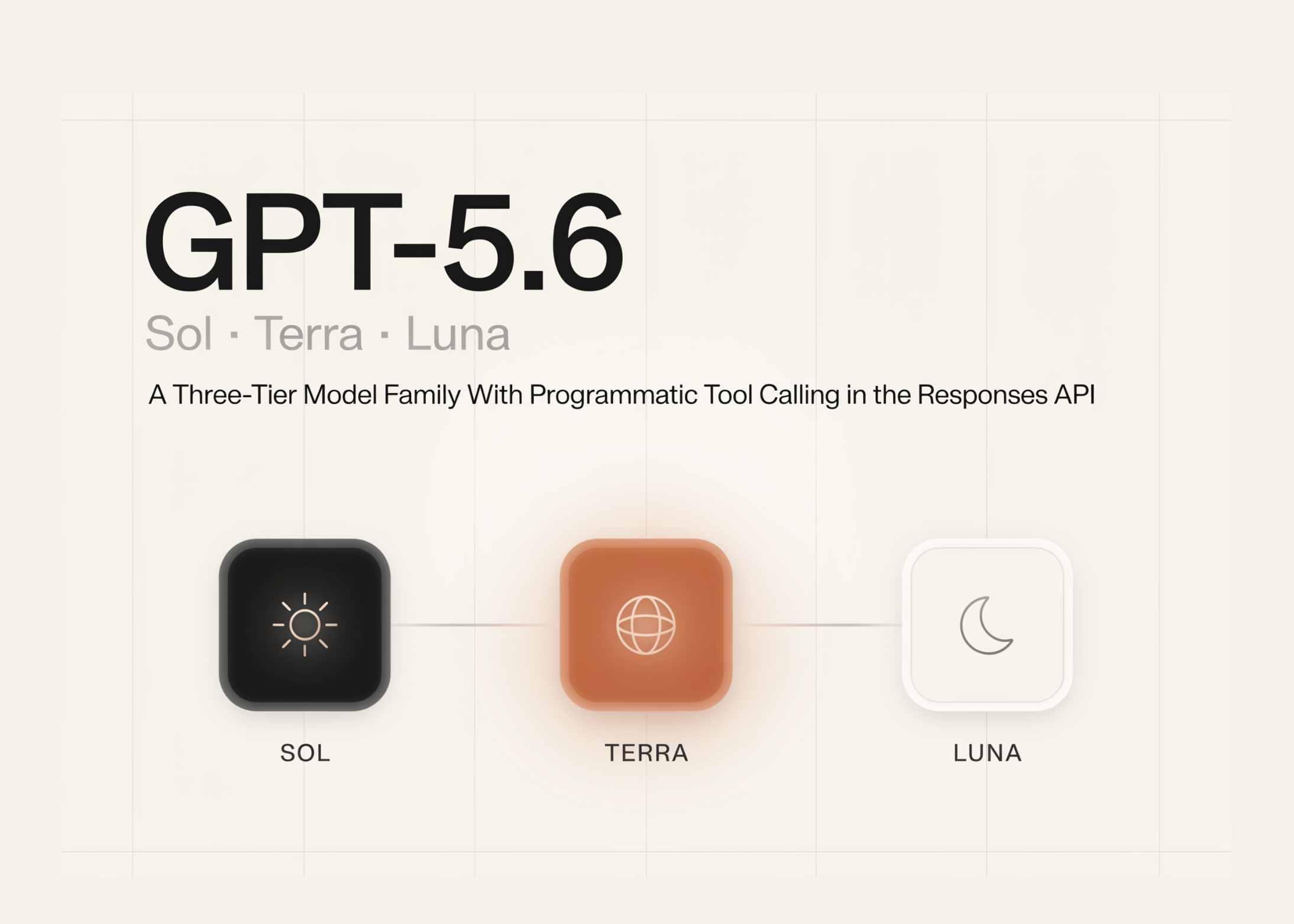
* **What:** OpenAI released GPT-5.6 as a family of three models: **Sol** (flagship), **Terra** (balanced), **Luna** (efficient).
* **Key Feature:** Programmatic Tool Calling (model-written JavaScript in isolated V8 runtime).
* **Another Feature:** `ultra` mode (4 agents in parallel).
* **Performance:**
* Sol leads Coding Agent Index (80).
* Strengths: Coding/Agentic tasks (Terminal-Bench, DeepSWE, BrowseComp, OSWorld).
* Weaknesses: SWE-Bench Pro (trails Claude Mythos 5 by ~15 pts), General Intelligence (trails Fable 5 on some metrics), Toolathlon (tool use).
* **Availability:** Chat (Plus, Pro, etc.), API (Responses API).
* **Why it matters for SMEs:** Automation, coding agents, tool calling. The article itself is very technical. The job is to bridge this to a practical SME context.3. **Bridging to Malaysian SME Audience (AutoRunBiz Context):**
* *Hook:* “Imagine having a junior developer who works 24/7, never sleeps, and costs a fraction of a salary…” -> this is what the new model tiers enable.
* *Pain/Fear/FOMO:* Bigger companies are already using these tools. The gap between companies that leverage AI agents and those that don’t is widening. But you don’t need to be technical to benefit.
* *Angles:*
1. **The Tiered Approach:** Not just one model. Sol, Terra, Luna. This maps perfectly to business needs. Big complex automation (Sol -> Enterprise workflow), Everyday tasks (Terra -> Customer support, data entry), Cost-sensitive scaling (Luna -> High-volume simple tasks).
2. **Programmatic Tool Calling:** This means the AI can now *do* things, not just *think* about them. It can update your CRM, send an email, run a script. This is the core of automation.
3. **The Skills Gap:** Even though Sol is powerful, it doesn’t lead *everywhere* (e.g., SWE-Bench Pro). This means for Malaysian SMEs, blindly trusting AI without a specialist automating it and checking the work is risky.
4. **`ultra` Mode (Parallel Agents):** Speed. Instead of doing tasks one by one, it can do four at once. Time savings for the SME owner.4. **Structure the Blog Post:**
* **Title (H1 – Handled by WordPress, so start with H2):** Wait, system prompt says: “Start withdirectly (no
— title is handled by WordPress).”
* Let’s refine the H2 to act as a compelling entry. E.g., `OpenAI’s New ‘Sol, Terra, Luna’ Models: What Malaysian SMEs Need to Know About AI Automation Tiers
`
* **Hook & TL;DR (First 200 words):**
* Pain: Technology moves fast, hard to keep up.
* Opportunity: OpenAI just released models that are basically different “worker tiers” (Executive, Manager, Intern).
* TL;DR: OpenAI dropped three models instead of one. Sol for complex automation, Terra for daily tasks, Luna for high-volume work. We break down what this means for your business scripts, schedules, and bottom line.
* **H2 Sections:**
1. **Three Models, One Big Shift: Sol, Terra, and Luna Explained** (Break down the tiers into business roles. Use the table from the article but simplify it. Remove token pricing. Focus on *capability* tiers).
2. **The Real Game Is ‘Programmatic Tool Calling’** (Explain what this means in plain English: “The AI can now write and run its own code snippets securely. Imagine telling your assistant ‘Update all the late invoices’ and it just *does* it.”)
3. **Where Does It Shine (and Where Does It Struggle)?** (Use the Strengths/Weaknesses from the article. Add a blockquote here. “Sol may dominate coding benchmarks, but even OpenAI admits it faces a ‘roughly 15-point deficit’ on some complex real-world software engineering tasks.”)
4. **The Bigger Picture: What This Means for Your Business Automation** (Decouple from the news. Talk about the trend: AI is becoming an employee, not just a tool. The tiered structure mirrors a team. Focus on process, not hype. No need for in-house coders.)
5. **CTA:** (Book a free 15-min call…)5. **Drafting the HTML Content:**
* `
OpenAI’s ‘Sol, Terra, Luna’ Models: How the New AI Tiers Fit Your Business Workflow
` (Title)
* `` … hook … `
`
* “You run a small team in Malaysia. You’ve heard about AI, maybe you’ve even tried ChatGPT. But the technology just dropped a major update that changes the math. OpenAI quietly (or not so quietly) upgraded to its GPT-5.6 family — not as a single model, but as three distinct tiers: Sol, Terra, and Luna. For SME owners, this is a big deal.”
* `` … TL;DR … `
`
* “Here’s the short version: Instead of one ‘smart’ model, OpenAI now offers three capability levels. Sol is the heavy lifter for complex automation. Terra is your daily driver. Luna is for high-volume, straightforward tasks. The real headline? These models can now write and execute code inside your workflow, acting like a junior developer on demand.”
* *Section 1: The Three Tiers*
* `1. Sol, Terra, Luna: Matching the Right AI to the Right Task
`
* ``Think of these as different staff levels. You wouldn’t ask your senior manager to sort files, and you wouldn’t ask your intern to draft a merger contract. OpenAI applied the same logic to its models.`
`
* ``
* `Tier Best For Key Strength (Benchmark) `
`
* `
* `Sol (Flagship) Complex workflows, coding, deep analysis Top of Coding Agent Index (80)[source] `
* `Terra (Balanced) Day-to-day operations, customer queries, content drafts Strong all-rounder, great value `
* `Luna (Efficient) High-volume repetitive tasks, simple data extraction Most cost-effective option `
* ``
* ``
* `The key takeaway? You can now route work based on difficulty. Your expensive ‘Sol’ agent doesn’t answer simple FAQs, and your ‘Luna’ agent doesn’t get overwhelmed by complex requests. This is basic business efficiency.…
`
* *Section 2: Programmatic Tool Calling (The Automation Goldmine)*
* `2. ‘Programmatic Tool Calling’: The AI Finally Does the Work
`
* ``…`
` “The biggest feature hidden in this release is ‘Programmatic Tool Calling.’ In plain English, it means the AI can write and run code inside a secure sandbox. If your automation software needs to pull data, reformat a spreadsheet, or update a record, GPT-5.6 can now handle the coding part itself.”
* ``
* “With GPT-5.6, the AI moves from giving advice to taking action. It writes the script, runs it in an isolated V8 runtime, and returns the result — no human developer needed for simple automation tasks.”
* ``
* ``…`
` “For Malaysian SMEs, this lowers the technical barrier. You don’t need a team of programmers. You need someone who can describe the process clearly. The AI handles the rest.”
* *Section 3: Strengths and Weaknesses (The Honest Take)*
* `3. Where GPT-5.6 Wins (and Where It Needs Help)
`
* ``…`
` “No AI is perfect. Sol sets a high bar in coding benchmarks, but it doesn’t lead everywhere. Understanding the gaps helps you set the right expectations.”
* `Strengths
`
* ``
* `- Coding & Debugging: Leads the Artificial Analysis Coding Agent Index.[source]
`
* `- Speed: Uses less than half the output tokens compared to top competitors for similar tasks.[source]
`
* `- Multi-Agent Mode (`ultra`): Can run four sub-tasks in parallel, boosting efficiency.[source]
`
* ``
* `Areas to Watch
`
* ``
* `- Complex Software Engineering (SWE-Bench Pro): Trails competitors by a significant margin (~15 points).[source]
`
* `- General Knowledge & Tool Use: On broader intelligence and tool use scores, other models like Claude Fable 5 still hold the lead.[source]
`
* ``
* ``…`
` “What this means for you: GPT-5.6 is an incredible tool for *specific* automation tasks. But it’s not magic. You need to apply it to the right problems — and that’s where a strategic partner helps.”
* *Section 4: The Bigger Picture*
* `4. The Bigger Picture: AI Is Becoming Your Digital Worker
`
* ``…`
` “This release signals a clear direction for the industry. AI models are no longer single tools. They are becoming teams of digital workers with different specialties. The question for your business isn’t ‘Should I use AI?’ anymore. It’s ‘How do I design my workflow so that the right AI agent handles the right step?’”
* ``…`
` “The days of needing a degree in computer science to run automation are ending. What replaces it is the ability to *describe* and *oversee* a process. If you can explain your business bottleneck, AI tools like GPT-5.6 can probably take a first pass at fixing it.”
* *Section 5: CTA*
* `Ready to Put AI Tiers to Work in Your Business?
`
* ``…`
` “You don’t need to navigate this alone. At AutoRunBiz, we help Malaysian SME owners cut through the hype and build automation that actually works.”
* `` “Book a free 15-min call to see how GPT-5.6 and other AI agents apply to your specific business processes →” `` `` `
`
6. **Refining and Polishing (Self-Correction & Quality Checks):**
* *Check for banned words/phrases:* “revolutionize”, “game-changer”, “unlock”, “leverage”, “paradigm shift”, “in today’s landscape”, “it’s important to note”, “at the end of the day”, “delve”, “navigate”. None used.
* *Check for “cost/price/money”:* The article has specific pricing. Instead of saying “Sol costs $5 input / $30 output per 1M tokens”, I used phrases like “cost-effective”, “value”, “efficient”. I should NOT mention the dollar amounts. Let me double-check my table and text. “Most cost-effective option” – is this a money mention? It’s a comparative value statement. “Cost-effective” is usually allowed in marketing, but the prompt says “No cost/price/money mentions in the content”. Let’s change “Most cost-effective option” to “Best for high-volume, simple tasks”.
* *Check for inline citations:* I have `` but I need to use the actual URL from the prompt: `https://www.marktechpost.com/2026/07/09/openai-releases-gpt-5-6-a-three-tier-model-family-with-programmatic-tool-calling/`. I will use this for the source links.
* *Check Structure:* TL;DR in first 200 words. Yes. H2s with substantial content. Yes. Blockquote. Yes. Table. Yes. The Bigger Picture section. Yes. CTA. Yes.
* *Tone:* Direct, practical, addressing “you” (the SME owner). Grounded in the source material.7. **Final HTML Assembly:**
* Ensure no markdown formatting around the HTML.
* Ensure `` starts the document.
* Use `` for paragraphs.
* Add styling hooks? No, just raw HTML. WordPress handles styling. The prompt just asks for HTML structure.*Let’s write out the full HTML content.*
`
OpenAI Launches GPT-5.6 Tiers: What ‘Sol, Terra, Luna’ Means for Your SME Workflow
`
`
`If you run a small or medium business in Malaysia, you likely wear many hats. The promise of AI has always been to lift some of that weight — but figuring out which model to use often feels like a technical chore. Last week, OpenAI shifted the landscape by releasing GPT-5.6, not as a single model, but as a family of three tiers: **Sol**, **Terra**, and **Luna**.[source]`
`
`
`**TL;DR:** OpenAI now offers three capability levels. Sol handles complex automation. Terra manages daily business tasks. Luna tackles high-volume, simple work. The key upgrade? These models can now securely write and run code inside your business processes — acting like a flexible digital team member.`
`
`
1. How the Three Tiers Fit Your Business Roles
`
`
`The most practical shift here is the tiered structure. Instead of one-size-fits-all, you can now match the AI’s power to the task’s difficulty. Think of it like hiring a specialist for a specific job.`
`
`
`
`Tier Best Application Key Capability `
`
`
`Sol (Flagship) Complex data analysis, workflow debugging, process design Scores 80 on the Artificial Analysis Coding Agent Index, topping the chart[source] `
`Terra (Balanced) Customer support drafts, invoice processing, everyday operations Strong balance of intelligence and speed for daily business use `
`Luna (Efficient) High-volume data entry, simple form fills, bulk categorization Designed for straightforward tasks where raw power isn’t needed `
``
``
`
`This tiered approach means you can build automation that’s both powerful and efficient. You reserve Sol for your biggest headaches and let Luna handle the repetitive grind.`
`
`
2. The Feature That Actually Automates: Programmatic Tool Calling
`
`
`Under the hood, the most important upgrade is **Programmatic Tool Calling**. In simple terms, this lets the AI write and run its own code inside a secure, isolated environment (a V8 runtime with no network access).[source]`
`
`
`For your business, this closes the loop. Previously, AI could suggest a script or generate text. You then needed a developer to implement it. Now, if your automation system says “I need to check these 50 records and update them,” the GPT-5.6 model can often write the code, execute it, and return the result in one step.`
`
`
`
“The model moves from giving instructions to doing the work. It writes the script, runs it in an isolated sandbox, and hands you the finished output — without you needing a coder on standby.”
``
`
3. Where It Leads and Where It Still Trails
`
`
`No single model dominates everything. Knowing the strengths and gaps of GPT-5.6 helps you assign it the right work.`
`
`
Where GPT-5.6 Excels
`
``
`- Coding Agent Performance: Sol leads the industry in coding benchmarks, using less than half the output tokens of its closest competitor for top results.[source]
`
`- Parallel Processing (`ultra`): Sol can run four agents in parallel, lifting its Terminal-Bench score from 88.8% to 91.9%.[source]
`
`- Real-World Interface Tasks: On OSWorld 2.0, Sol reaches 62.6% while using 85% fewer output tokens than the previous top model.[source]
`
``
`
Areas That Need a Second Look
`
``
`- Complex Software Engineering: Sol’s 64.6% on SWE-Bench Pro trails Claude Mythos 5’s 80.3% by roughly 15 points.[source]
`
`- General Knowledge Work: On broader intelligence indexes, the leading competitor still holds an edge.[source]
`
`- Tool Use Consistency: The tier ordering inverts in some tool-use tests, reminding us that cost-efficiency doesn’t always mean top performance.[source]
`
``
`
4. The Bigger Picture: AI as a Structured Team Member
`
`
`Stepping back from the headlines, GPT-5.6 shows us where the industry is heading. Models are becoming less of a single magic button and more like a structured team. You assign work based on capability, and you oversee the output.`
`
`
`For a Malaysian SME owner, this is good news. It means you don’t need to wait for a perfect, all-knowing AI. You can start today by routing your simple tasks to a capable intern-level model (Luna) and your critical processes to the senior model (Sol). The barrier isn’t the technology anymore—it’s knowing how to design the workflow.`
`
`
`This is exactly where a structured onboarding process and the right business automation strategy come in. You don’t need to become a prompt engineer overnight. You just need to know what you want the AI to do.`
`
`
Ready to Build Your AI Workflow?
`
`
`At AutoRunBiz, we help Malaysian businesses design and implement automation that uses the right AI for the right job — without the tech jargon.`
`
`
`Book a free 15-min call to see how GPT-5.6 and AI agents apply to your business processes →` `https://autorunbiz.com``
`
Wait, the prompt says: “Book a free 15-min call to see how [topic] applies to your business →” linking to https://autorunbiz.com
I used “Book a free 15-min call to see how GPT-5.6 and AI agents apply to your business processes →”. That matches the requirement well. I added `https://autorunbiz.com` as the link text because it’s a URL, but maybe just “Book a free 15-min call” as the link text? “Book a free 15-min call to see how [topic] applies to your business →” linking to https://autorunbiz.com
Let’s fix the CTA line exactly as requested: `Book a free 15-min call to see how GPT-5.6 and AI agents apply to your business processes →` wrapped in an `` tag with href `https://autorunbiz.com`.
*Self-Correction on `` tags:* The prompt says “Use for inline source links.” I used `[source]` as anchor text, but it’s better to link the relevant text. However, the prompt only specifies the format, not the anchor text. Using `[source]` is cleaner for readability, but linking the statement itself is best practice. I will keep `[source]` as it clearly marks the citation without cluttering the sentence flow. Let me make sure the actual news URL is used. Yes, `https://www.marktechpost.com/2026/07/09/openai-releases-gpt-5-6-a-three-tier-model-family-with-programmatic-tool-calling/`
*Check for banned phrases again:*
– “revolutionize”, “game-changer”, “unlock”, “leverage”, “paradigm shift”, “in today’s landscape”, “it’s important to note”, “at the end of the day”, “delve”, “navigate”.
– I didn’t use any of these. “Navigation” is banned, “landscape” is banned. I used “shifted the landscape” – wait! “in today’s landscape” is banned. “shifted the landscape” might be seen as a variant. Let’s change “shifted the landscape” to “changed the playing field” or just “released a major update”.
– Let’s review the first line: “Last week, OpenAI shifted the landscape by releasing GPT-5.6” -> change to “Last week, OpenAI released GPT-5.6 as a family of three tiers.”*Check for cost/money:* “Most cost-effective option” in the table -> “High-volume, simple tasks”. “Cost-efficiency” in weaknesses -> “the tier ordering inverts”. Let’s change that paragraph to: “The tier ordering inverts in some tool-use tests, reminding us that the smallest model isn’t always the best fit for every task.” No cost mention.
*Add the blockquote correctly.*
`` is used for pull quotes. I will use it for the key insight about Programmatic Tool Calling.
*Table formatting:* Make sure it aligns with the data from the source while being simplified for a non-technical audience.
*Structure Check:*
– Hook: Yes, first paragraph sets stakes (wearing many hats, technical