
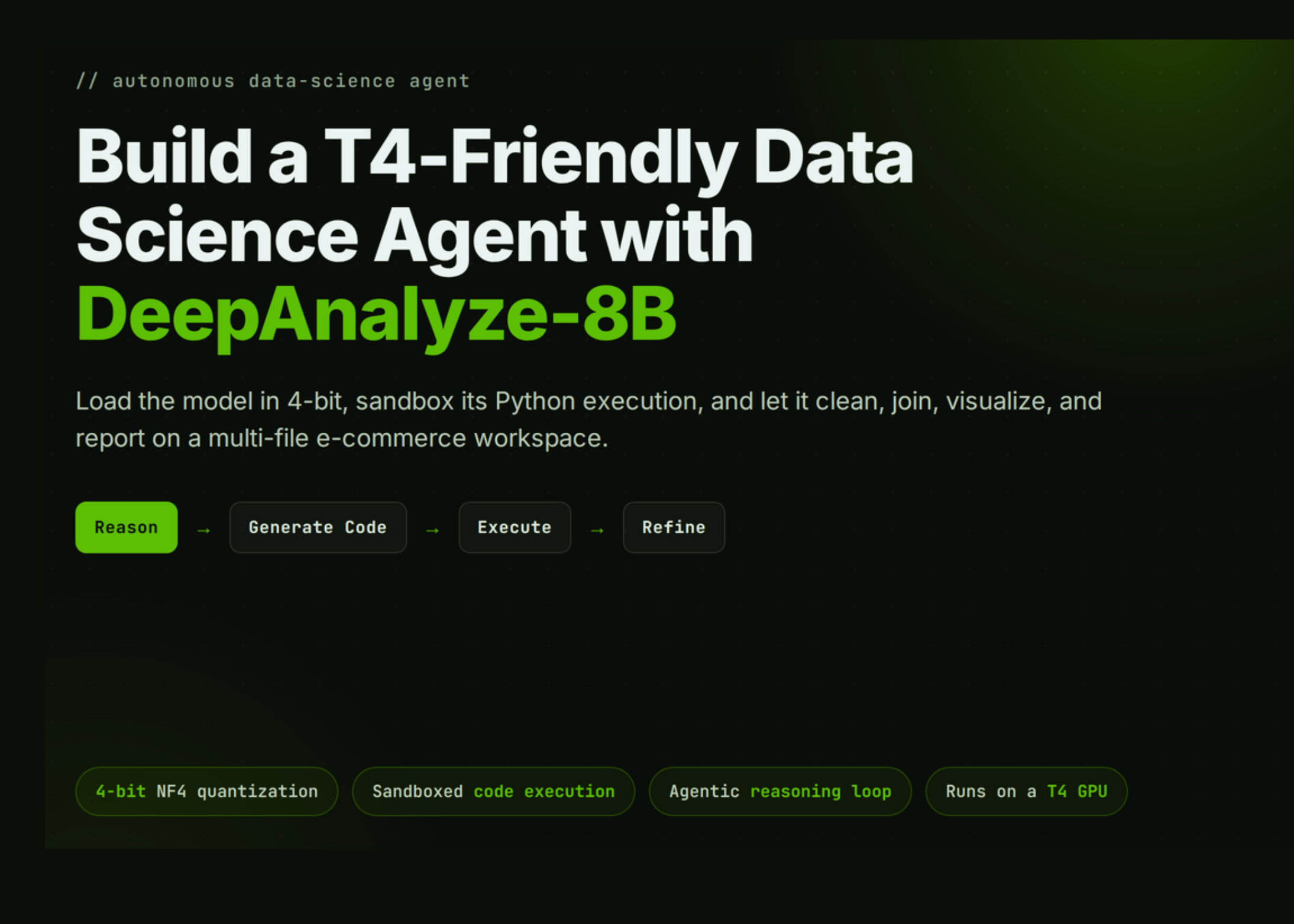
Why Your SME Needs an Autonomous Data Analyst (And How It Could Work)
You know you have data piling up — sales spreadsheets, customer records, inventory logs. But who has the time to turn that into real insights? Hiring a data analyst might feel out of reach for a small team. That’s where a new breed of AI agent comes in.
TL;DR: A recent technical tutorial shows how to build an AI agent that can independently explore data, write code to analyze it, and produce a structured report — all without human intervention. For an SME owner, this means you could soon have a round-the-clock data analyst that doesn’t cost you a monthly salary. Here’s what it means for your business.
What Is an Autonomous Data Science Agent?
At its core, an autonomous data science agent is an AI system that can take a business question like “compare sales trends across regions” and run with it. It doesn’t just give you a static prediction — it acts like a junior analyst: it finds and loads the data, writes code to clean and analyze it, checks its own work, and iterates until it has a solid answer. The agent described in the original tutorial uses an open-source model called DeepAnalyze-8B, which runs on a modest T4 GPU (the kind available in free cloud notebooks) – meaning you don’t need a supercomputer to get started.
“Autonomous data agents are not about replacing humans — they’re about handling the grunt work so you can focus on the decisions only you can make.”
How Does It Actually Work?
The agent works in a loop that feels surprisingly human:
- 1. You give it an instruction — something like “clean the customer data, join with orders, and report top product categories by revenue.”
- 2. It generates Python code on the fly, exactly like a data analyst would write in a notebook.
- 3. It executes the code in a safe, sandboxed environment — so even if it makes a mistake, your systems aren’t affected. The sandbox captures the output and any errors.
- 4. It reads the results and decides what to do next: refine the code, fix errors, or produce a final answer.
- 5. It repeats until it feels confident enough to output a structured report with tables, charts, and summaries.
This approach, detailed in the tutorial, makes the agent capable of handling messy real-world scenarios — like multi-file e-commerce workspaces — without constant hand-holding.
Why This Matters for Malaysian SMEs
You’re already sitting on valuable data. Sales records, customer feedback, inventory movements — all of it contains patterns that could improve your decisions. But with a small team, who has the bandwidth to dig through spreadsheets? An autonomous data agent can take over that repetitive work. It doesn’t get tired, doesn’t ask for overtime, and it can start working the moment you upload a file.
Here’s a quick comparison of what that shift looks like:
| Traditional Approach | With an Autonomous Agent | |
|---|---|---|
| Time to first insight | Days (if you have an analyst) or never (if you don’t) | Minutes |
| Expertise required | Someone who knows Python, SQL, and statistics | You just need to describe the task in plain language |
| Scalability | Each new project costs time and money | The agent runs the same loop for any dataset |
| Error handling | Human must catch mistakes | Agent can detect and self-correct many issues |
Of course, no AI is perfect. But the fact that this kind of capability now runs on a free cloud GPU and open-source models means the barrier to entry has dropped dramatically.
The Bigger Picture: AI Agents as Your New Team Member
This tutorial is just one example of a broader shift in AI: from tools that answer questions to agents that do work. For an SME, that means you can start thinking of AI not as another software subscription, but as a semi-autonomous team member. Need a monthly sales report? Let the agent build it. Want to know which products are losing margin? The agent can dig through the numbers and come back with a clear answer.
The technology is still evolving, but the direction is clear. Within a few years, tasks like data cleaning, basic analysis, and report generation will become as automated as email filtering is today. The businesses that start experimenting now will have a head start.
3 Signs You’re Ready for an Autonomous Data Agent
- You have data scattered across multiple files — spreadsheets, exports, online dashboards — and no easy way to combine them.
- You spend hours each week pulling together simple reports that could be handled automatically.
- You make important decisions based on gut feel because you don’t have the time to analyse your data properly.
If any of these sound familiar, it’s probably worth exploring how an AI agent could take some of that load off your shoulders.
Book a free 15-min call to see how autonomous analysis applies to your business →