
A powerful new AI model is making enterprise automation more accessible
If you run a Malaysian SME, the most important part of the latest AI release is not the impressive parameter count. It is the possibility of handling large amounts of business information, images, videos, code and documents with one model instead of stitching together several separate tools.
Z.ai has released GLM-5.3-Flash, a multimodal mixture-of-experts model designed for coding, document analysis, automation and computer-use tasks. It accepts image and video input, supports a context window of up to 1,048,576 tokens, and is released with weights under the MIT licence, according to MarkTechPost’s report.
For you, this could mean better ways to review contracts, investigate long customer-service histories, test websites, analyse spreadsheets and automate repetitive office work. It does not mean handing your entire business to an AI system overnight. The practical opportunity is to identify one workflow where the model can reduce manual checking while keeping a human responsible for important decisions.
What Happened
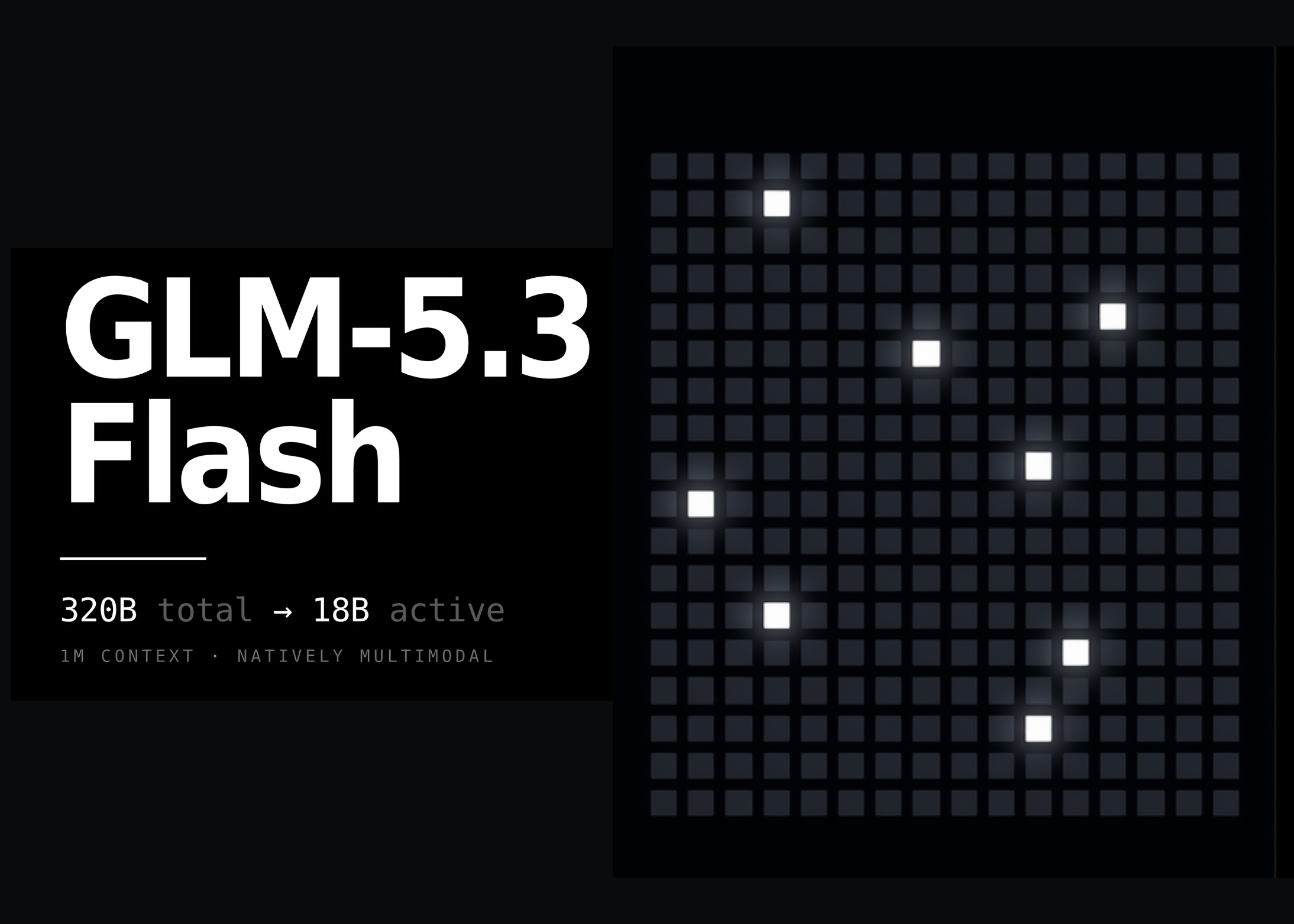
GLM-5.3-Flash is a 320-billion-parameter mixture-of-experts model with approximately 18 billion active parameters per token. Its architecture routes each part of a request through selected expert networks rather than activating the full model every time. The release also includes native image and video understanding, meaning users can provide visual material directly instead of always converting it into text first. These specifications are reported by MarkTechPost.
The model supports a context window of 1,048,576 tokens. In simple terms, it can process a very large collection of related information in one session, such as lengthy contracts, software repositories, logs, policy documents or multiple business reports. Z.ai reports that GLM-5.3-Flash outperformed GLM-5.2 across several internal benchmarks and reached results close to Claude Opus 4.8 on one internal coding benchmark, although comparisons depend on each benchmark’s setup and should not be treated as universal rankings.
Z.ai says the model uses hybrid attention, combining KDA linear-attention layers with NoPE sparse MLA layers. It also uses an approach called IndexPool to reduce retrieval overhead in very long contexts. According to the source report, Z.ai reports roughly three times less attention computation and a 4.4-times smaller key-value cache compared with GLM-5.3. These are vendor-reported architectural results, so you should validate performance with your own documents and tasks.
The model is available through hosted access, while its weights are published on Hugging Face under an MIT licence, as reported by MarkTechPost. However, local deployment is not a small-office project. The default FP8 checkpoint is reported to require roughly 306 GiB of storage for weights before the memory needed for the model’s working context, and the current vLLM route supports NVIDIA Hopper and newer hardware.
Why This Matters for Malaysian SMEs
Many Malaysian SMEs have information spread across WhatsApp exports, email threads, PDFs, spreadsheets, accounting documents, product images, scanned forms and internal software. The challenge is often not a lack of data. It is the time required to find the relevant detail and turn it into an action.
A long-context multimodal model could support a document assistant for a trading company that receives supplier quotations, delivery orders and invoices in different formats. You could ask it to compare product descriptions, flag mismatched quantities, identify missing fields and prepare a review list for your operations team. A person should still approve the final transaction, but the first round of checking could become faster and more consistent.
For an e-commerce business, the model could inspect product screenshots, compare catalogue images against listing requirements and review customer conversations for recurring complaints. For a software or digital agency, it could examine a large codebase, test user-interface screenshots and suggest likely causes of a defect. For a BPO or administrative-services provider, it could classify incoming documents and draft responses in English, Bahasa Malaysia or other languages used by your customers.
These use cases are especially relevant when your team is small and the same employees handle sales, operations, customer service and administration. The value is not simply generating text. It is reducing the number of times your staff must open different files, copy information between systems and repeat the same visual or clerical checks.
| Potential SME use | What GLM-5.3-Flash may help with | Human control required |
|---|---|---|
| Invoice and document review | Extract fields, compare documents and identify anomalies | Approve exceptions and financial records |
| Website and app testing | Review screenshots, trace code and suggest defects | Confirm fixes before deployment |
| Customer support | Summarise long histories and draft replies | Handle sensitive or escalated cases |
| Business reporting | Analyse spreadsheets, dashboards and written reports | Validate figures and business conclusions |
What You Should Test First
Start with a workflow that is repetitive, easy to measure and low risk. Do not begin with payroll decisions, credit approvals, legal conclusions or fully autonomous customer promises. Choose a task such as sorting incoming enquiries, summarising service tickets or checking whether a document contains required fields.
Create a small test set using real but properly protected business examples. Remove unnecessary personal information, identity numbers, bank details and confidential commercial terms. Then compare the model with your current process using measures such as review time, missed fields, incorrect classifications and the number of cases requiring staff correction.
The right question is not “Can this model do everything?” It is “Which repeatable part of our workflow can it perform reliably, with a clear approval step?”
You should also test how the system handles Malaysian business context. Give it documents containing local date formats, Bahasa Malaysia terms, product codes, tax-related wording, abbreviations and mixed-language messages. A model that performs well on general benchmarks may still misunderstand your company’s naming conventions or industry vocabulary.
The Bigger Picture
GLM-5.3-Flash shows that AI competition is moving beyond chatbot answers. Models are increasingly being built to work across text, images, video, code, browsers and business systems. The one-million-token context window is particularly important because business work is rarely contained in a single short prompt. A real task may involve a repository, a policy manual, screenshots, customer records and a spreadsheet.
The release also highlights a growing choice between hosted AI access and self-hosting. For most Malaysian SMEs, operating a model of this scale on their own servers is impractical because of hardware, maintenance, security and engineering requirements. A hosted API is the more realistic starting point, provided you understand where data is processed, how long it is retained, what controls are available and whether your contracts permit external processing.
Open weights can give larger organisations and local technology providers more control, but an MIT licence does not automatically solve every operational issue. You still need suitable infrastructure, model monitoring, access controls, testing and a plan for handling inaccurate outputs. You also need to review the model provider’s documentation and your obligations under applicable Malaysian privacy and sector requirements.
For an SME owner, the sensible response is neither to ignore this release nor to deploy it everywhere. Map your processes, select one contained use case, protect sensitive data and keep a person accountable. If the pilot produces measurable improvements without creating new operational risks, you can connect it gradually to your helpdesk, document system, website testing process or internal knowledge base.
GLM-5.3-Flash is a sign that capable multimodal AI is becoming more flexible and more usable through hosted services. Your competitive advantage will not come from merely having access to the model. It will come from turning that access into a dependable workflow that fits how your Malaysian business actually operates.
Ready to Streamline Your Operations?
Technology moves fast. Your operations should keep up. AutoRunBiz builds AI systems that run your daily workflows — from WhatsApp order capture to accounting. Book a free 15-min ops audit →