
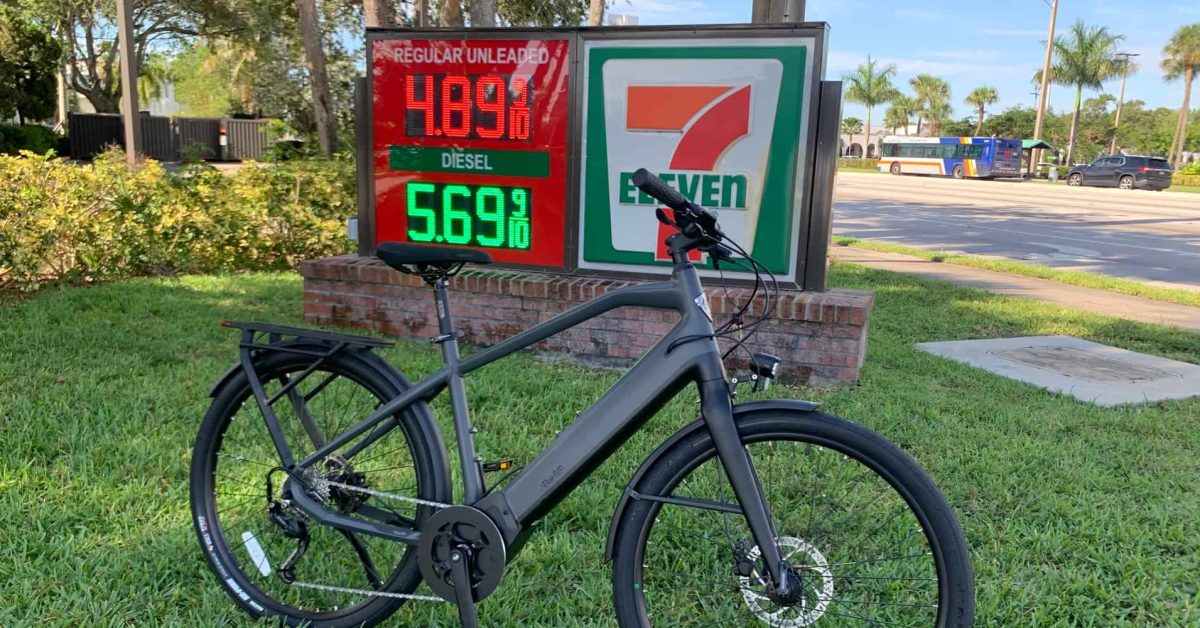
Your vans and motorcycles are burning fuel every day — and the next price bump is already on the way.
If you run a business that depends on wheels — a bakery doing deliveries, a hardware store sending supplies, a service company visiting clients — you’ve felt it. Every trip costs more than it did last year. Global oil supply is being disrupted by tensions around the Strait of Hormuz, and officials have warned that gas prices are expected to rise further (source). Malaysia may subsidise some fuels, but global movements still reach your pump before too long.
Here’s the thing: you don’t need a fleet of electric vans, a corporate sustainability plan, or a complete overhaul of how your business runs. There’s a much simpler tool already used by thousands of delivery riders and couriers across the country: the electric bicycle.
E-bikes are not a gimmick. They are quietly replacing short car and motorcycle trips every day — the exact kind of trips your staff probably make several times a day.
TL;DR: Most daily business trips are short — under 10 km. E-bikes can handle a significant portion of those trips without burning a drop of fuel. You keep your existing vehicles for heavy and long-distance work, and deploy e-bikes for the short trips that drain your fuel. Your business becomes less exposed every time global oil prices jump.
What This Means
An e-bike is a bicycle with a battery and electric motor. You pedal, the motor assists, and you move. No fuel, no engine oil, no clutch. The battery recharges from a regular wall socket in a few hours, giving a range that comfortably covers city riding. Racks, panniers, baskets, and even small trailers can be fitted, making it a genuinely useful cargo tool rather than a toy (source).
The original article makes a crucial point: most of our daily trips are short and single-passenger — running to the store, grabbing supplies, commuting a few kilometres (source). The same is true in business. Most SME trips are errands: drop off an order, collect a part, send documents, meet a client. Each trip carries one person and a small load — a perfect match for an e-bike.
The key mindset shift is this: you are not replacing your vehicle, you are replacing trips. As the article puts it, think of an e-bike as a tool that chips away at your fuel usage one trip at a time (source). That is a far more practical frame than “go fully electric or nothing.”
How This Applies to Malaysian SMEs
Malaysian SMEs are built on short trips. A typical food and beverage business delivers to customers within a 3–5 km radius. A spare parts shop sends runners to suppliers in the same industrial estate. A clinic sends documents to panel labs. A creative agency delivers mockups to clients across town. These trips happen daily, and each one burns fuel. Choose any of them, and you have a candidate for an e-bike.
Congestion is where e-bikes win big. In Petaling Jaya, KL, Georgetown, or Johor Bahru, a van doing a 4 km delivery during peak hours can sit in traffic for 20 minutes. An e-bike filters through gridlock, uses quieter side roads, and parks right at the customer’s door — no circling for parking. For businesses already using motorcycles for delivery, electric two-wheelers offer the same mobility without the fuel dependence, with many models capable of up to 45 km/h, which is plenty for city riding (source).
Weather is the first objection everyone raises, and it’s a fair one. The heat is tiring and the rain is relentless. But the answer is practical: schedule e-bike deliveries for early morning and evening slots, invest in proper rain gear and waterproof bags, and stick to routes with quieter roads or covered walkways. Malaysian delivery riders already work through the rain daily on conventional motorcycles — an e-bike rider in a raincoat faces the same weather, without the fuel usage. Some days the weather will win, and that’s fine. That’s why you keep your existing vehicles. The goal is to replace the easy trips, not every trip.
Charging is refreshingly simple. A standard wall socket charges an e-bike battery in a few hours, so your rider parks it at the shop, plugs in overnight, and starts the next day with enough range for a full shift of urban deliveries. For a business running two or three e-bikes, this is far easier than installing charging infrastructure for electric cars. Maintenance is lighter than a motorcycle too: no engine oil changes, no spark plugs, no air filters. Simpler drivetrain, fewer things to break.
Then there’s the errand-heavy SME. A retail shop that sends staff to the bank, the post office, the supplier, and the hardware store across town might make five to ten such trips a week. These are exactly the short, single-person trips that e-bikes handle well (source). Your van gets freed up for what it does best: carrying large inventory, moving equipment, and covering long distances.
“You don’t need to replace every vehicle in your operation. You only need to replace the trips that make sense — every short errand done on an e-bike is one less trip that burns fuel.”
A Practical Look at Your Trips
| Business trip | Typical distance | E-bike fit? |
|---|---|---|
| Food delivery to nearby customers | 2–5 km | Excellent |
| Documents / small parcels within town | 3–8 km | Excellent |
| Bank, post office, supplier errands | 3–10 km | Good |
| Client site visits | 5–15 km | Good, weather permitting |
| Bulk inventory / equipment moves | 10+ km with heavy cargo | Poor — keep the van |
Practical Takeaways
- Audit your trips for one week. Write down every vehicle trip your business makes. You will likely be surprised how many are under 10 km.
- Start with a single e-bike. Assign it to your most frequent short route, test it for a month, then decide whether to expand.
- Equip it properly. Rear rack, panniers, a sturdy lock, and a high-visibility vest for the rider.
- Plan around the weather. Use e-bikes for morning and late-evening slots; keep a vehicle available for sudden downpours.
- Train your rider. Helmet, proper signalling, and familiarity with safe routes make a real difference.
- Mix and match. A delivery run does not have to be 100% one vehicle. Ride the e-bike through the congested zone, hand over to the car for the long leg — or vice versa.
The Bigger Picture
Fuel price volatility is not a temporary blip. Disruptions around critical shipping routes such as the Strait of Hormuz show how fragile the global fuel supply chain has become (source). For Malaysian SMEs, this means the burden of running petrol-powered vehicles will keep swinging unpredictably. Businesses that reduce their dependence on fuel gain a genuine edge: when prices spike, their daily rhythm barely changes.
There is also a bigger shift underway in urban logistics. Delivery fleets around the world are adopting electric two-wheelers for last-mile runs because they are simply more efficient in dense cities. Malaysian SMEs don’t need to wait for policy changes or incentive schemes to benefit. The technology is mature, the maintenance is straightforward, and the use case already exists in every neighbourhood — one short trip at a time.
You don’t need to become a “green” company. You need to become a resilient one. Cutting fuel dependency, one short trip at a time, is the most direct route there.
Ready to Streamline Your Operations?
Your business should run itself. AutoRunBiz deploys AI agents to automate your daily operations — WhatsApp orders, invoicing, customer follow-ups, and accounting. Book a free 15-min ops audit to see where automation fits your business →