
Why Voice AI Speed Is Becoming a Business Advantage
Voice AI is moving beyond novelty. For a Malaysian SME, it can answer customer calls, qualify enquiries, schedule appointments, check order details and support staff without requiring someone to monitor every conversation. But the difference between a useful voice agent and a frustrating one is rarely the model’s headline intelligence. It is how quickly the system responds after you finish speaking.
A recent benchmark of inference APIs for voice and realtime agents shows why business owners should look beyond a single metric called time to first token, or TTFT. The benchmark explains that TTFT measures when an AI model begins generating text, but a voice assistant still needs to receive enough text for its text-to-speech system to produce a natural spoken phrase. The delay you feel as a caller can therefore be much longer than the published TTFT number. Source: MarkTechPost
For you, this matters because a silent pause during a sales enquiry or customer-service call can make your company appear disorganised, even when the AI eventually gives the correct answer.
What Happened
The benchmark compares latency across the main layers of a voice-agent system: speech-to-text, language-model inference, text-to-speech and speech-to-speech processing. It argues that TTFT is a useful starting point, but not the final measure of conversational quality. A voice system must first recognise that the caller has stopped speaking, transcribe the request, generate an answer and then turn that answer into audio. Source: MarkTechPost
The article introduces time to first sentence, or TTFS, as a more practical voice metric. A text-to-speech model generally cannot speak naturally from a single incomplete word or token. It needs a complete clause or sentence. This means that a provider with an excellent TTFT can still sound slow if its output speed is poor or if its voice pipeline waits too long before sending text to speech. Source: MarkTechPost
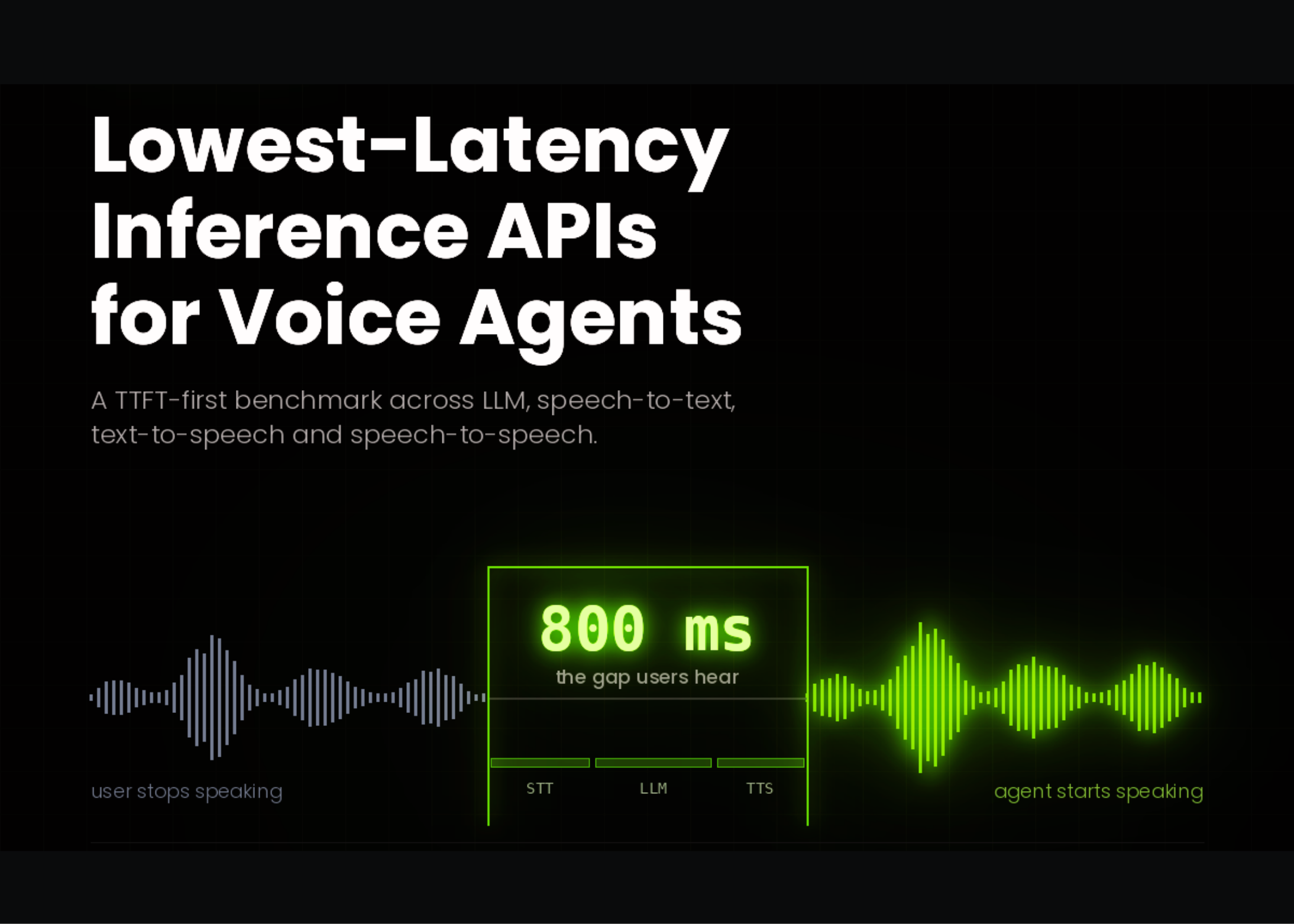
The benchmark cites LiveKit’s practical voice-agent breakdown: speech-to-text may take roughly 100–200 milliseconds, the language model about 300–500 milliseconds with streaming, text-to-speech another 100–200 milliseconds and network transmission around 50–150 milliseconds. Its practical end-to-end target is approximately 700 milliseconds to 1.2 seconds. Source: MarkTechPost
Daily’s research is also cited as a useful human comparison: normal conversational responses often happen at around 500 milliseconds, while pauses beyond 800 milliseconds can begin to feel unnatural. The exact experience depends on the caller, network and conversation, but the lesson is straightforward: a voice agent should acknowledge and respond quickly enough that you do not need to say “hello?” twice. Source: MarkTechPost
Selected benchmark figures
| Provider or model | Reported TTFT | Reported output speed | What it suggests |
|---|---|---|---|
| Baseten gpt-oss-120b high | 0.23 seconds | 266 tokens per second | Fast initial response with solid generation speed |
| DeepInfra Nemotron 3 Ultra | 0.28 seconds | 371 tokens per second | Strong balance for streamed responses |
| Cerebras gpt-oss-120b high | 0.49 seconds | 1,697 tokens per second | Very high output speed after generation starts |
| OpenAI GPT-5.6 Luna | 0.74 seconds | 113 tokens per second | Hosting and routing can affect the same model |
| Inception Mercury 2 | 3.07 seconds | 770 tokens per second | High throughput does not guarantee a quick first response |
All figures and benchmark context: MarkTechPost
Why This Matters for Malaysian SMEs
Consider a Malaysian automotive workshop receiving calls about servicing, tyre availability and appointment slots. A caller may say, “My Perodua is making a noise when I brake, can you check it this Saturday?” The system needs to detect the end of the sentence, understand the vehicle and issue, check the appointment system and respond in a way that sounds immediate. If each stage adds a small delay, the total pause becomes noticeable.
The same issue appears in clinics, tuition centres, property agencies, restaurants, logistics companies and online sellers. A voice agent answering in Bahasa Malaysia, English or a mixture of both must handle local names, addresses, product terms and Malaysian accents. Speed alone does not guarantee accuracy, but a slow response makes every mistake more visible. Testing with real customer phrases is therefore more useful than relying on a provider’s best-case demonstration.
You should also consider where your customers are located and where the AI service is hosted. The benchmark notes that some measurements include network latency from a virtual machine in Google Cloud’s United States central region. This means a published result may not represent the experience of someone calling from Kuala Lumpur, Johor Bahru, Penang or East Malaysia. Source: MarkTechPost
For an SME, the practical test is simple: call the system using the same mobile networks and communication channels your customers use. Test during office hours, evenings and busy periods. Ask short questions, long questions, questions with background noise and questions that require a database lookup. Record the time from the end of your speech to the beginning of a useful spoken answer.
A practical testing checklist
- Measure voice-to-voice delay: Start the clock when you finish speaking and stop when the agent begins a meaningful response.
- Test first sentence speed: Do not judge the system only by when the first hidden token arrives.
- Check turn detection: See whether the agent interrupts you or waits too long after you stop speaking.
- Test local language patterns: Include Bahasa Malaysia, English, Manglish, names and local place names.
- Repeat the same test: Benchmark results can vary between runs, and providers may change infrastructure or model weights without changing the model name. Source: MarkTechPost
- Check escalation: The agent should transfer or create a follow-up task when it cannot answer confidently.
The Bigger Picture
The important shift is that voice AI should be treated as a complete operational workflow, not simply as a chatbot with a microphone. A fast language model cannot compensate for slow speech recognition, poor turn detection, distant servers or a text-to-speech system that waits for lengthy responses.
The benchmark also highlights a throughput trap. Some systems generate tokens extremely quickly but take too long to produce the first chunk. In the cited example, Mercury 2 reports output speed of 770 tokens per second but a TTFT of 3.07 seconds, which is already longer than the complete language-model allowance commonly associated with natural conversation. Source: MarkTechPost
For your business, this means the “fastest AI model” is not automatically the best choice. A smaller model with quick first-sentence delivery may create a better customer experience than a more powerful model that pauses before every answer. You should also design responses to be short and useful. A voice agent that speaks one clear sentence, asks one follow-up question and continues the task will usually feel more responsive than one that delivers a long explanation.
When choosing voice AI, measure the delay your customer hears—not merely the timestamp an API reports.
The best starting point for a Malaysian SME is a narrow workflow: booking appointments, answering frequently asked questions or qualifying leads. Define acceptable response time, test it with real callers and review failed conversations weekly. Track whether callers complete the interaction, ask the agent to repeat itself or request a human immediately.
As voice agents become more capable, latency will remain a practical differentiator. The companies that benefit first will not necessarily be those using the most advanced model. They will be the ones that connect a reliable voice pipeline to accurate business information, local communication habits and a clear handover process. For you, that is the real lesson from the TTFT-first benchmark: responsiveness is a system property, and every millisecond belongs to the customer experience.
Ready to Streamline Your Operations?
Technology moves fast. Your operations should keep up. AutoRunBiz builds AI systems that run your daily workflows — from WhatsApp order capture to accounting. Book a free 15-min ops audit →