
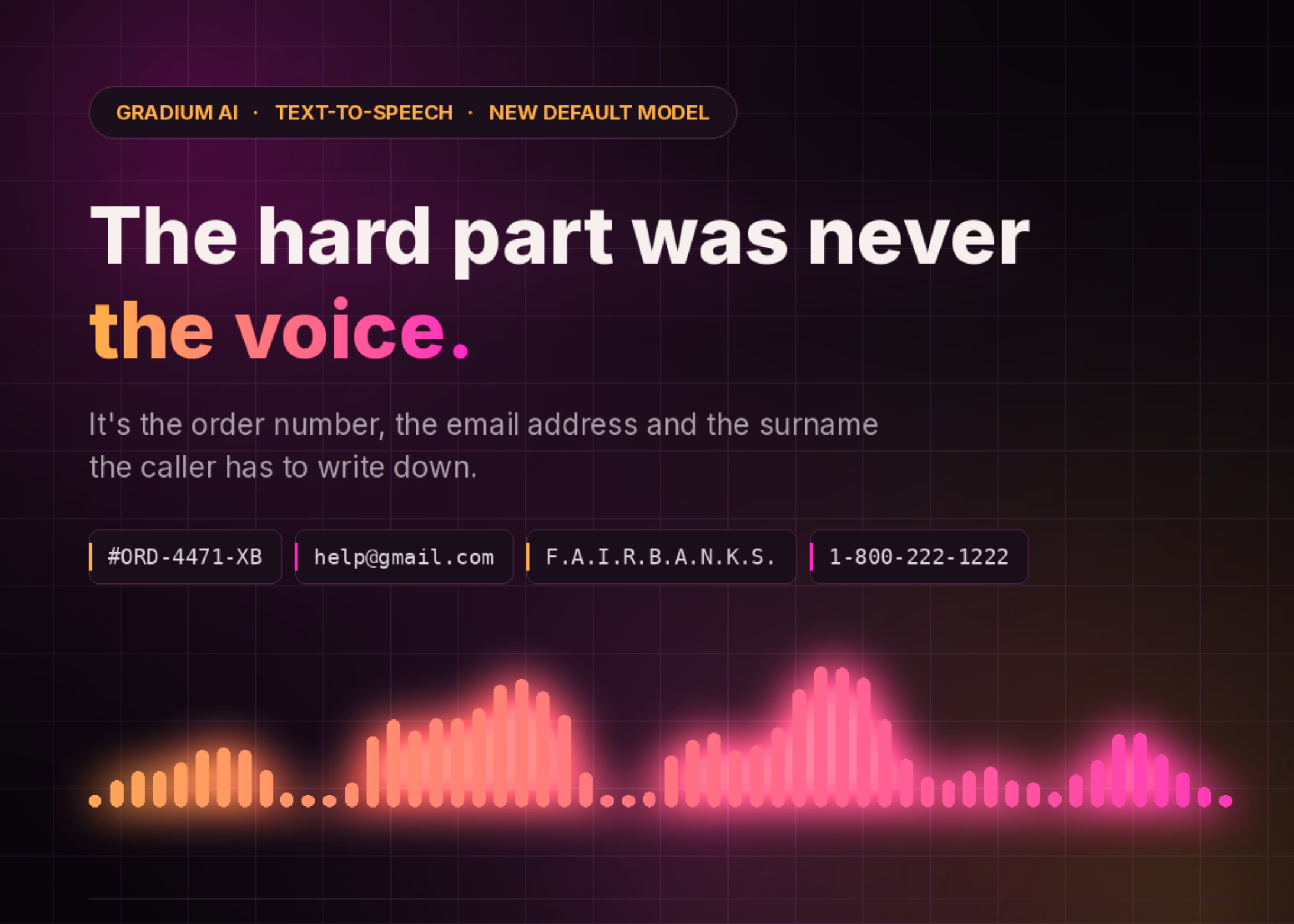
AI Voice Agents Are Getting Better at the Details That Matter
If you run a Malaysian SME, an automated voice assistant may already be on your technology roadmap. It could answer customer calls, confirm delivery details, collect service information or handle appointment requests after office hours. However, these systems are only useful when they correctly understand and communicate practical details such as order numbers, phone numbers, email addresses and reference codes.
A new text-to-speech release from Gradium AI highlights why voice technology is becoming more relevant for smaller businesses. The company says its latest model has an 81.0% human-rated pass rate on a difficult 500-sentence test set and reaches 216 milliseconds for time to first audio at the median on Coval’s benchmark. The model became the default across Gradium’s API and Studio on 31 August 2026, while existing voices and custom voice clones continue working without migration. Source
What Happened
Gradium AI released a new default text-to-speech model designed to handle the difficult information found in real customer conversations. Its evaluation covered spelling, acronyms, alphanumeric tokens, dates, regular numbers, large and floating-point numbers and email addresses. It also included realistic composite scenarios involving orders, IT tickets and insurance claims. The test covered English, German, French, Spanish and Portuguese, with 500 sentences assessed by native-speaking human raters. Source
The scoring method was deliberately strict. A sentence passed only when every required element was pronounced correctly and completely. If one digit was dropped from a phone number or reference code, the sentence failed. Gradium reports an 81.0% pooled pass rate, compared with 75.1% for Cartesia Sonic 3.6, 65.4% for ElevenLabs v3 Conversational, 49.5% for Fish Audio S2.1 Pro and 46.5% for Inworld TTS 1.5 Max. These figures came from vendor-run testing using default settings, although the evaluation dataset has been published on Hugging Face under a CC BY 4.0 licence. Source
Latency is another part of the release. Gradium reports 216 milliseconds of median time to first audio on Coval, which is 170 milliseconds faster than the model it replaced. Across 480 runs, the reported interquartile spread was 30 milliseconds. In comparison, Cartesia Sonic 3.6 recorded a 454-millisecond median and a 165-millisecond spread, while Inworld TTS 2 recorded a 166-millisecond median. Source
For a customer calling your business, a voice agent does not need to sound impressive if it reads the booking number incorrectly. Accuracy on small details is often more valuable than a dramatic or highly expressive voice.
Why This Matters for Malaysian SMEs
Many Malaysian SMEs operate with small teams covering sales, customer service, operations and administration at the same time. A voice agent that can reliably handle structured details could help manage common call flows without requiring someone to answer every routine enquiry immediately.
For example, a repair company could use a voice assistant to collect a customer’s name, postcode, appliance model and preferred appointment date. A wholesaler could let retailers check order references or delivery status. A tuition centre could answer enquiries, capture a student’s preferred class schedule and repeat a registration number. A clinic, subject to applicable privacy and healthcare requirements, could use an automated system for basic appointment information rather than asking staff to repeat the same details throughout the day.
The Malaysian business environment also creates practical communication challenges. Customers may switch between English, Bahasa Malaysia, Mandarin or Tamil during a conversation, and many businesses serve callers with different accents and speech patterns. The Gradium evaluation covered five languages, but it did not establish performance for Bahasa Malaysia, Mandarin or Tamil. You should therefore treat the reported result as an indicator of technical progress, not proof that the system will perform equally well for your customers. Source
Fast response time could also improve the feel of a call. A long pause after every customer answer can make an automated system seem broken or force callers to repeat themselves. A 216-millisecond median time to first audio is designed to support quicker responses, although your actual experience will depend on internet connectivity, telephony providers, language processing, server location and the complexity of your workflow. Source
| Reported capability | What it could mean for your business | What you should verify |
|---|---|---|
| 81.0% hard-case pass rate | Better handling of numbers, emails and reference codes | Performance using your real customer phrases and accents |
| 216 ms median first audio | Quicker voice responses during calls | End-to-end delay through your phone and software systems |
| 30 ms interquartile spread | More consistent response timing in the reported test | Peak-hour behaviour and network reliability |
| No migration for current Gradium users | Existing voice IDs and clones continue operating | Any changes to consent, privacy and service terms |
How You Can Test It Safely
Do not begin by connecting an AI voice agent to every customer call. Start with one narrow, low-risk process. Good candidates include delivery-status questions, opening-hour enquiries, appointment requests or lead capture. Keep refunds, complaints, payment instructions and sensitive account changes with trained staff until the system has been thoroughly tested.
Create a test script using the information your business handles every day. Include Malaysian phone numbers, unit numbers, dates, email addresses, booking references, product codes and mixed-language phrases. Ask the system to read each item back to the caller and compare the audio with the original data. Test background noise, fast speech, interruptions and customers who correct an answer.
Measure more than response speed. Track how often the system misreads a digit, asks a customer to repeat information, transfers a call unnecessarily or records the wrong field in your business software. Set a clear fallback: when confidence is low or the caller sounds frustrated, transfer the conversation to a person or offer a message channel such as WhatsApp.
The Bigger Picture
The important development is not simply that one AI voice model is faster. The larger shift is toward evaluating voice agents on business-critical accuracy rather than only on natural-sounding speech. A pleasant voice that mispronounces a parcel number can create more work for your team. A slightly less expressive voice that consistently confirms the correct details may be more useful.
Open evaluation datasets could also help businesses make better comparisons. Gradium says its 500-sentence hard-case set is available on Hugging Face under CC BY 4.0, giving developers a reference point for testing. Still, the benchmark is vendor-associated and does not represent every Malaysian scenario. You should build a private test set from your own call recordings or manually written examples, while following privacy obligations and obtaining the necessary permissions.
For Malaysian SME owners, the practical lesson is straightforward: consider voice AI as a controlled workflow tool, not a replacement for your entire customer service team. Test it on the numbers, names and instructions that your customers actually use. Confirm its language performance, protect customer information, provide a human handover and review the results regularly. If it can reduce routine call work without creating new errors, it may become a useful part of your business automation plan.
Ready to Streamline Your Operations?
Technology moves fast. Your operations should keep up. AutoRunBiz builds AI systems that run your daily workflows — from WhatsApp order capture to accounting. Book a free 15-min ops audit →