
When AI Feels Slow, Your Workflow Pays the Price
If you are running a small business, you may already know the frustration of waiting for an AI assistant to finish a response. A coding helper pauses before suggesting the next function. A customer-service tool takes too long to prepare an answer. An internal agent spends more time planning than carrying out the task.
These delays become more noticeable when AI runs locally on a laptop, office server, or private machine. You may prefer local processing because customer records, quotations, product information, or internal documents should remain under your control. The trade-off has often been slower responses compared with large hosted systems.
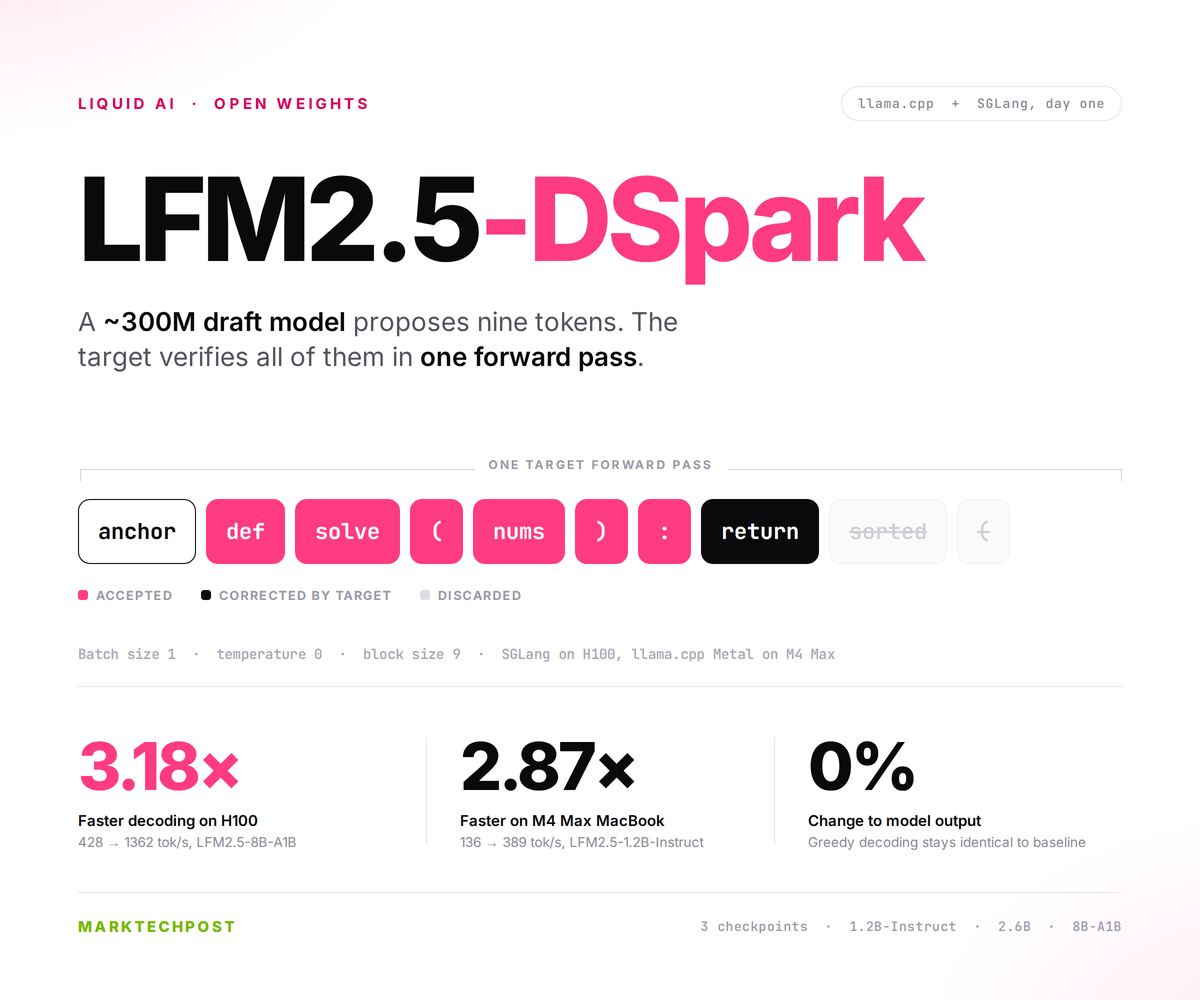
Liquid AI’s new DSpark draft model checkpoints address that delay by helping selected LFM2.5 models generate responses faster without changing the output under greedy decoding. The reported improvement reaches 3.18 times faster on an H100, although your actual result will depend heavily on the model, hardware, and task.
TL;DR
DSpark adds a small “drafter” model that proposes several tokens before the larger model checks them. This can reduce waiting time while keeping greedy-decoded output identical to the original model.
For Malaysian SMEs, the strongest opportunity is local or self-hosted AI for coding, document workflows, customer support, and multi-step agents. Test it on your own tasks before committing because speed gains vary widely.
What This Means in Plain Language
A language model normally generates text one token at a time. A token may be a short word, part of a word, punctuation, or a space. Each step requires the main model to calculate what should come next.
Speculative decoding changes the sequence. A smaller draft model quickly suggests a group of possible tokens. The larger target model then checks that group in one forward pass. If the suggestions are correct, several tokens are accepted at once. If they are not, the target model rejects the uncertain portion and continues normally.
DSpark uses a draft model of roughly 300 million parameters alongside selected LFM2.5 target models: LFM2.5-1.2B-Instruct, LFM2.5-2.6B, and LFM2.5-8B-A1B. The draft checkpoints use a block size of nine tokens, meaning they can propose a short group before verification.
The important point for a business owner is that this is mainly a speed improvement, not a new AI model with different business knowledge. Under greedy decoding, Liquid AI says the emitted sequence is identical to the target model running by itself. That means you should not expect better reasoning or more accurate answers simply because DSpark is attached.
The practical question is not “Is this AI smarter?” It is “Does this AI finish the same work quickly enough for my team to use it comfortably?”
What the Reported Results Show
The results were measured with batch size one, temperature zero, and block size nine. The tests used an H100 through SGLang and an M4 Max MacBook Pro through llama.cpp. These conditions are useful for understanding the direction of the technology, but they are not a guarantee for your office computers.
| Target model | Mean H100 speedup | Best H100 speedup | Mean M4 Max speedup | Best reported case |
|---|---|---|---|---|
| LFM2.5-1.2B-Instruct | 2.10x | 2.56x | 2.54x | 2.87x on HumanEval |
| LFM2.5-2.6B | 2.67x | 3.06x | 2.27x | 2.63x on HumanEval |
| LFM2.5-8B-A1B | 2.54x | 3.18x | 1.18x | 1.44x on GSM8K |
All figures in this table come from the reported Liquid AI benchmark results. Notice the spread. The same 8B-A1B model performed strongly on the H100 but showed only a modest average improvement on the M4 Max. A faster model is therefore not automatically a faster business process.
How This Applies to Malaysian SMEs
1. Local customer-service assistants. Suppose you operate a property agency, education centre, clinic administration team, logistics company, or online retailer. A local assistant could search approved documents and draft replies without sending every customer message to an external service. Faster decoding may make the assistant feel more responsive when staff ask for a reply in Bahasa Malaysia, English, Mandarin, or a mixture of languages. You still need human review for sensitive responses, but reducing the waiting time can make adoption easier.
2. Internal document and quotation workflows. Many SMEs repeatedly prepare quotations, delivery explanations, sales follow-ups, tender summaries, and standard operating procedures. A self-hosted model can help staff turn structured information into a first draft. DSpark may be most useful when the model produces predictable text, such as formatted emails, product descriptions, meeting summaries, or checklist-based instructions. Because the output is intended to remain the same under greedy decoding, you can compare the faster setup with your existing baseline more easily.
3. Coding and automation support. If your business uses a small development team or relies on an external developer, a local coding assistant could help with scripts, spreadsheet automation, API integration, and database queries. The report includes HumanEval and MBPP testing, with some of the strongest speed results appearing on coding-related workloads. Faster suggestions can reduce interruptions during development, particularly when the assistant runs on a workstation rather than through a hosted service.
4. Multi-step operational agents. An agent may need to read an order, check inventory, call a system, interpret the result, and prepare the next action. Each planning stage adds generation time. Liquid AI reports an average 57% latency reduction for multi-tool function-calling scenarios with LFM2.5-2.6B. Treat that figure as a test target rather than a promise. Your agent’s tools, prompts, database speed, and network connections may matter just as much as token generation.
5. On-device and offline use. A field-sales team, warehouse supervisor, technician, or remote-site worker may not always have reliable connectivity. Running an assistant on a laptop or local machine can help with offline procedures and document lookup. However, the 8B-A1B result on Apple silicon shows why hardware testing matters. The reported average improvement was only 1.18x on an M4 Max, partly because the current MoE implementation and extra expert weight traffic reduce the benefit.
Practical Takeaways
- Start with one workflow: choose a task where employees currently wait for AI responses, such as document drafting or coding assistance.
- Measure end-to-end time: record the time from request submission to a usable result, not just tokens per second.
- Compare predictable and creative tasks: speculative decoding generally benefits output that the smaller drafter can predict accurately.
- Test your real language mix: use the Bahasa Malaysia, English, Chinese, or Tamil prompts your staff actually write.
- Check hardware limits: the drafter adds approximately 300 million parameters and the 2.6B drafter repository is reported at 655 MB in BF16; source: MarkTechPost coverage.
- Confirm software support: DSpark requires compatible builds of llama.cpp or SGLang, according to the source article.
- Review licensing: the LFM Open License v1.0 allows free commercial use while an entity remains below $10 million in annual revenue, according to the reported license terms; obtain professional advice before deployment.
- Keep approval controls: faster generation does not remove the need to check medical, financial, legal, employment, or customer-facing content.
The Bigger Picture
For SMEs, local AI adoption is often limited by practical friction rather than interest. Staff do not want to wait through several slow responses. Owners do not want sensitive documents moving through systems they cannot inspect. IT teams do not want to maintain a large, complicated platform.
Techniques such as speculative decoding address one part of that friction: response latency. They may make smaller local models more suitable for everyday business tasks, especially when one person is using the system at a time. That matters for SMEs because many internal tools do not need hundreds of simultaneous users.
Still, speed is only one part of a reliable setup. You must also consider accuracy, data retention, access permissions, audit logs, model updates, language performance, and how the assistant connects to your existing accounting, inventory, CRM, or document systems.
The sensible path is a controlled pilot. Pick one process, establish a baseline, test the faster model on real but approved examples, and ask employees whether the waiting experience has genuinely improved. If the result is useful, you can then decide whether to keep the model on a laptop, place it on an office server, or work with an automation partner to integrate it into your daily operations.
DSpark is not a reason to replace every AI tool you use. It is a reminder that better AI operations can come from making an existing model more efficient. For a Malaysian SME, that can be valuable when faster responses help your team spend less time waiting and more time completing the work that matters.
Ready to Streamline Your Operations?
Your business should run itself. AutoRunBiz deploys AI agents to automate your daily operations — WhatsApp orders, invoicing, customer follow-ups, and accounting. Book a free 15-min ops audit to see where automation fits your business →