
Why Weather Intelligence Matters to Your Business
If rain starts while your delivery riders are on the road, outdoor work is underway, or customers are deciding whether to visit your premises, the impact is immediate. A forecast that simply says “thunderstorms” may not tell you enough. You need to know when rain is likely, how strong it may be, and which operating decisions should change.
That is why Google’s new WeatherNext 3 model is worth your attention, even if you do not work in technology. The model uses artificial intelligence to produce more frequent and more detailed weather forecasts. Google says it will feed into information shown through Search, Maps and Gemini, while also being available through its cloud platforms. Source
For a Malaysian SME, the important question is not whether you should build your own weather model. You should not. The practical question is how better weather information can improve scheduling, customer communication, stock handling, staff safety and daily decisions.
TL;DR
AI weather forecasting is becoming more detailed, more frequent and more useful at local level. WeatherNext 3 can forecast certain variables at a 5-kilometre resolution and produce hourly forecasts, according to Google’s researchers. Source
You can benefit by connecting reliable weather checks to your operating routines instead of treating weather as an afterthought.
What This Means
Traditional weather forecasting relies heavily on government-owned supercomputers running complex mathematical simulations of the atmosphere. These systems remain important, but they can be expensive and slow to operate. AI models learn patterns from large amounts of historical and current weather data, allowing them to produce forecasts more quickly.
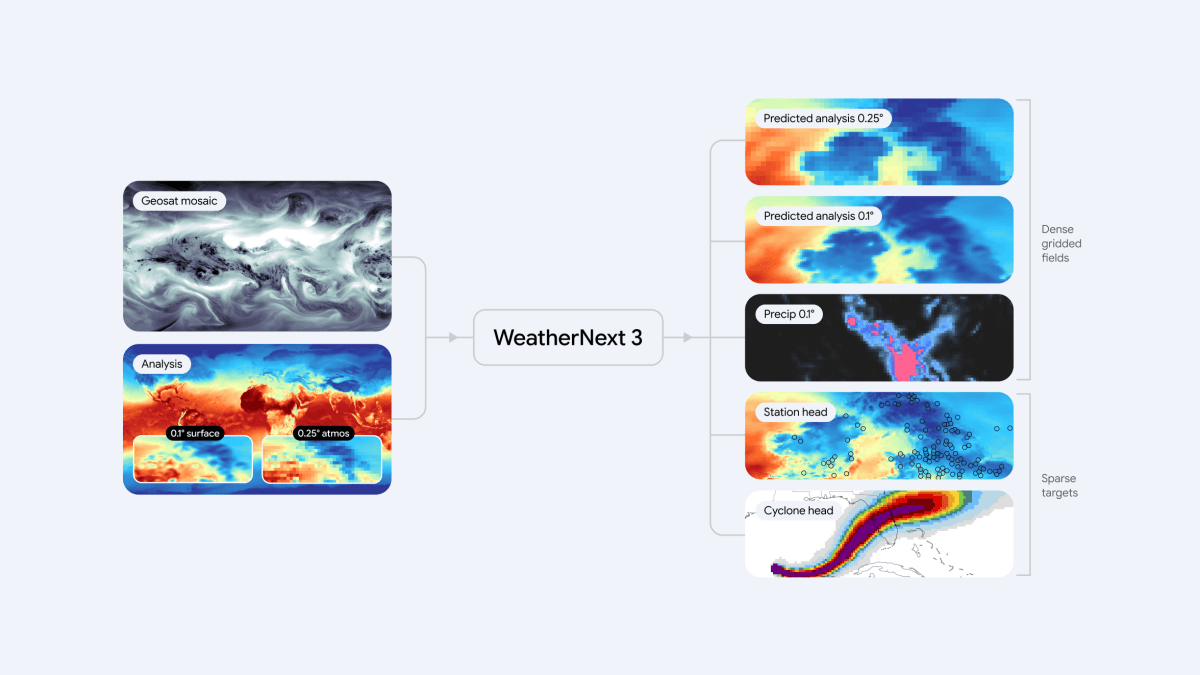
WeatherNext 3 is designed to address several weaknesses found in earlier AI weather models. Google says it can forecast key variables at a resolution of 5 kilometres, improve rainfall evaluations by 60% compared with WeatherNext 2, and produce hourly forecasts rather than forecasts issued every six hours. Source
The model also uses real-time satellite observations collected hourly and is trained to make predictions for specific weather stations. In plain language, this moves the forecast closer to what a particular location may actually experience, rather than giving only a broad regional estimate. Source
However, a better forecast is not automatically a better business decision. You still need a simple process that turns information into action. For example, “rain likely between 3pm and 5pm” should trigger a decision about delivery routes, outdoor appointments, stock placement or customer notifications.
The value is not in seeing a forecast. The value is in deciding earlier what your business will do because of it.
How This Applies to Malaysian SMEs
1. Delivery and field-service businesses can plan around short weather windows. If you operate a food delivery service, florist, laundry collection business, repair team or maintenance company, heavy rain can delay jobs and make travel less safe. An hourly forecast can help you group nearby deliveries before a predicted downpour, move non-urgent appointments to a later period, or alert customers before your staff are already stuck on the road.
For example, a small air-conditioning service company could review the next day’s rain forecast during its morning briefing. Outdoor condenser work, rooftop inspections and jobs requiring ladders may be scheduled during clearer periods. Indoor work can fill the more uncertain slots. You are not trying to predict the weather perfectly; you are reducing avoidable disruption.
2. Food, beverage and retail businesses can prepare for changes in customer behaviour. A café near a school, office area or transport hub may see fewer walk-in customers during intense rain. A hardware shop may see higher demand for tarpaulins, buckets or basic flood-prevention items. A convenience store may need to adjust staffing at the busiest periods when commuters arrive later than usual.
You can create simple weather-based operating rules. If strong rain is forecast during the normal lunch period, your team can prepare takeaway packaging earlier, confirm rider availability and publish a short notice about possible delivery delays. If the forecast is clear, you may prioritise dine-in service or outdoor seating preparation. The decision process matters more than the sophistication of the weather tool.
3. Construction, landscaping and outdoor businesses can improve safety and scheduling. Contractors, event companies, nursery operators, car-wash businesses and renovation teams are exposed to weather changes. Rain affects painting, concrete work, electrical installations, tent setup, grass cutting and outdoor customer activities. A more local and frequent forecast can support a daily “go or postpone” checklist.
For a small event company, the process could include checking the forecast at booking confirmation, 48 hours before setup, and again on the morning of the event. The team can then confirm drainage, prepare covered equipment areas, protect cables and communicate any timing changes. Weather information should support your risk controls, not replace professional judgement or official warnings.
4. Agriculture and food producers can make better operational choices. Malaysian farms, nurseries and small food producers depend on weather for planting, spraying, harvesting, drying and transport. Better rainfall, wind and cloud-cover forecasts may help you decide when to move harvested produce, protect seedlings or organise workers.
The article notes that higher-resolution forecasts may also help make renewable energy projects more dependable and improve crop yields in developing regions. Source For an SME, this does not mean relying on one app without checking conditions on the ground. It means combining forecast information with your own observations, supplier updates and official alerts.
A Simple Weather-Ready Operating System
| Business activity | Weather signal to monitor | Action to consider |
|---|---|---|
| Deliveries | Hourly rain and wind outlook | Group nearby jobs, adjust routes and notify customers |
| Outdoor work | Rain timing, lightning and strong wind | Reschedule exposed tasks and protect equipment |
| Retail and cafés | Rain during peak customer periods | Prepare takeaway service and review staffing |
| Events | Forecast changes from booking to setup | Confirm shelters, equipment protection and timing |
| Agriculture | Rain, humidity, wind and cloud cover | Plan harvesting, spraying, drying and transport |
Practical Takeaways
- Choose one reliable weather source and make it part of your daily opening routine.
- Check forecasts at useful decision points: the previous afternoon, early morning and before peak operating periods.
- Write down simple triggers, such as “if heavy rain is expected during delivery hours, call customers before dispatch”.
- Separate weather decisions into safety, staffing, customer service, stock protection and scheduling.
- Use local observations as a second check. A forecast is guidance, not a guarantee.
- Do not promise exact arrival times when weather conditions may change quickly.
- Keep an alternative plan for outdoor work, including indoor tasks, covered storage and rescheduling procedures.
- Record what happened after each weather-related disruption so you can improve your operating rules.
- Make sure staff know who has authority to postpone a task or change a route.
- Continue following official warnings from Malaysian authorities for severe weather and emergency conditions.
How to Start Without Adding Complexity
Begin with one recurring problem. Perhaps your riders regularly face delays during afternoon storms, or your outdoor team loses productive time when rain arrives unexpectedly. Track the issue for two weeks. Note the forecast, the actual conditions, the affected jobs and the decisions your team made.
Then create a one-page response guide. It might say who checks the forecast, which conditions require a customer message, which jobs can be brought forward, and which tasks must stop for safety reasons. Share the guide through the communication channel your staff already use.
After a month, review whether the process helped. Look for fewer last-minute calls, clearer customer updates, safer scheduling or less stock exposure. If the result is useful, extend the same approach to another part of the business.
The Bigger Picture
Weather forecasting is becoming more closely connected to everyday digital services. Google says WeatherNext 3 will provide information for products such as Search, Maps and Gemini, while cloud access will allow users and researchers to work with the model. Source That means weather data may increasingly appear inside the tools you already use rather than in a separate weather application.
For SMEs, this could lead to practical automation: a delivery dashboard that flags risky time windows, a booking system that suggests rescheduling, or an inventory workflow that reminds staff to protect sensitive goods. The technology will be useful only when connected to clear business rules and human responsibility.
Start small. Use better weather information to improve one decision that currently causes stress or delay. Once your team learns to respond consistently, you will have a stronger foundation for automating other routine decisions as well.
Ready to Streamline Your Operations?
Your business should run itself. AutoRunBiz deploys AI agents to automate your daily operations — WhatsApp orders, invoicing, customer follow-ups, and accounting. Book a free 15-min ops audit to see where automation fits your business →