
If you run a Malaysian SME, you’ve probably heard that AI is changing business. What you haven’t heard is how it specifically helps a 10-person operation compete with a 1,000-person company.
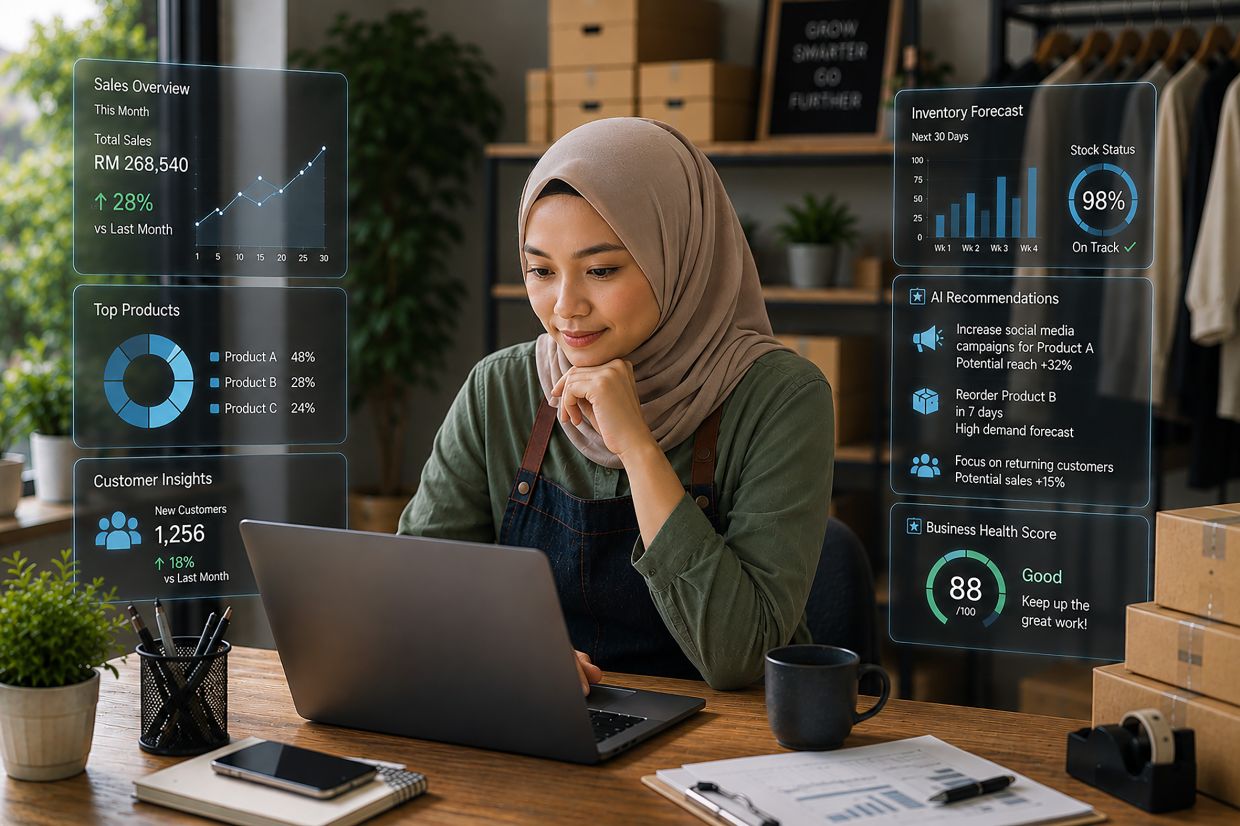
That’s the question at the heart of a recent analysis by Dr Sharlene Thiagarajah in The Star: can AI truly level the playing field for Malaysia’s 1.07 million micro, small, and medium enterprises (MSMEs)?
The short answer is yes — but only if you know where to start. And most business owners don’t.
Here’s what the data says, what’s actually working for Malaysian SMEs right now, and a practical roadmap to get started this week.
What Does “AI for SMEs” Actually Mean in Malaysia?
Let’s cut through the hype. When we talk about AI for Malaysian SMEs, we’re not talking about building machine learning models or hiring data scientists. We’re talking about using existing AI tools to automate repetitive business tasks — invoicing, customer follow-ups, data entry, inventory tracking, and lead management.
Malaysia’s MD2030 plan targets 30% of GDP from the digital economy by 2030, with 500,000 new digital jobs. The government has launched initiatives like the National AI Office and the SParK 2026 financing program (RM2.25 billion via PUNB) to help Bumiputera entrepreneurs digitise. But the day-to-day reality for most SME owners is far simpler: they need tools that save time and reduce errors, right now.
Malaysia’s MD2030 plan targets 30% of GDP from the digital economy by 2030, creating 500,000 new digital jobs — and AI automation is the fastest route for SMEs to contribute to that goal.
— Malaysia Digital Economy Blueprint 2030 (MD2030)
| Key Stat | Data Point | Source |
|---|---|---|
| Digital economy GDP target | 30% by 2030 | MD2030 |
| Bumiputera entrepreneur financing | RM2.25 billion | PUNB SParK 2026 |
| Malaysian MSMEs | 1.07 million | SME Corp Malaysia |
In many ways, SMEs are better positioned than larger organisations to adopt AI. They are more agile, less constrained by legacy systems and faster to make decisions and implement changes.”
— Dr Sharlene Thiagarajah, The Star
This is where AI-powered automation tools — like AI invoicing, WhatsApp chatbots, and smart document processing — deliver immediate ROI without requiring technical expertise.
How Are Malaysian SMEs Using AI Right Now?
Adoption is happening faster than many realise. Malaysian SMEs are using AI across three primary areas:
1. Customer communication. AI chatbots on WhatsApp handle after-hours enquiries, booking confirmations, and FAQ responses. For a restaurant in Penang or a clinic in Johor, this means not losing a customer who messages at 10 PM.
2. Invoice and payment automation. AI extracts data from invoices, matches payments, and sends reminders automatically. A distributor in Klang can reduce their monthly error rate from thousands of ringgit to near zero.
3. Document and data processing. AI reads purchase orders, delivery orders, and receipts. Instead of a staff member spending three hours keying data, the AI does it in 30 seconds.
These aren’t hypothetical use cases. They’re running in Malaysian businesses today — reducing costs, freeing up staff, and cutting errors.
What’s Stopping Most SMEs from Adopting AI?
Three barriers keep coming up in every conversation with SME owners:
Barrier 1: “I don’t know what AI can do for my business.” Most business owners understand AI exists but can’t connect it to their specific operational pain points. The solution isn’t more education — it’s seeing a real example in an industry like yours.
Barrier 2: “I don’t have time to learn new technology.” This is the most valid concern. SME owners are already overstretched. The answer is to choose AI tools that require zero training — tools that work the same way you already work (whatsapp, email, web dashboard).
Barrier 3: “AI tools are expensive.” This is a misconception that costs businesses money. The most impactful AI automation tools for SMEs start at under RM200 per month. That’s less than one hour of a part-time assistant’s time. The real cost is continuing to do things manually.
Which AI Tools Deliver the Fastest ROI for Small Businesses?
Based on what’s working for Malaysian SMEs right now, here are the highest-ROI AI applications — ranked by how quickly they pay for themselves:
1. AI invoicing and payment reconciliation. A food distributor processing 200 invoices monthly with a 4% error rate loses around RM8,000 per month in errors. AI invoicing cuts this to near zero. ROI timeframe: 2-4 weeks.
2. AI WhatsApp customer service. A retail shop losing 60% of after-hours leads can recover most of them with an AI chatbot. A chatbot costs less than one part-time assistant. ROI timeframe: 1-2 months.
3. AI document and data extraction. A wholesaler manually keying 100 purchase orders daily can automate 90% of that data entry. ROI timeframe: 2-3 months.
Where to Start: A 4-Step AI Adoption Plan for Malaysian SMEs
Here’s a practical roadmap that any SME owner can follow — no technical expertise required:
Step 1: Map your operational bottlenecks (30 minutes). Write down the top three tasks that consume the most staff time every week. Look for work that is repetitive, rule-based, and doesn’t require human judgment. Invoicing, data entry, and customer follow-ups are almost always on this list.
Step 2: Find an AI tool that solves exactly that problem (1 hour). Don’t search for “AI for business” — search for “AI invoicing Malaysia” or “WhatsApp chatbot retail.” Narrow your search to tools built for your region and industry.
Step 3: Test it with real data for one week (1 hour setup + daily use). Most AI tools offer demos or free trials. Don’t run a pilot project — just use it. Process 10 real invoices. Let the chatbot handle 20 real customer queries. Measure time saved and errors reduced.
Step 4: Measure the difference and expand (ongoing). If it saved time and reduced errors, keep it and move to the next bottleneck. If it didn’t, try a different tool. The key is to start with one problem, solve it, then move to the next.
Malaysia’s digital transformation isn’t a theoretical future. It’s happening now. The businesses that will thrive are the ones that pick one bottleneck, automate it, and repeat.
Not sure where to start? AutoRunBiz automates invoices and WhatsApp follow-ups for Malaysian SMEs — set up in 30 seconds. Book a demo →
Sources: “Can AI level the playing field for SMEs?” — Dr Sharlene Thiagarajah, The Star, July 4, 2026; MD2030 — Malaysia Digital Economy Blueprint; SME Corp Malaysia — MSME Statistics; PUNB SParK 2026.