
Why a Robot Data Release Matters to Your Business
Robots are often presented as something only large manufacturers can consider. You may associate them with automotive plants, semiconductor facilities or warehouses with large engineering teams. A new release from Axis Robotics suggests that an important part of robotics development is moving in a more accessible direction: data collection can increasingly happen through a web browser, while demanding computing work runs in the cloud or a central backend.
That matters even if you do not plan to buy a robot today. Malaysian SMEs in food production, packaging, logistics, electronics assembly, agriculture and hospitality are already dealing with repetitive work, labour shortages, inconsistent processes and pressure to fulfil orders faster. The companies that learn how robotics data is created, tested and improved will be better prepared when practical automation becomes available for smaller operations.
What Happened
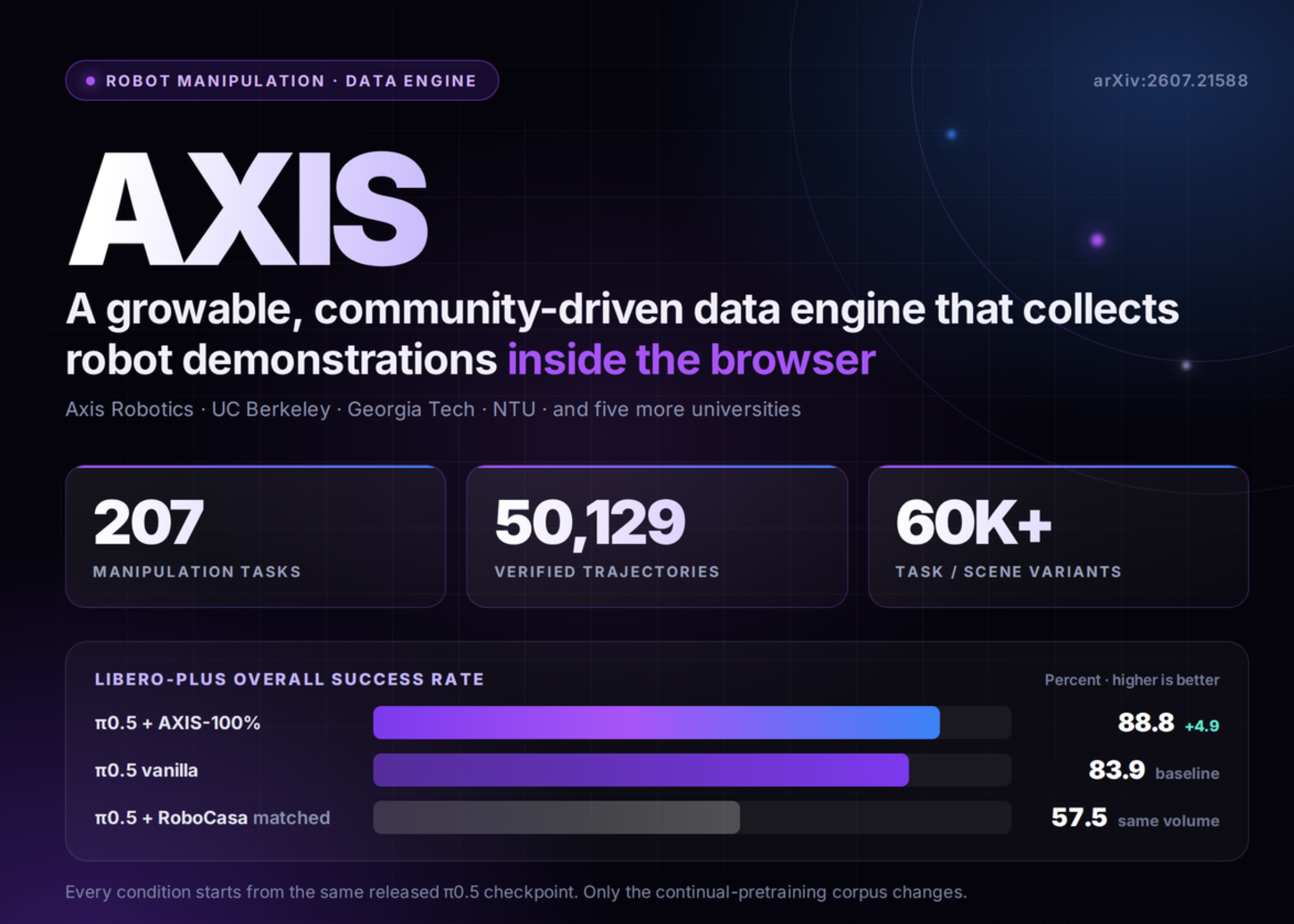
Axis Robotics, working with researchers from institutions including UC Berkeley, Georgia Tech and NTU, released AXIS, a browser-based data engine for robot manipulation. Instead of requiring every contributor to operate specialised laboratory equipment locally, the platform allows users to control a simulated robot through a browser using a keyboard, mouse, virtual joystick or gamepad. The system runs in a MuJoCo WebAssembly frontend, while rendering, training and evaluation take place on backend GPU infrastructure. Source: MarkTechPost
The released snapshot contains 207 tasks, 50,129 episodes and more than 60,000 task or scene variants across seven scene categories. Each trajectory includes information such as robot and object states, actions, task metadata, success labels and camera observations. More than 70,000 community members are credited with contributions, according to the source article. The dataset is hosted on Hugging Face, but access is gated and restricted to non-commercial academic use, while the training code is published as a patch layer over OpenPI. Source: MarkTechPost
AXIS also uses automated task generation. A language instruction can be broken into a task, scene and object configuration. The system then proposes layouts, creates or retrieves 3D assets and applies success checks. Backend verification is important because it does not simply trust whether the browser interface reports that an action succeeded. The system cleans and replays demonstrations, although the published results show a trade-off: refinement reduced mean acceleration from 1.3539 to 0.4885 and mean jerk from 11.5899 to 2.2243, while replay success declined from 100% to 86.2%. Source: MarkTechPost
Why This Matters for Malaysian SMEs
The most useful lesson is not that you should immediately deploy a robot. It is that automation depends on structured operational data. A small food manufacturer, for example, may want a robot to pick containers, place them into cartons or sort products by size. Before automation can work reliably, the business needs clearly defined steps, known object positions, acceptable handling variation and an unambiguous definition of success.
AXIS shows one possible future in which more people can contribute demonstrations without owning a robotics laboratory. For a Malaysian SME, a similar approach could support remote process design. Your production supervisor could record how a task should be performed in a simulated environment, while an engineering partner tests different layouts and robot movements remotely. A logistics operator could model parcel sorting. An electronics subcontractor could document component placement. A food-processing company could simulate tray loading before touching its live production line.
This browser-first approach may also make collaboration easier across Malaysia. A local SME, a technical college, a systems integrator and a robotics vendor could work from the same digital task definitions. Instead of relying only on informal instructions such as “place the box carefully,” they could define the box orientation, placement zone, acceptable movement and quality check. That creates a clearer basis for training staff, comparing automation proposals and identifying where a human must remain involved.
| AXIS lesson | What you can apply in your business |
|---|---|
| Browser-based demonstrations | Document repeatable work digitally before buying equipment. |
| Structured success checking | Define measurable quality conditions for each process step. |
| Simulation and replay | Test layout changes before interrupting live operations. |
| Data cleaning | Remove inconsistent or incomplete process records before automation. |
| Variation testing | Check whether a process works under different lighting, positions and product conditions. |
What You Should Do Before Exploring Robotics
Start with one repetitive task rather than your entire operation. Choose a process that happens frequently, has a stable sequence and creates a visible bottleneck. Examples include carton forming, label placement, counting, sorting, pallet movement or transferring items between trays. Record the task using simple video, written steps and examples of acceptable and unacceptable results.
Next, identify the variations that cause problems. Are products presented at different angles? Does lighting change during the day? Do workers use slightly different methods? Are packaging materials sometimes crumpled or misaligned? These details matter because a robot trained only on ideal conditions may fail when placed in your actual workplace.
You should also map the data and system requirements. Where will process records be stored? Who can access them? Are customer labels, invoices or product designs visible in the recordings? What happens if the internet connection fails? These questions are especially relevant for SMEs that share facilities, use outsourced IT support or handle confidential manufacturing information.
Automation readiness begins with a well-defined task, not with a robot purchase. If your team cannot agree on what successful completion means, a machine-learning system will struggle to learn it consistently.
The Bigger Picture
AXIS points to a wider shift in physical AI: robotics progress may depend less on a small number of closed laboratories and more on distributed, continuously expanding data systems. The release demonstrates that demonstrations can be collected through a browser, tasks can be generated and varied automatically, and training can be conducted centrally. Its reported results show π0.5 improving from 83.9 to 88.8 overall on LIBERO-Plus after continual pretraining with AXIS data, while the volume-matched RoboCasa365 control scored 57.5. Source: MarkTechPost
However, the release also shows why you should avoid treating benchmark results as proof that every robot is ready for every workplace. Performance gains were uneven across conditions. Sensor Noise improved by 13.7 points and Camera improved by 11.3 points, but Light declined by 1.7 points and Language declined by 1.3 points against the vanilla baseline. The dataset is also academic-use restricted, and no policy checkpoints were released, which limits immediate commercial deployment. Source: MarkTechPost
For you, the practical message is clear: build your digital process foundation now. Standardise work instructions, collect representative examples, measure quality and identify variation. When affordable robotics platforms and local integrators become more capable, you will have the information needed to evaluate them quickly.
Browser-based robotics will not remove the need for shop-floor expertise. It may do something more useful: make that expertise easier to capture, test and share. For Malaysian SMEs, that could turn years of practical know-how into a foundation for safer, more consistent and more scalable automation.
Ready to Streamline Your Operations?
Technology moves fast. Your operations should keep up. AutoRunBiz builds AI systems that run your daily workflows — from WhatsApp order capture to accounting. Book a free 15-min ops audit →