
Why Your AI Answers Need More Than a Confident Sounding Response
You may already be using AI to compare suppliers, summarise regulations, research competitors, draft customer replies, or check industry developments. The answer often arrives quickly and sounds convincing. That convenience is useful, but it creates a practical business question: did the AI actually find reliable information, or did it produce an answer from memory and incomplete search results?
This matters when your team is small and one wrong detail can cause rework. A missed product requirement, outdated policy, incorrect company record, or poorly researched market assumption can affect a quotation, procurement decision, customer communication, or internal process. You need a way to judge whether an AI search tool is consistently finding the right evidence, not merely writing fluent sentences.
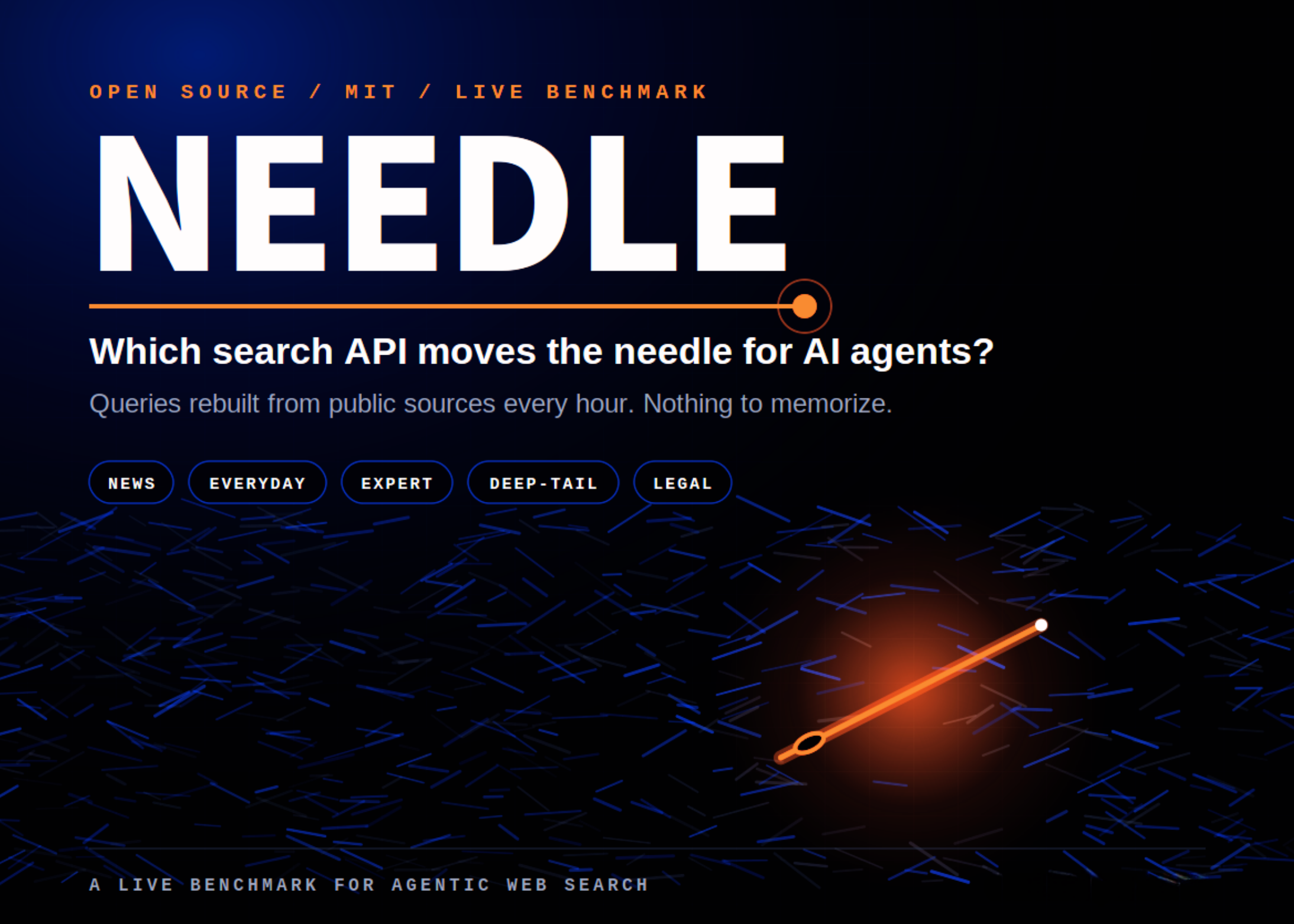
A new open-source benchmark called NEEDLE approaches this problem by testing search systems against fresh queries generated from public sources. Instead of using one permanent question set, it rebuilds parts of the test regularly, making it harder for systems to memorise the answers.
TL;DR
NEEDLE tests 15 search APIs using the same queries across news, finance, scholar, deep-tail, and legal research. It also compares each result with an “ultimate” pooled benchmark that represents what all tested systems collectively found.
For your SME, the lesson is simple: evaluate AI tools using fresh, realistic business questions and check the supporting sources before allowing automation to act on the answer.
What This Means
Traditional benchmarks use a fixed list of questions and answers. That makes comparison straightforward, but it also creates a weakness. If a system has seen the test set or the answers are publicly available, it may appear capable without genuinely retrieving the information during the test.
NEEDLE, which stands for News, Everyday, Expert, Deep-tail, and Legal Evaluation, tries to reduce that weakness. Its news queries are regenerated hourly from RSS feeds and Google Trends. Its finance, scholar, deep-tail, and legal queries are regenerated daily from sources including SEC XBRL, arXiv, Europe PMC, CourtListener, and public agent logs. Source: MarkTechPost
The test gives different search APIs the same query text and measures their results under one process. It limits evidence to 2,000 characters, looks at titles and snippets, and does not allow the systems to fetch and re-rank the underlying pages. This makes the comparison more consistent. Source: NEEDLE details reported by MarkTechPost
One particularly useful idea is the ultimate ceiling. NEEDLE pools the results from every search engine tested and treats the combined set as an empirical reference point. This does not mean it knows every possible answer. It shows what the participating systems, collectively, were able to retrieve.
A fast AI answer is not necessarily a well-researched answer. The quality of the retrieved evidence comes first.
If one search engine performs far below the ultimate ceiling, the problem may be ranking: the right page was available but buried too far down. If the ultimate ceiling itself is weak, the problem may be retrieval: none of the systems found strong evidence. That distinction helps you decide whether to change the search tool, improve the question, or ask a human to investigate further.
How This Applies to Malaysian SMEs
Imagine you operate a small food manufacturing business in Selangor. You ask an AI assistant to summarise a labelling requirement, check an ingredient restriction, or compare a retailer’s supplier conditions. A generic benchmark may show that the assistant performs well overall. However, your actual question may involve a recent announcement, a specific product category, or a Malaysian authority’s latest guidance. A live evaluation approach reminds you to test the assistant using current, local, and difficult questions rather than relying on general claims.
For a service business, such as an accounting practice, logistics company, or engineering consultancy, research quality affects client work. Your staff may ask AI to identify a company director, find a technical paper, locate a court decision, or verify a regulatory reference. NEEDLE separates finance, scholar, and legal tasks because each type requires different search behaviour. You can apply the same thinking internally: create separate test groups for company checks, technical research, compliance questions, and competitor monitoring.
Consider a Malaysian e-commerce seller tracking product trends. News and trend information changes quickly. A search result that was correct last month may no longer reflect current customer demand, marketplace rules, or competitor activity. If your AI workflow uses a fixed collection of saved prompts and pages, it may become stale without anyone noticing. Testing it with newly generated questions every week can reveal whether it still finds relevant and recent information.
Rare or obscure questions deserve special attention. NEEDLE’s deep-tail category uses rare-word queries and public agent-trajectory releases to represent the type of difficult research an AI agent may encounter. For your business, this could mean asking about an unfamiliar industrial standard, a niche export requirement, a specific software integration, or a supplier with limited online information. These are exactly the cases where a confident answer may hide weak evidence.
What the Published Results Suggest
In the reported seven-day window ending 28 August 2026, finance scores were relatively strong: Exa recorded 0.910, Keenable 0.872, Perplexity 0.871, and Google 0.847 against an ultimate score of 0.965. Scholar results varied more widely, from Keenable at 0.774 to Tavily at 0.310, against a ceiling of 0.869. Deep-tail search was harder, with Exa reaching 0.557 of the ultimate ceiling and Bing reaching 0.199. Source: MarkTechPost report of NEEDLE’s published results
These figures are not a promise about how any tool will perform for your company. They show why one overall score is not enough. A system may be strong at finding structured financial facts but weaker at locating obscure research or recent legal material.
| NEEDLE area | What it represents | SME test example |
|---|---|---|
| News | Recent developments from feeds and trends | Find the latest update affecting your sector |
| Finance | Registry and company filing facts | Verify a public company’s reported figure |
| Scholar | Research papers and technical details | Find evidence for a product or process claim |
| Deep-tail | Rare and difficult-to-find information | Research an obscure standard or supplier |
| Legal | Court decisions and legal material | Locate a relevant case or statutory section |
Latency also matters when an AI agent performs many searches. The reported figures showed Keenable-realtime at 193 milliseconds p50 and 284 milliseconds p95, while Exa recorded 1,876 milliseconds p50 and 2,955 milliseconds p95. Bing recorded 2,767 milliseconds p50 and 9,381 milliseconds p95. Source: MarkTechPost latency figures For your team, speed should be considered alongside relevance and evidence quality. A fast wrong answer still creates work.
Practical Takeaways for Your Business
- Build a small test set. Prepare 20 to 30 questions based on your real workflows: supplier checks, customer research, compliance, competitor updates, and technical searches.
- Refresh the questions. Replace time-sensitive questions regularly so your team does not judge the tool only on familiar examples.
- Separate easy and difficult tasks. Test simple company facts separately from obscure research and recent regulatory questions.
- Record the source links. Ask the AI to show the page, publication date, and exact supporting passage for every important claim.
- Score evidence, not writing style. Give higher marks when the result directly answers the question and the source clearly supports it.
- Check the top five results. A useful result appearing only after several irrelevant pages may slow your staff down.
- Use a human approval step. Do not allow AI research to trigger a purchase, legal response, customer promise, or compliance decision automatically.
- Test local relevance. Include Malaysian terms, states, agencies, currencies, company registration details, and industry vocabulary in your evaluation.
- Review failures by type. Decide whether the issue was an outdated source, poor query wording, missing coverage, or bad ranking.
The Bigger Picture
AI assistants are moving from answering questions to carrying out multi-step work. An agent may search for suppliers, compare specifications, draft a recommendation, and prepare an email. As the number of automated steps increases, small errors can travel further before someone notices them.
That makes live evaluation increasingly practical for SMEs. You do not need a research laboratory or a large technical department. You need a repeatable list of business questions, a simple scoring method, and a habit of checking whether the evidence is current. The open-source nature of NEEDLE also points towards more transparent testing, with its code, public runs, and archived artifacts available for inspection. Source: MarkTechPost report on NEEDLE’s open-source harness
The most useful question is not “Which AI tool is best?” It is “Which tool performs reliably for the jobs you need done?” A search API that is excellent for structured financial information may not be suitable for niche technical research. A very fast system may be valuable for customer-service lookups, while a slower but more thorough system may suit monthly market reviews.
Start with one workflow this week. Choose a task where your team regularly spends time searching, create a fresh test set, and compare the answers with the original sources. That small exercise will show you more about practical AI quality than a polished product demonstration.
Ready to Streamline Your Operations?
Your business should run itself. AutoRunBiz deploys AI agents to automate your daily operations — WhatsApp orders, invoicing, customer follow-ups, and accounting. Book a free 15-min ops audit to see where automation fits your business →