
When Business Video Shows What Happened, Not Why
You may already use cameras, mobile recordings, product demonstrations, or delivery footage in your business. But watching a video often leaves an important question unanswered: what caused the movement, delay, collision, or mistake?
A recording can show a box falling, a worker moving around a shelf, or a vehicle approaching a loading area. It usually cannot directly tell you the object’s weight, the force involved, the friction of the floor, or what would happen if one condition changed. That limitation matters when you want to improve safety, training, warehouse layouts, or service procedures.
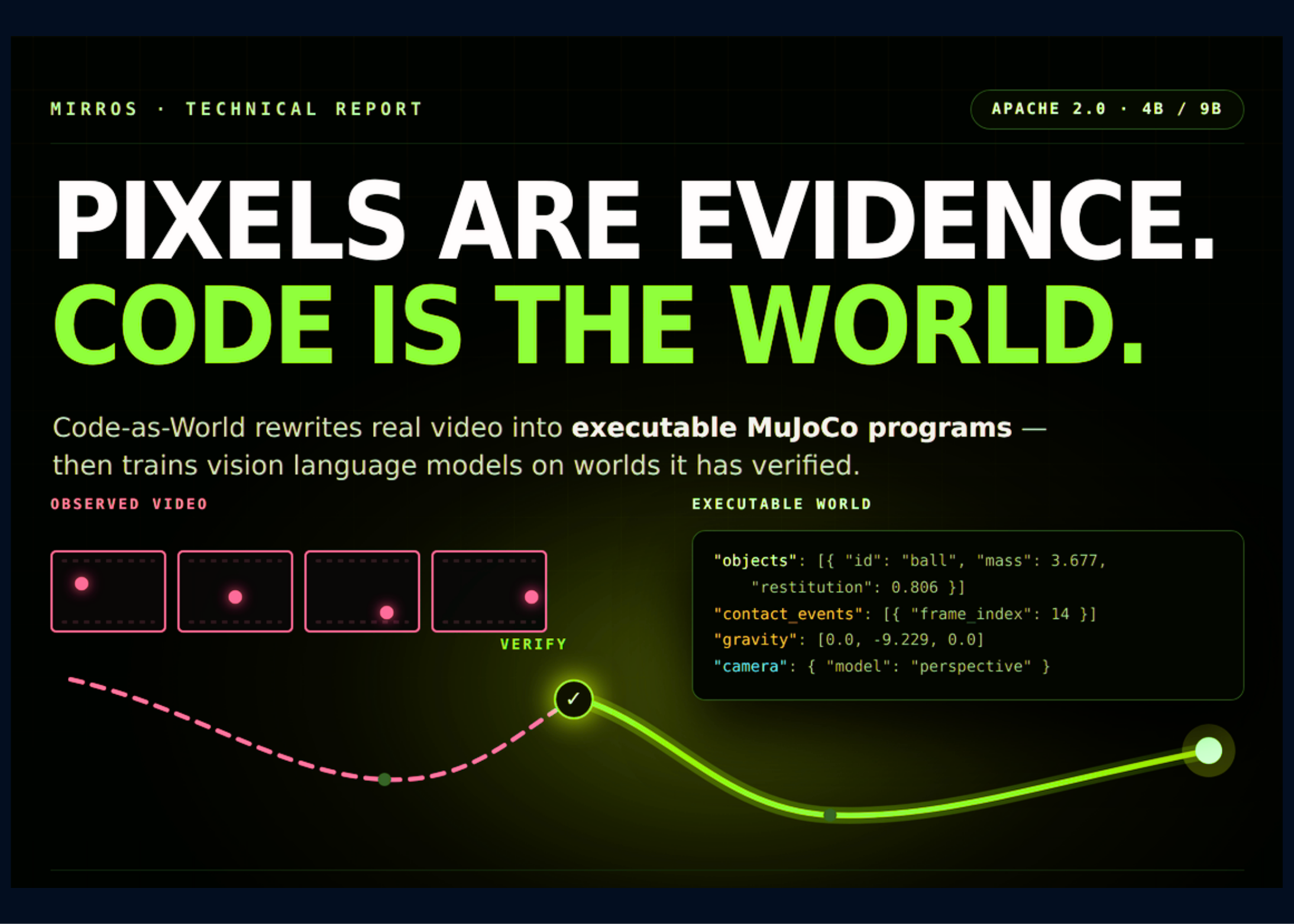
The “Code-as-World” approach described by MarkTechPost offers a useful way to think about the next stage of AI: instead of merely describing video, an AI system attempts to convert a scene into editable, executable code that can be tested in a physics simulator.
TL;DR: Code-as-World turns video into a simulated scene that can be inspected, edited, and re-run. For Malaysian SMEs, the near-term lesson is to treat operational video as structured business data rather than footage kept only for review.
The technology remains at the research and internal-prototype stage, but its underlying workflow can influence how you plan automation projects today.
What This Means
Traditional computer vision often answers questions such as “Where is the person?”, “Which object moved?”, or “When did the package fall?” Those answers are useful, but they do not necessarily explain the physical mechanism behind the event.
Code-as-World represents a scene as an executable world representation. In the released system, the representation is compiled into a scene.json file that can run in the MuJoCo physics simulator. The scene includes three broad elements:
- Composition: objects, dimensions, mass, friction, gravity, floors, and walls.
- Evolution: starting positions, forces, collisions, contacts, movement, and duration.
- Appearance: cameras, lighting, materials, backgrounds, and frame settings.
This separation is important. Changing the lighting should not change the physics. Changing an object’s mass should affect how it falls or collides. That gives you an editable model instead of a fixed recording.
The system uses an agentic loop: propose, instantiate, execute, render, and verify. It creates a possible scene, runs it, renders the result, compares that result with the original video, and revises the scene. The reported process can run for up to five rounds. The comparison checks areas such as RGB appearance, depth, object masks, and movement paths, according to the source article.
The practical idea is simple: do not ask AI only to describe what happened. Ask whether it can build a testable model of what happened.
How This Applies to Malaysian SMEs
1. Warehousing and stock handling. If you operate a small warehouse, workshop, retailer, or distributor, you may have recurring problems involving misplaced cartons, blocked aisles, unstable stacking, or slow picking routes. A future system could use camera footage to create a simplified simulation of shelves, workers, pallets, and packages. You could then test whether changing the shelf position, walking route, or carton arrangement reduces unnecessary movement and contact.
You do not need to begin with a full physics model. Start by identifying one repeated operational problem. For example, record the movement of goods from receiving to storage and then to dispatch. Mark where staff wait, turn around, search, or cross paths. Even a basic process map can help you decide whether a more advanced simulation would be worthwhile.
2. Manufacturing and workshops. Malaysian SMEs in food processing, furniture, metalwork, printing, electronics assembly, and other production activities often depend on consistent physical movement. A video-based model could eventually help test whether a fixture is placed too close to a machine, whether materials are likely to fall, or whether a revised workstation arrangement creates unnecessary handling.
For now, you can apply the same thinking through recorded process reviews. Capture a normal work cycle, list the objects and actions involved, and separate appearance from mechanics. “The table is blue” is an appearance detail. “The table supports a 20-kilogram component” is a physical detail. This distinction makes your operational documentation more useful for future automation.
3. Delivery, loading, and service operations. If your business handles deliveries, installation, catering, maintenance, or event setup, your team repeatedly performs physical tasks outside the office. A video may reveal that a trolley takes an awkward turn, a loading area becomes congested, or equipment is placed in an unstable position. A structured simulation could help you compare alternative loading sequences before changing the real process.
This is especially relevant when your staff work at customer premises. You can build a library of common environments, such as shop lots, offices, kitchens, or small storerooms. The objective is not to create a perfect digital copy of every site. It is to capture enough structure to identify hazards, delays, and unnecessary movement.
4. Staff training and safety. Training videos often show the correct procedure, but they may not explain why a particular order matters. An executable scene could allow a trainee to alter one step and observe the likely result. For example, the model might compare placing a heavier item below a lighter one, or moving a fragile item before clearing the pathway.
Until such tools become reliable and easy to use, you can still improve your training material by adding decision points. Show the correct action, then explain the physical reason. Record common mistakes and label the conditions that caused them. This creates better data for any future AI system and makes training more practical now.
What the Numbers Tell You
The reported results are research benchmarks, not guarantees for your business. They are useful because they show how the method was evaluated.
| Reported item | Figure | Why it matters |
|---|---|---|
| Maximum discovery rounds | 5 | The system revises its physical hypothesis repeatedly instead of relying on one prediction. |
| Image-space training pairs | 73,335 | Shows the scale of the visual question-answering supervision used. |
| Video-driven executable worlds | 988 | Represents the video-based portion of the world-space training data. |
| Code-as-World-VL-9B score | 55.4 MRA | Its reported QuantiPhy-validation result. |
| QuantiPhy validation items | 159 | Indicates the evaluation set was a focused research benchmark. |
| Training hardware | 8 NVIDIA H100 GPUs | Shows that the reported training setup was substantial. |
Practical Takeaways for Your Business
- Choose one physical process: begin with loading, picking, packing, assembly, or installation rather than trying to model the whole company.
- Record consistent footage: keep the camera position, viewing angle, and process steps reasonably stable.
- Document objects and measurements: note dimensions, approximate weights, surfaces, storage positions, and common contact points.
- Separate facts from guesses: record what the camera proves and what staff believe happened.
- Build a process library: store videos, incident notes, layouts, and standard operating procedures together.
- Protect personal data: limit access, blur faces where appropriate, and explain how recordings are used.
- Use simulations for decisions, not blind control: a model should support staff judgement until you have validated it properly.
- Check compatibility: ask automation vendors whether their systems can use video, structured events, or simulator-ready data.
The Bigger Picture
The long-term importance of this trend is not limited to robotics. It points towards AI systems that can reason about actions, constraints, and consequences. That could affect inventory planning, workplace safety, facility design, field service, and quality control.
However, the limitations are equally important. The released approach focuses on rigid-body physics, and the model does not learn the discovery loop itself, according to the source article. Real SME environments also include people, flexible packaging, liquid spills, changing lighting, incomplete camera views, and unusual events. A neat simulation may still be wrong if the original footage does not provide enough evidence.
That is why you should view this as a direction for better operational data, not an immediate replacement for experienced workers. The strongest advantage for your business may come earlier: clearer recordings, better process measurements, and a habit of testing changes before implementing them.
If you begin organising your operational video now, you will be better prepared for tools that can transform footage into editable simulations later. The question to ask is not whether your SME needs a research-grade physics model today. Ask instead: which repeated physical process would be safer, faster, or easier to improve if you could test it without disrupting the real operation?
Ready to Streamline Your Operations?
Your business should run itself. AutoRunBiz deploys AI agents to automate your daily operations — WhatsApp orders, invoicing, customer follow-ups, and accounting. Book a free 15-min ops audit to see where automation fits your business →