
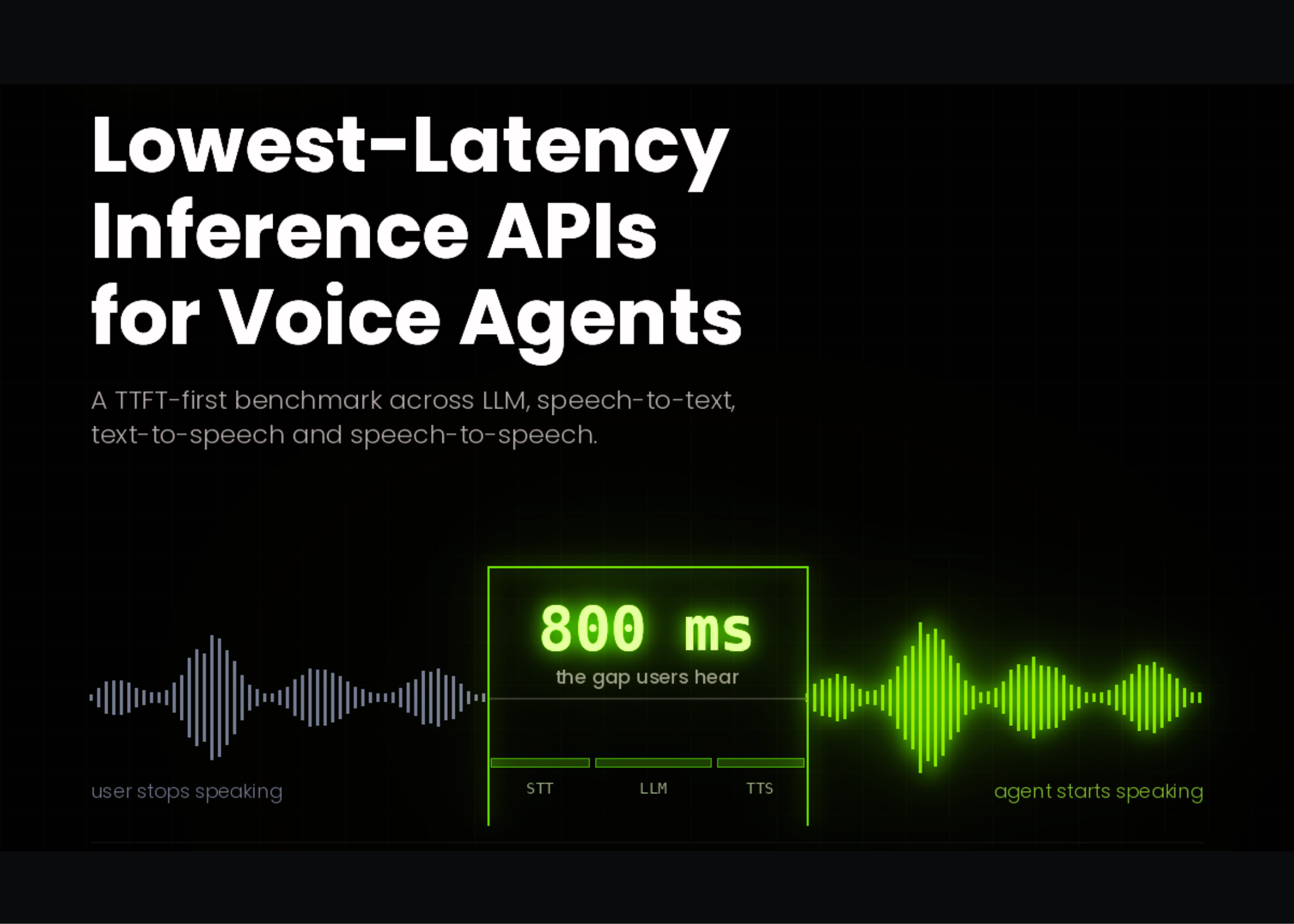
Why Voice AI Can Feel Slow Even When Your System Is Fast
If you are considering a voice assistant for customer enquiries, appointment booking, order updates or internal support, you may assume the main question is simple: which AI model returns an answer fastest?
That question is useful, but incomplete. A voice conversation involves several waiting points. The system must detect that a person has finished speaking, convert speech into text, generate a response, turn that response back into audio and deliver it over the network. A delay in any one stage can make your assistant sound hesitant, interrupt the caller or respond after the conversation has already moved on.
This matters for you because customers do not experience technical metrics. They experience silence. A response that begins quickly but takes too long to form a usable sentence can feel slower than a system with a slightly higher first-token result but better end-to-end timing.
TL;DR: Time to first token, or TTFT, is only the start of the measurement. For voice, you should also track time to first sentence, end-of-turn detection and total voice-to-voice latency.
A practical target cited in the source material is roughly 700 milliseconds of LLM latency within a natural voice interaction, while a broader end-to-end voice turn may be around 700 milliseconds to 1.2 seconds. Treat these as testing references, not guarantees.
What This Means
Time to first token measures how long an AI model takes to send its first piece of generated text after receiving a request. It is a useful starting point for comparing inference services, especially for text chat.
Voice systems have an additional limitation: text-to-speech software generally cannot speak naturally from a single incomplete word. It needs a meaningful phrase, clause or sentence. This is why time to first sentence, or TTFS, can describe the user experience more accurately than TTFT alone.
Imagine two systems. System A sends its first token in 300 milliseconds but needs another 900 milliseconds to form a speakable sentence. System B sends its first token in 500 milliseconds and completes a short sentence in another 200 milliseconds. To the caller, System B may feel faster because speech begins earlier.
Key insight: A fast first token is not the same as a fast spoken response. Test the moment the user hears a useful sentence.
The complete voice turn normally includes these stages:
| Stage | What happens | Reference timing or consideration |
|---|---|---|
| End-of-turn detection | The system recognises that the caller has stopped speaking | Vendor figures vary; test with Malaysian accents, pauses and background noise |
| Speech-to-text | The caller’s speech becomes text | Streaming systems can provide partial text before the final transcript |
| LLM inference | The language model decides what to say | Some benchmark results report TTFT below one second, but workload and location affect results |
| Text-to-speech | The response becomes spoken audio | Short, complete clauses usually start speaking sooner than long paragraphs |
| Network delivery | Audio travels to the caller | Server location, routing and connection quality affect the experience |
The source benchmark highlights several reasons you should avoid accepting a provider’s headline latency figure without testing it yourself. Workload size changes the result. A system tested with a short prompt may perform differently when your real prompt includes business rules, customer history, product information, escalation instructions and tool definitions.
Location also matters. A test run from a cloud machine in the United States includes a different network path from a call handled in Kuala Lumpur, Penang or Johor. The same model can produce different results on different hosting platforms. Queueing, routing, hardware configuration and whether the system is already warm all influence the delay.
How This Applies to Malaysian SMEs
For a Malaysian clinic, dental practice or beauty centre, a voice agent may need to handle appointment requests. The assistant must understand names, dates, times and locations, then check availability before answering. If the system waits too long after every sentence, callers may repeat themselves or hang up. You should test common local phrases such as “esok pagi,” “hari Isnin petang” and mixed Malay-English requests, rather than measuring only a clean English script.
For a restaurant, catering business or food supplier, the assistant may answer questions about operating hours, delivery areas, menu items and order status. These interactions often require short answers, so response design becomes especially important. A voice agent that says, “I’m checking that for you” immediately, then delivers the result, may feel more responsive than one that remains silent while performing the same lookup. You can also limit the first spoken sentence to one clear idea before giving further details.
For a contractor, distributor or service company, callers may ask for quotations, technician availability or delivery updates. The AI may need to retrieve information from a CRM, spreadsheet, inventory system or messaging workflow. That business lookup can create more delay than the language model itself. Measure the complete journey from the caller stopping speech to hearing a useful answer, including database and automation steps.
Retailers and online sellers should also consider language switching. Malaysian customers may move between Bahasa Malaysia, English, Mandarin phrases, Tamil phrases and industry terms during one call. A speech-to-text model can appear fast in a controlled demo but struggle with product names, local pronunciation or noisy shop environments. Record representative calls with permission, remove sensitive information and test the system against real speech patterns.
For internal operations, voice AI can help staff check stock, submit a leave request or ask for delivery progress while their hands are occupied. In this setting, accuracy and confirmation may matter more than absolute speed. A fast assistant that changes the wrong delivery quantity creates more operational risk than a slightly slower assistant that confirms the item and quantity clearly.
Practical Takeaways
- Measure the full voice turn. Record the time from the end of the caller’s speech to the start of a useful spoken response.
- Track more than TTFT. Include end-of-turn detection, time to first sentence, total response completion and interruption rate.
- Use your real prompts. Include your actual policies, service areas, FAQs, customer records and tool instructions during testing.
- Test from Malaysia. Network routing can change results, so evaluate the experience from the locations where your customers and staff are based.
- Keep spoken replies short. Give the direct answer first, then ask whether the caller wants more detail.
- Design for interruption. Customers will speak over a slow or overly detailed assistant. The system should stop audio and listen again.
- Test local speech patterns. Include code-switching, names, addresses, Malaysian place names and background noise.
- Separate speed from quality. A response that arrives quickly but misunderstands the request is not a successful interaction.
- Set an escalation path. Let the caller reach a person when the request is uncertain, sensitive or outside the assistant’s authority.
- Review results by percentile. Median performance can hide occasional long pauses. Check slower sessions as well as typical ones.
A Simple Pilot Scorecard
Before choosing a provider, run a small pilot using 20 to 30 common call scenarios. The exact sample size is your choice, but keep the scenarios consistent across providers. Score each test using the following structure:
| Measure | Question to ask | What good performance looks like |
|---|---|---|
| Recognition | Did the system understand the caller? | Correct names, dates, products and request intent |
| Responsiveness | How long was the silence after the caller stopped? | Consistent response without uncomfortable pauses |
| First sentence | When did the caller hear a useful answer? | Early acknowledgement followed by a relevant result |
| Interruption handling | Could the caller correct or redirect the assistant? | Audio stops promptly and the assistant listens |
| Task completion | Was the requested action completed correctly? | Accurate booking, update, lookup or escalation |
The Bigger Picture
Voice AI selection is likely to move away from one headline metric. Providers may continue publishing TTFT, output speed and model capability scores, but your business needs an end-to-end measurement that reflects what callers hear.
This also means the best system for your SME may not be the model with the highest general benchmark score. A smaller model with fast first-sentence timing, strong local speech recognition and reliable integration with your business tools may deliver a better customer experience.
Architecture will matter as much as model choice. Streaming speech recognition, short response chunks, warm services, sensible prompt design and nearby infrastructure can reduce perceived waiting. So can a well-written conversation flow that acknowledges the request without pretending to have completed an action.
Start with one narrow workflow, such as appointment confirmation or order-status enquiries. Capture real performance, review failed conversations and improve the flow before expanding. Your goal is not merely to make the AI answer quickly. Your goal is to make the caller feel understood, informed and able to complete the task without repeating themselves.
For a Malaysian SME, that is the practical test: does the voice assistant reduce interruptions and staff workload while keeping the conversation clear? If it does, the latency numbers are supporting the business rather than distracting from it.
Ready to Streamline Your Operations?
Your business should run itself. AutoRunBiz deploys AI agents to automate your daily operations — WhatsApp orders, invoicing, customer follow-ups, and accounting. Book a free 15-min ops audit to see where automation fits your business →