
When Charging Infrastructure Gets in the Way
If your business operates vehicles, manages a busy service area, or handles customer cars, you already know that floor space is not just empty space. It is where vehicles move, staff work, stock is handled, and customers are served. Any equipment placed there can become an obstruction, a safety concern, or another item that gets damaged.
Electric vehicles add a new operational question: where do you charge them without disrupting the work already happening? A conventional charging point may be practical in an open car park, but it can be less suitable in a tight workshop, vehicle depot, rental yard, hotel driveway, or delivery hub.
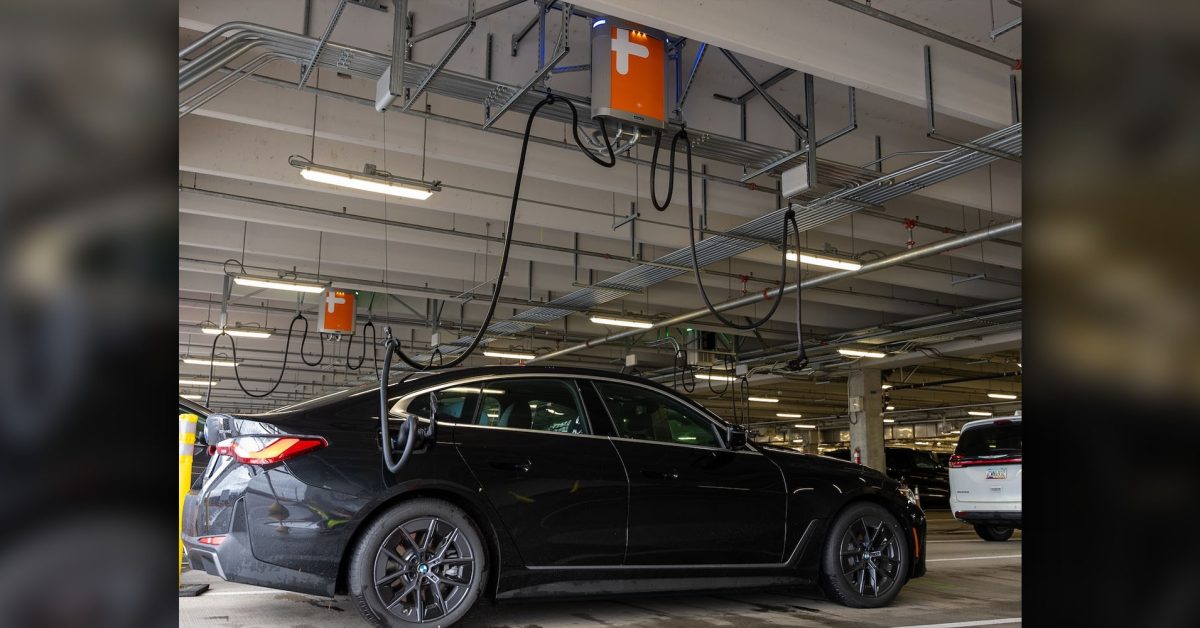
A recent installation at Portland International Airport offers a useful idea. The airport fitted 10 dual-port fast chargers above its rental-car processing area, allowing up to 20 rental EVs to charge while keeping the equipment away from vehicle paths. The system uses retractable cables that staff pull down when needed. Source: Electrek
TL;DR
Overhead EV charging shows how you can solve a capacity problem by changing the layout, not simply adding more equipment on the ground.
For Malaysian SMEs, the main lesson is to plan charging around workflow, safety, vehicle turnaround, and digital monitoring before choosing hardware.
What This Means
The Portland system places the charging equipment above the vehicles instead of beside them. Ten chargers have two ports each, creating capacity for 20 vehicles at once. Each charger is rated at 200 kilowatts. Source: Electrek
The cables can be pulled down when a vehicle needs charging and retracted afterwards. This keeps the cables and charger housings out of the way while cars move through the facility. It also reduces the chance that a vehicle will hit a charging unit.
The airport’s rental-car facility is designed for quick preparation between customers. Vehicles are cleaned, checked, and serviced before returning to the fleet. Charging takes place within that short operating window, rather than requiring a separate trip to a distant charging area.
This is not merely a story about a particular charger design. It is an example of infrastructure fitting the workflow. Instead of asking staff to change their entire process around charging equipment, the equipment is installed where the existing process can support it.
The useful question is not “Where can we put a charger?” but “Where can charging happen without slowing the work?”
How This Applies to Malaysian SMEs
1. Vehicle rental and leasing businesses
If you manage rental cars, company vehicles, or short-term leases, vehicle turnaround is central to your operation. A car may need inspection, cleaning, charging, and handover within the same day. Ground-mounted chargers placed beside moving vehicles can create obstacles for cleaners, drivers, and technicians.
An overhead arrangement could make sense in a covered depot where vehicles already follow fixed lanes. You could designate charging bays within the cleaning or inspection sequence, allowing staff to connect a vehicle while other preparation work continues. Before considering this design, review ceiling height, cable reach, drainage, lighting, emergency access, and the movement of SUVs or vans.
2. Workshops and automotive service centres
Malaysian workshops are often organised around limited working space. Tools, lifts, spare parts, customer vehicles, and technician movement already compete for room. Adding multiple chargers at ground level may increase clutter, especially if the charger is near a service bay entrance.
A ceiling-mounted system may help in selected bays, particularly when the charging cable can reach the vehicle without crossing a walkway. However, you should not treat overhead installation as automatically safer. The structure must support the equipment, cables must be protected from heat and fluids, and technicians need clear procedures for connecting and disconnecting vehicles.
3. Delivery, logistics, and service fleets
If your company operates vans or light commercial vehicles, charging may need to happen during loading, dispatch preparation, or driver changeover. A busy yard can become difficult to manage when cables are laid across vehicle routes.
You can apply the same principle even if you do not need high-power fast charging. A structured charging zone with cables suspended above the parking positions may keep the ground clear. Fleet software can help your team see which vehicles are charging, which are ready, and which require attention. The Portland installation includes remote monitoring, troubleshooting, and charging management based on vehicle requirements. Source: Electrek
4. Hotels, serviced apartments, and transport operators
Hotels and transport companies may need to serve EVs while preserving customer parking and driveway access. An overhead approach could be useful in a covered arrival area or fleet holding zone, but only if it does not affect clearance for luggage vehicles, buses, or emergency services.
You should also consider who will connect the charger. If guests are expected to do it themselves, the cable system must be simple and clearly labelled. If your staff manage charging, assign responsibility for checking the connector, returning the cable, and reporting faults.
A Simple Comparison
| Charging arrangement | Best suited to | Main operational concern |
|---|---|---|
| Ground-mounted charger | Open car parks and spacious yards | Vehicle impact, cable obstruction, and parking layout |
| Wall-mounted charger | Fixed bays beside suitable walls | Limited positioning and cable reach |
| Overhead charger | Covered depots with fixed vehicle routes | Structural design, ceiling clearance, and maintenance access |
| Shared charging area | Small fleets with flexible schedules | Vehicle queuing and unclear charging priority |
The Portland installation uses 10 dual-port chargers to serve up to 20 vehicles at once. Source: Electrek Your own requirement may be much smaller. The important point is to match the layout to the number of vehicles, their daily movement, and the time available for charging.
Practical Takeaways
- Map vehicle movement first. Draw the route from arrival to inspection, cleaning, charging, loading, and departure.
- Identify the charging window. Note when vehicles are stationary and how long they normally remain in that location.
- Separate charging from pedestrian routes. Avoid cables crossing staff walkways, ramps, entrances, or emergency paths.
- Measure clearance carefully. Check ceiling height and vehicle height, including roof racks and opened tailgates.
- Assess electrical capacity. Ask a qualified electrical contractor to review the supply, protection systems, cable routes, and future expansion needs.
- Plan for Malaysia’s conditions. Consider heat, humidity, heavy rain, water exposure, dust, and frequent washing activities.
- Use charging priorities. A vehicle leaving soon may need priority over one scheduled later.
- Assign responsibility. Decide who connects vehicles, checks charging status, handles faults, and records completed charging.
- Start with a controlled pilot. Test one or two bays before changing the layout across the whole facility.
- Keep an alternative process. Your team should know what to do if a charger is unavailable or a vehicle fails to charge.
Questions to Ask Before You Install
Start by asking how many vehicles genuinely need charging during the busiest operating period. Do not base the answer only on your total fleet size. A fleet of 15 vehicles may not require 15 charging points if departures are spread across the day, while a smaller fleet may need more capacity if all vehicles leave at the same time.
Next, ask whether your current site can support a dedicated charging sequence. If vehicles arrive randomly and staff park them wherever space is available, charging equipment may not solve the underlying coordination problem. You may first need marked bays, simple booking rules, and a clearer vehicle status system.
Finally, ask how charging information will reach the person making operational decisions. Remote monitoring is useful only when someone reviews alerts and acts on them. A dashboard that no one checks will not prevent delays.
The Bigger Picture
As more businesses add EVs, the challenge will not be limited to buying chargers. It will involve redesigning how vehicles are parked, serviced, dispatched, and monitored. Space-constrained businesses will need to think vertically, share equipment intelligently, and connect charging data to daily operations.
The Portland example also shows why charging should be treated as part of a business process rather than a standalone electrical installation. The airport selected an overhead arrangement because its rental-car facility has constant vehicle movement and limited usable floor space. The stated benefits include reduced conduit and wiring requirements and better protection against vehicle damage. Source: Electrek
For a Malaysian SME, you do not need to copy the exact system. You can borrow the thinking behind it: place infrastructure where it supports work, remove avoidable obstructions, and use clear operating rules. Whether you eventually install one charger or a larger fleet system, the best design will be the one your staff can use consistently during a busy day.
Your next step: walk through your site during its busiest period and observe where vehicles wait, where staff cross, and where cables would create problems. That simple exercise can reveal whether your business needs more chargers, a different layout, or better coordination before you commit to equipment.
Ready to Streamline Your Operations?
Your business should run itself. AutoRunBiz deploys AI agents to automate your daily operations — WhatsApp orders, invoicing, customer follow-ups, and accounting. Book a free 15-min ops audit to see where automation fits your business →