
Your SME’s Next Productivity Boost Isn’t Software. It’s Power.
Think about the last time you had to hunt for a free wall socket in your office. Then multiply that by every employee, every laptop, every phone, and every pair of wireless earbuds. For a Malaysian SME owner with a lean team, the battle for charging ports is real—and it’s a silent killer of productivity. That’s why the launch of the Satechi 240W ChargeView desktop charger is more relevant than you might think.
What Happened
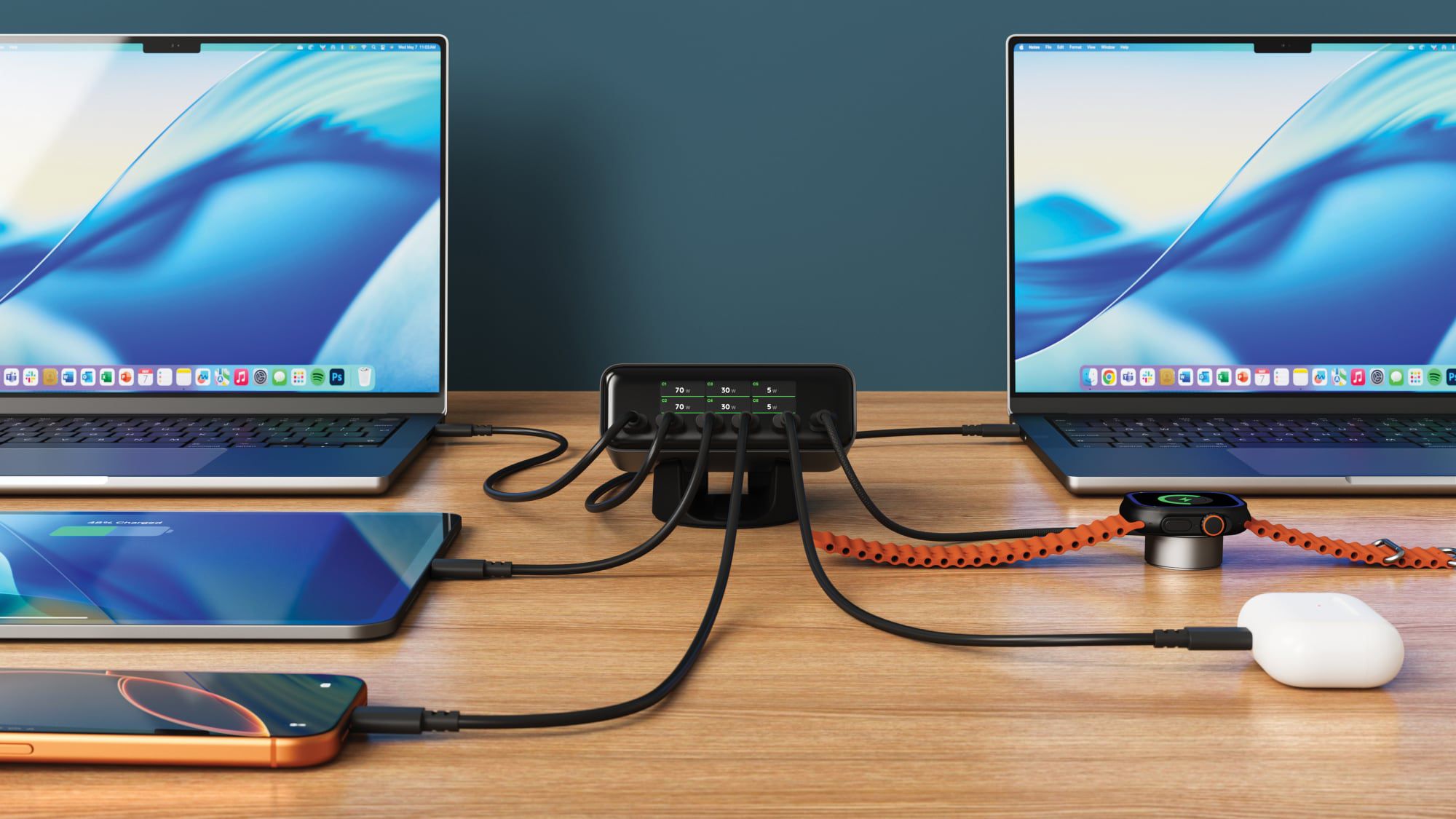
Satechi this week unveiled the ChargeView 240W Desktop Charger—a follow-up to its popular 140W model from last year. The new unit packs six USB-C ports into a compact, fanless chassis built around gallium nitride (GaN) technology. It also adds a live LCD display showing the wattage flowing to each connected device, so you always know where your power is going.
Here’s the division of power: The first two ports (C1 and C2) can each deliver up to 140W, enough to fast-charge a MacBook Pro. The next two (C3 and C4) each cap at 100W, while the final two ports (C5 and C6) output up to 30W each. But if you plug in six devices simultaneously, the charger intelligently redistributes its 240W total—splitting 70W/70W/30W/30W/20W/20W across the ports. The adapter also momentarily interrupts power to a connected device when you plug in a new one, because it recalculates the load. It comes in a Space Black finish that’s clearly designed to match Apple’s ecosystem, but its utility goes far beyond that.
“In a small business, every minute of downtime is lost revenue. If your device isn’t charged, you’re not working.” — A common sentiment among Malaysian SME owners we’ve spoken to.
Why This Matters for Malaysian SMEs
Your office doesn’t need a 240W desktop charger just to juice up a few phones. But consider what your typical workday looks like. Your team likely juggles multiple gadgets: a company laptop, a personal phone, a tablet for client presentations, perhaps a portable Wi-Fi router. In many Malaysian SMEs, particularly those in hybrid or hot-desking setups, the charging situation is chaotic. Power strips get overloaded, chargers get lost, and employees either fight over sockets or spend half an hour with a phone at 10% battery. The ChargeView’s six-port design eliminates that conflict in one elegant unit. The LCD display gives you instant visibility—no more guessing which device draws the most power or whether a port is actually working.
There’s also the Malaysian climate to consider. GaN technology allows this charger to be compact, and because it’s fanless, it operates silently—a blessing when your office air-conditioning is already working overtime. The vertical or horizontal stand included with the charger means you can place it on a shared desk without it taking up critical space. For SMEs that host clients or run demo stations, one multi-port charger can power the laptop, the sales screen, and a customer’s phone simultaneously. That small touch of polished convenience leaves a strong impression.
But let’s talk about efficiency. A single high-wattage charger uses energy more efficiently than five separate low-quality adapters plugged into one extension cord. In a small office, every socket counts, and every ringgit of electricity matters. The ChargeView’s automatic power redistribution ensures that the most demanding device gets the juice it needs, while lower-priority gadgets still keep ticking. That’s not just convenient; it’s smart power management—something that belongs in any SME’s digital infrastructure toolkit.
The Bigger Picture
The Satechi ChargeView 240W is part of a broader trend: business hardware is becoming simpler, denser, and more integrated. The days of a separate charger for every device are ending. Instead, we’re seeing multi-port hubs serve as central charging stations—essentially the power equivalent of the USB-C dock that turned many Malaysian home offices into professional setups during the pandemic.
For SMEs, adopting such tools is about more than convenience. It’s about future-proofing your operations. As more business processes move to mobile devices, retail payments via tablets, and remote client meetings over laptops, your team’s ability to stay charged directly impacts revenue. A charger that can handle all of your devices at once reduces friction and helps you maintain momentum throughout the day. That’s a quiet but meaningful step in your business automation journey.
The technology also reflects a growing recognition that power delivery is a data problem, not just a hardware one. The LCD display on the ChargeView treats electricity like information—you can monitor it, measure it, and understand your usage patterns. For a business owner who cares about efficiency in all forms, this is a philosophical shift as much as a practical upgrade.
Key Points at a Glance
| Port | Maximum Power | When All Six Ports Are Used |
|---|---|---|
| C1 & C2 | 140W each | 70W each |
| C3 & C4 | 100W each | 30W each |
| C5 & C6 | 30W each | 20W each |
Yes, the ChargeView is an Apple-adjacent accessory in its design language, but its real audience is any small business that wants one clean, powerful, and observable charging solution for its everyday devices. The price might make some owners pause, but when you add up the time saved, the clutter removed, and the productivity gained, the logic becomes clear.
Take a moment to assess your own work desk right now. How many chargers and cables are lying around? How many times each week does someone ask, “Is there a free plug?” If the answer is more than zero, you’ve just identified a small, solvable bottleneck in your SME’s daily operations. A six-port charger like this could be the next simple, high-impact addition to your office—and unlike a new software subscription, you’ll only need to buy it once.
Ready to Streamline Your Operations?
Technology moves fast. Your operations should keep up. AutoRunBiz builds AI systems that run your daily workflows — from WhatsApp order capture to accounting. Book a free 15-min ops audit →