
Shieldstral AI: Content Moderation Just Got Smaller and Smarter
If you run a Malaysian SME, you probably think AI safety tools are huge, expensive, and built for Silicon Valley giants. A new release from European AI lab Mistral AI suggests otherwise. The company has launched Shieldstral 1.0 3B, an open-weights multimodal safety classifier that runs locally on a single GPU and treats content moderation as one yes/no question. For your business, this could change how you manage customer comments, chatbot answers, and even product images — without relying on a distant moderation vendor. Here is what happened, why it matters to you, and what it signals for business automation in Malaysia.
What Happened
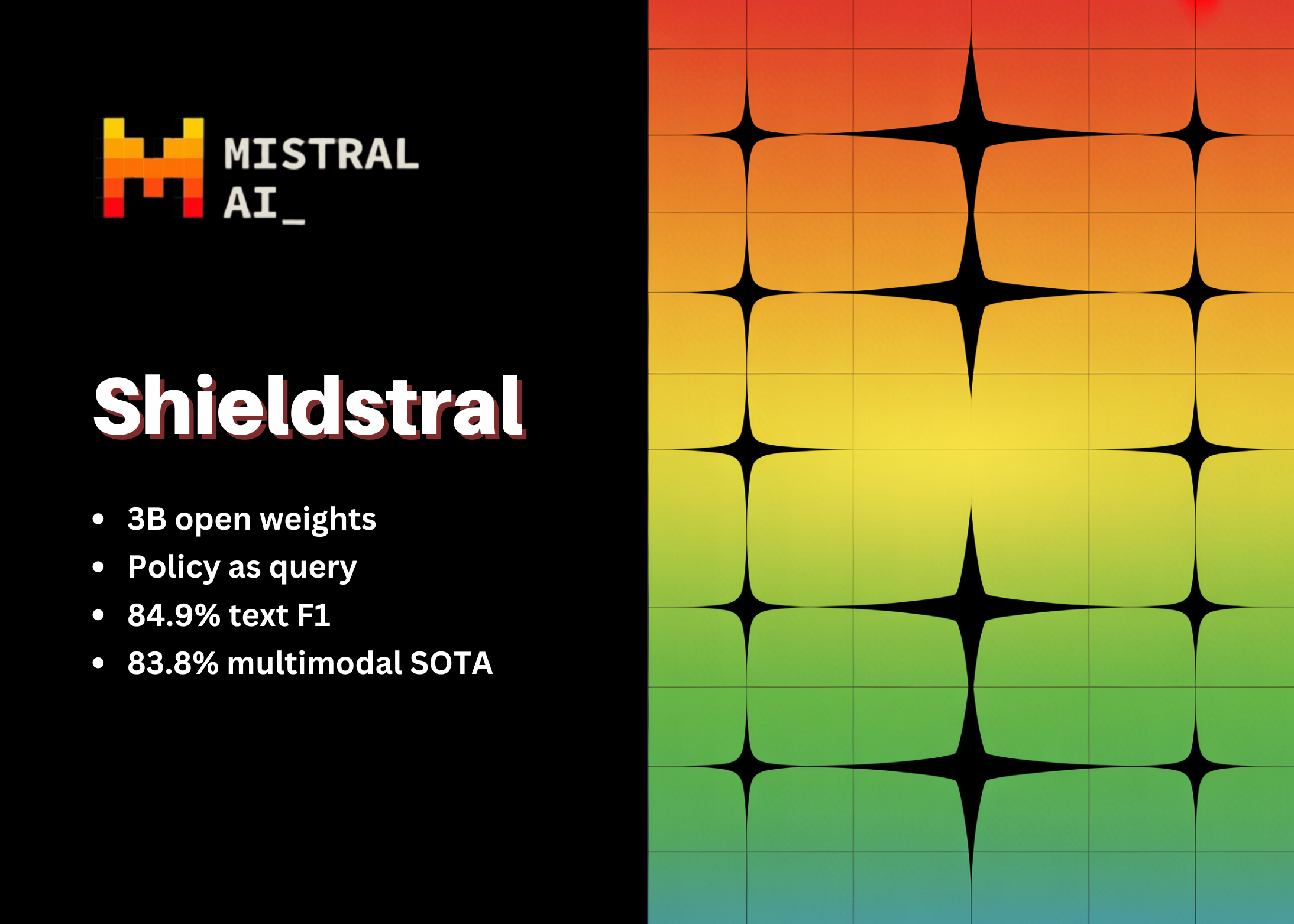
On August 7, 2026, Mistral AI released Shieldstral 1.0 3B, an open-weights, policy-adaptive multimodal safety classifier. Unlike traditional guardrails that have fixed harm categories, Shieldstral lets you define the moderation policy as a plain-language question at run time. You send a prompt, a response, or an image and ask something like, “Does this content violate our platform’s safety rules?” The model returns a continuous safety score from a single forward pass, and you decide where to set the threshold. Built on Ministral-3-3B-Base-2512 with a Pixtral vision encoder, the model is licensed under Apache 2.0 and fits in 16GB of VRAM in BF16, making it deployable on one GPU (source).
Mistral’s reported results are remarkable for a 3B model. It scores an 84.9% average F1 on text safety, matching GPT-OSS-Safeguard-20B, while ranking best among evaluated baselines on multimodal safety at 83.8% (source). The secret is the data recipe: roughly 54.1 million training samples, including 4.4 million synthetic contrastive text examples where an LLM rewrites safe text into an unsafe variant that violates a specific category. That teaches the model which policy is violated rather than just safe/unsafe. It also supports vLLM, llama.cpp, SGLang, and Transformers, so you can serve it through standard tools (source).
Why This Matters for Malaysian SMEs
Think about how many places your business already has user-generated content. If you operate an online store, customers post reviews and comments on product pages. If you use a chatbot on WhatsApp or your website, it may just have said something off-brand or worse, off-policy. If you run a community marketplace, a booking platform, or a food-delivery service, you need to check messages for scams, offensive language, or unsafe images. Previously, a robust moderation system would require integrating a cloud API from a big tech vendor, sending your customer data to a foreign server, and paying per request. With Shieldstral, because it is open-weights and runs locally on a single 16GB GPU, you can keep everything inside your own infrastructure on the cloud or on-premises. That aligns with data-residency concerns and Malaysia’s Personal Data Protection Act (PDPA), which is a growing conversation for SMEs handling customer data.
Another angle: the policy-adaptive design means you aren’t locked into a fixed taxonomy. Say you run an ed-tech platform for Malaysian children. Your safety question might be stricter and include child-safety categories. If you also run a separate loyalty app for a retail brand, you can define a completely different moderation question. The same checkpoint can enforce a different policy per customer or per channel. Mistral’s guidance is one policy per call, so a multi-tenant SaaS platform can ask different yes/no questions for different tenants without training separate models. For an SME offering white-label automation services, that is massive – you can build a moderation layer that is flexible and defensible (source).
But be careful: the model has known weak spots. It struggles on some low-resource languages, including Indonesian and Arabic, and on adversarial or obfuscated inputs (source). Since Bahasa Melayu is linguistically close to Indonesian, you should run a small pilot on your actual Malaysian texts before putting it in production. Also note that while trained context is 32k tokens across 12 languages, English dominates the training mix. You’ll want to test local slang and code-switching common in Malaysia.
The Bigger Picture
This release is part of a wider trend: AI safety models are becoming smaller, cheaper to run, and more adaptable, meaning SMEs can soon afford the same protection as large enterprises. It’s not about building a giant in-house AI team. It’s about taking an open model and embedding it into your existing business workflow – your autoresponder, your review queue, your support ticket triage. At AutoRunBiz, we’re watching this because automation for Malaysian SMEs should include guardrails that are practical to run, not theoretical.
“Operators write the policy as a plain-language question at inference time, and the model returns a calibrated safety score from a single forward pass.” – MarktechPost
What does that mean for your bottom line? Fewer reputation headaches, faster customer response, and less manual screening. The model even outputs a continuous score instead of a hard label, so you can route borderline cases to human review rather than blocking a disgruntled customer who’s spelling slightly wrong. Combined with tools like vLLM, the latency is far below reasoning-based guards, making real-time gating of AI-generated responses viable (source).
Key takeaways at a glance
| Aspect | What it means for your SME |
|---|---|
| Policy definition | You write the moderation policy as a yes/no question at inference time, so no retraining per use case. |
| Deployment size | Fits in 16GB VRAM on a single GPU, so you can self-host in your own environment. |
| Open license | Apache 2.0 allows commercial use and modification, without vendor lock-in. |
| Multimodal support | Can check both text and image-plus-caption content, useful for online stores and ad creative review. |
| Language caution | Weaker on Indonesian/Arabic, so test with your Malaysian English and Malay content first. |
For a Malaysian SME owner, the prudent step is to start small. Pick one channel, like automated customer-service responses or product review comments. Run Shieldstral against a few hundred real examples. Tune the threshold until false positives and false negatives are acceptable. Once it’s comfortable, expand to other surfaces. The open-weight nature means you won’t be nickel-and-dimed per API call, and you stay in control of your data. The big-picture signal is clear: the latest open AI safety models are not just for enterprises anymore. They are for businesses like yours, if you know how to automate with them.
Ready to Streamline Your Operations?
Technology moves fast. Your operations should keep up. AutoRunBiz builds AI systems that run your daily workflows — from WhatsApp order capture to accounting. Book a free 15-min ops audit →