
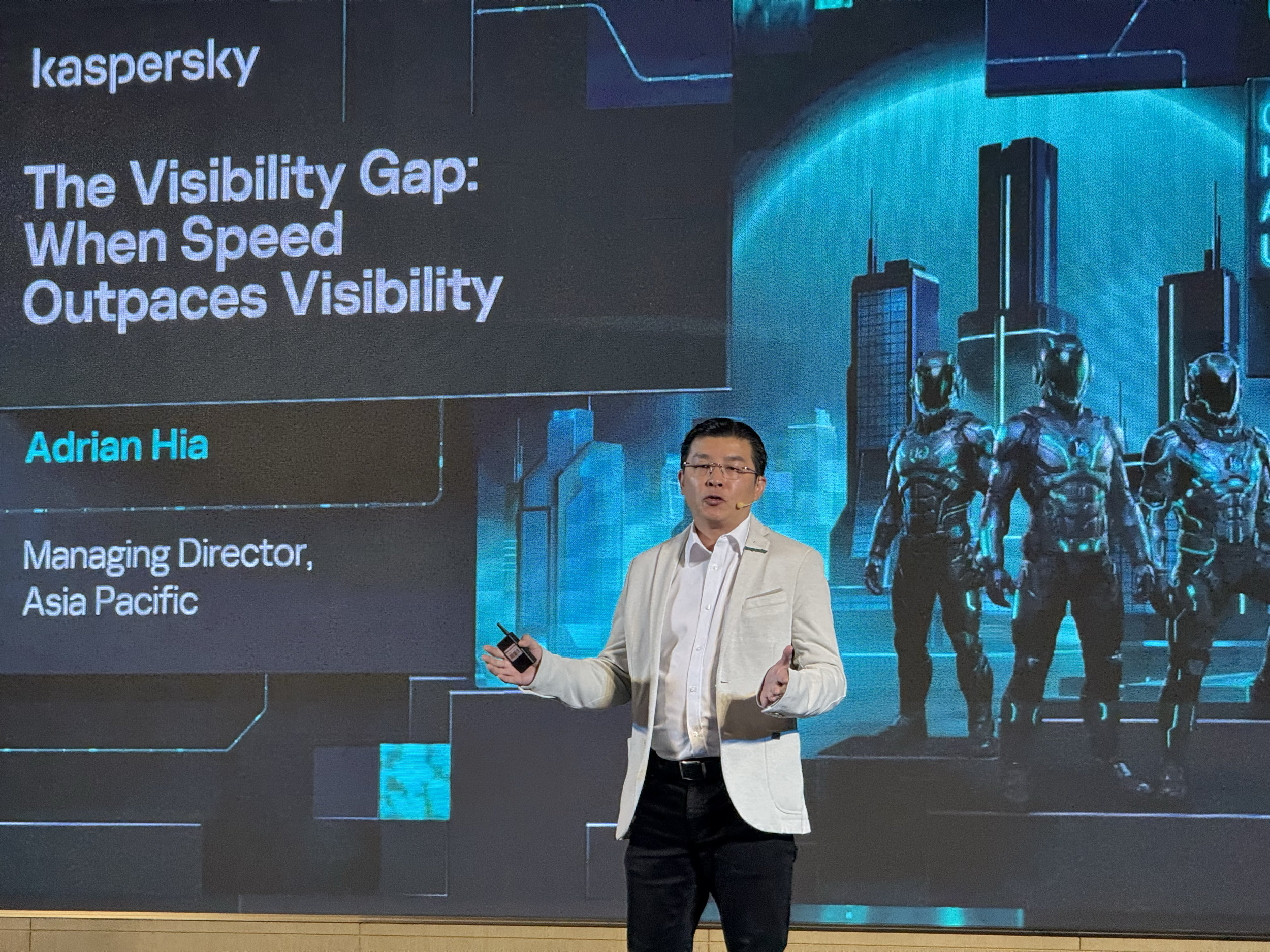
Your Business Is Now the Target — and the Attackers Are Faster Than You
You run a business in Malaysia. You’ve got stock to manage, staff to pay, customers to answer. The last thing on your mind is cyber security — and that is exactly what the attackers are counting on. While you’re busy running your operations, automated systems are working around the clock to find a way into your company.
Here is the uncomfortable truth: cybercriminals no longer need to be clever. They just need to be fast. Kaspersky’s latest research shows that AI-powered cyberattacks are now moving faster than companies can detect them (source). For a business with no dedicated IT team, that speed gap is not a minor inconvenience. It’s a survival issue.
TL;DR: AI lets attackers generate phishing emails, fake voice calls, and malware in minutes. Most SMEs still rely on manual checks and human vigilance — which is simply too slow. You don’t need to become a security expert. But you do need to build simple automated defences before the next attack finds you.
What This Means
When security researchers talk about “AI-powered attacks,” they’re not describing robots breaking down your door. They’re describing software that can do in minutes what used to take a human hacker weeks. AI can analyse your company’s public footprint — your website, your social media, your vendor announcements — and craft a convincing attack tailored to you.
Kaspersky’s warning is specifically about detection speed. Traditional security tools work by recognising known threats. But AI can create new variations of attacks faster than those tools can be updated. By the time your antivirus software sees a new phishing pattern, the attacker has already moved on to two dozen more variants. For large corporations, this means a race between AI attackers and AI defenders. For a small business, there is no race — because the race never even started.
“The speed gap is the new vulnerability. Attackers don’t need to be smarter than you. They just need to move faster than your manual processes.”
How This Applies to Malaysian SMEs
Let’s make this real. Imagine you run a mid-sized hardware supply company in Johor. You regularly transfer money to an overseas supplier. One Monday morning, you receive an email that looks exactly like a previous invoice from that supplier — same logo, same phrasing, same sender address format. The only difference is the bank account number in the payment instructions. This kind of attack has existed for years, but AI makes it infinitely more dangerous. The email is written in perfect English or Bahasa Melayu, it arrives at the exact moment your supplier usually bills you, and it references real past transactions scraped from compromised email threads. A human would struggle to spot the difference.
Then there’s the voice angle. Malaysian business culture still runs heavily on phone calls and WhatsApp. AI-powered deepfake audio can now mimic a business partner’s voice convincingly. There are documented cases globally of employees receiving urgent “calls” from their boss authorising emergency transfers. For a Malaysian SME where the boss is often the owner and makes quick decisions by phone, this is a genuine exposure. Your staff are trained to obey instructions from the top — and AI just made those instructions easy to fake.
What worries security experts most is the smallest business. Kaspersky’s finding about attack speed matters less to a company with a full security operations centre, and far more to a company with one part-time IT person — or none at all (source). If a ransomware attack hits your business on a Friday night, a large company’s automated systems might detect and contain it within minutes. Your business might discover it on Monday morning, when your entire customer database is encrypted. The attack didn’t get faster. Your detection simply never got started.
The Malaysian SME Reality Check
Most SME owners I talk to in Malaysia have one of two responses. Either they think “we’re too small to be targeted,” or they think “security is too complicated and expensive for us.” Both reactions are now dangerously outdated. AI has made targeting small businesses cheap and scalable. An attacker doesn’t need to manually hunt for weak targets — the software does it. And security tools have also become more accessible, but only for businesses that actively choose to automate their defences.
The businesses that survive this shift will be those that treat security as part of their daily operations, not an annual audit. That means automating backups, automating software updates, and automating the verification of any financial instruction that arrives digitally. None of this requires you to become a hacker. It requires you to add small, repeatable systems — the same way you automate your accounting or inventory processes.
Think about the last time your business faced a disruption. Maybe a flood, a system crash, or a supplier delay. You had a way to recover, because you’d built processes around those risks. Cyberattacks are now the same category of risk — predictable, frequent, and manageable with the right preparation. The difference is that the window for response is shrinking, and only automation can keep pace.
| Attack vector | How it used to work | What AI changes |
|---|---|---|
| Phishing emails | Written by humans, often with grammar mistakes and generic content | Generated in minutes, perfect language, personalised to your actual vendors and customers |
| Voice calls / WhatsApp | Obvious scams, scripted calls | Deepfake audio of your business partner’s voice authorising urgent payments |
| Malware and ransomware | Slow to develop, often reused for years | Adaptive malware that changes itself to avoid detection by signature-based tools |
| Scanning for weak targets | Manual, limited to high-value victims | Automated scanning of thousands of SME websites overnight, looking for one weak entry point |
Practical Takeaways: What You Can Do This Week
You don’t need a security department to close the most dangerous gaps. Start with these five actions:
- Turn on two-factor authentication everywhere. Email, banking portals, and especially your accounting software. This single step blocks the majority of account takeover attempts.
- Create a “payment verification rule.” Any change to bank account details or any urgent transfer request must be confirmed through a separate channel — ideally a phone call to a number you already have, not the number in the suspicious email.
- Automate your backups. Offline or cloud backups that run daily without anyone having to remember them. Test a restore at least once every three months.
- Educate your staff on the deepfake risk. Tell them that seeing a familiar face or hearing a familiar voice is no longer proof of identity. This awareness costs nothing and prevents the most expensive mistakes.
- Patch your software on a schedule. Set a recurring weekly task to update your systems and plugins. Unpatched software is the easiest entrance for automated attackers.
The Bigger Picture
What Kaspersky is really telling us is that the era of “wait and see” security is over. In the past, a small business could reasonably respond to a cyber incident after it happened — the damage was often limited and contained. AI has changed that equation. Attacks now move faster than human response, which means the only viable defence for a small business is prevention through automation (source).
The good news is that the same AI that powers attacks also powers defence. Automated email filtering, AI-based threat detection for cloud systems, and automated backup verification are all becoming more effective and more practical for businesses of your size. You don’t need to choose between running your business and protecting it. You need to choose which systems you will automate — and do it before the attackers make that choice for you.
Start small. Pick one automated defence this week. Because the attackers are already moving at machine speed, and the only way to match them is to stop relying on manual effort.
Ready to Streamline Your Operations?
Your business should run itself. AutoRunBiz deploys AI agents to automate your daily operations — WhatsApp orders, invoicing, customer follow-ups, and accounting. Book a free 15-min ops audit to see where automation fits your business →