
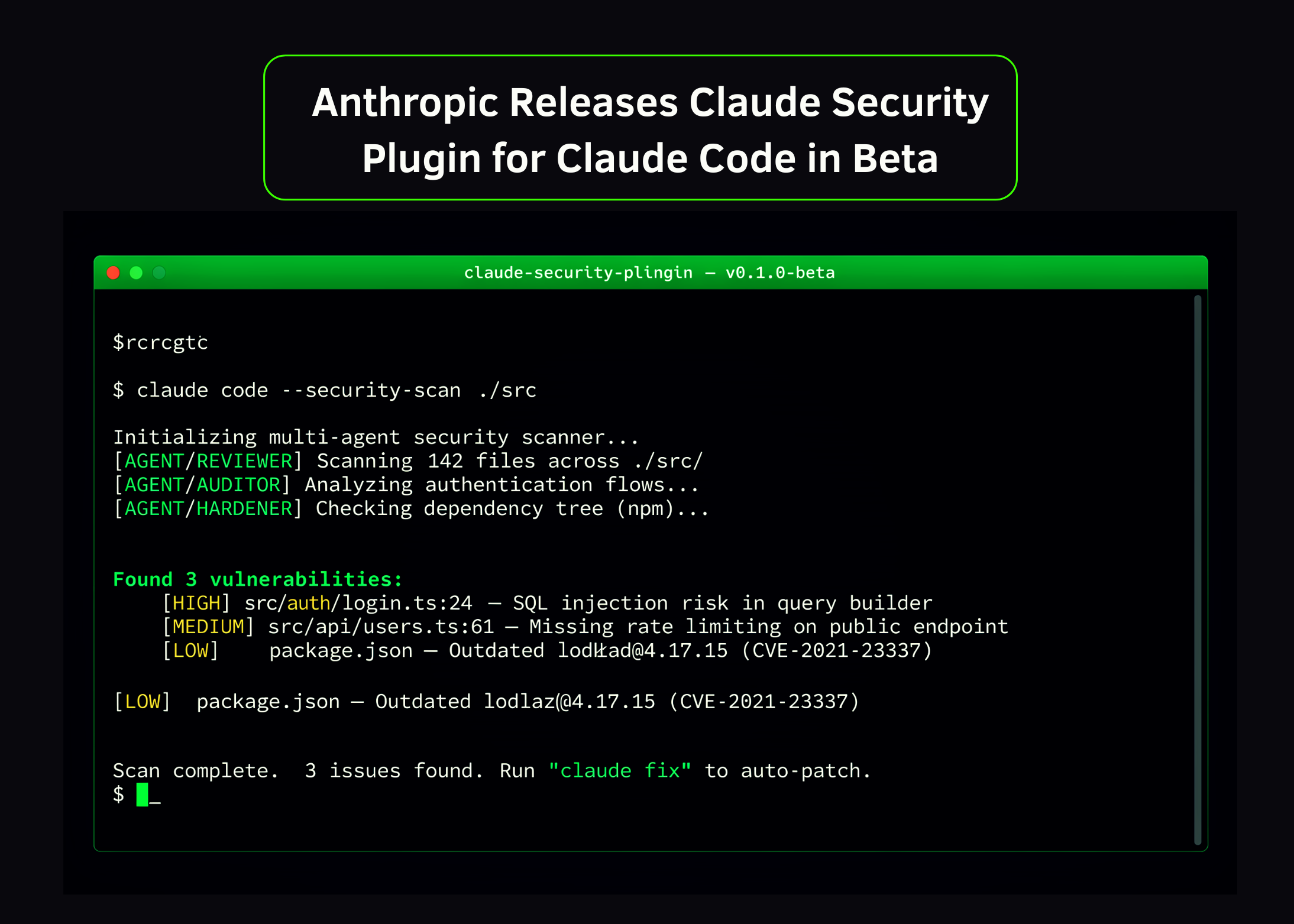
Your Code Ships with a Built-in Security Panel Now
Running a small to medium enterprise in Malaysia means you are used to wearing many hats—marketer, accountant, operations manager. If you manage any sort of digital product, you are also the de facto Head of IT Security. But what do you do when your code is built by a small team or freelancers, and none of you have deep cybersecurity expertise? Trusting that a project is “secure” is a gamble. Now, imagine a tool that acts as a panel of expert security reviewers, automatically scanning your entire application and only flagging bugs that survive a rigorous vote. That’s exactly what Anthropic released in beta with their Claude Security plugin for Claude Code.
What Happened?
Anthropic announced the Claude Security plugin for Claude Code in beta, as covered by Marktechpost. The plugin transforms a normal terminal session into a sophisticated multi-agent vulnerability scanner. It adds a single command, /claude-security, which opens a menu of three jobs, per the official documentation: scan the full codebase, scan recent changes (a specific commit, branch, or pull request), and automatically generate patches.
The scanning process is not a simple single-pass AI query. It is a fully structured dynamic workflow divided into six phases: Inventory, Threat Model, Research, Sweep, Panel, and Adversarial.
The most critical part is the “Panel” phase. Your code is analyzed by researchers looking at four fixed security categories: injection/input, auth/access, memory/unsafe operations, and crypto/secrets. Every candidate finding must be validated by three independent verifiers, each assessing a specific lens (Reachability, Impact, and Defenses). The process is clear: a finding only enters the final report if at least 2 out of 3 verifiers agree it is a true positive.
“A candidate finding does not go into the report because a researcher found it. It goes in only after surviving a panel. The keep quorum is 2 of 3… A unanimous 3/3 panel allows a confidence ceiling of high; a 2/3 quorum caps it at medium.” — Anthropic / Claude Code Documentation
Once a finding survives verification, the tool generates patches. Critically, these patches are developed in an isolated scratch clone of your repository to avoid touching your working tree. An independent agent reviews the patch, verifying it addresses the specific finding, introduces no new vulnerability, and does not change expected behavior. Only if these conditions are met do you receive a .patch file for manual application.
Why This Matters for Malaysian SMEs
Let’s connect this directly to your business reality. If you own a small e-commerce site or a booking platform for your service in Malaysia, every line of code is a potential liability. A single SQL injection or exposed API key can leak your customer’s data, costing you reputation and trust. Most small businesses do not have the luxury of a dedicated security operations center or a static analysis license.
This plugin bridges that gap. Imagine you run a small software house in KL building a mobile app for a client. After your developers finish, you can run a full /claude-security scan. The output is not just a list of bugs. It is a file containing a revision stamp—a structured JSON file that proves which commit was scanned, the exact effort tier used, and the verification status of every finding. You can show this file to your client as proof of a thorough security audit. The report artifact directory (CLAUDE-SECURITY-[timestamp]/) even ships with its own .gitignore so it doesn’t accidentally pollute your commit history, but deleting that file lets you commit the report for an audit trail.
For a solo entrepreneur or a micro business in Malaysia, this is a force multiplier. You don’t need to hire a security specialist for a pre-deployment check. You just need a paid Claude Code subscription and a few minutes in the terminal. The tool scales its effort using four tiers (Low, Medium, High, Max). If you are shipping a quick patch on a Friday, use a low-effort scan. For a quarterly architectural review, run a max-effort scan that deploys up to 24 components and multiple researchers. The flexibility respects both your timeline and your need for rigor.
Key Features at a Glance
| Feature | Detail |
|---|---|
| Command Entry | /claude-security inside Claude Code session |
| Scan Targets | Full Codebase, Changes (Branch/Commit/PR) |
| Fix Generation | .patch files, reviewed by separate agent |
| Verdict System | Panel of 3 Verifiers. 2/3 majority for True Positive. Caps confidence. |
| Effort Tiers | Low, Medium, High, Max (scales components & researchers) |
| Agent Roles | Opus (Orchestrator), Sonnet (Cartographer & Researchers) |
| Artifacts Written | MD Report, JSONL Data, Revision Stamp (with verification status) |
The Bigger Picture
This release signals a major shift in how developers and small businesses will interact with AI in production environments. The age of treating AI as a simple chat interface for writing code is closing. The new paradigm is agentic quality assurance—using structured, multi-step workflows to independently verify work.
The plugin’s architecture explicitly separates duties. The orchestrator runs on Opus (Anthropic’s strongest model) while the researchers and verifiers run on Sonnet. This is not just an optimization; it is a trust model. The orchestrator plans the strategy, and the verifiers execute the checks. The tool owns its limitations clearly. It tells you that scans are non-deterministic and do not replace traditional static analysis, dependency scanning, or code reviews. This honesty builds confidence. It knows where it fits in the stack: as a deep, on-demand, multi-agent scan that sits beyond a quick guidance plugin or a one-pass security review.
For the Malaysian SME market, the takeaway is profound. The cost of high-level code verification is dropping toward zero marginal effort. You are no longer forced to choose between “fast” and “secure”. By integrating this tool into your workflow, you create a verifiable, structured security posture for your applications. The next time you hand off a project or deploy a feature, you can point to a revision stamp that explicitly tracks how thoroughly the code was vetted. This is the security net every small business building software has been waiting for. It does not make the human developer obsolete, but it makes the process ruthlessly auditable.
Ready to Streamline Your Operations?
Technology moves fast. Your operations should keep up. AutoRunBiz builds AI systems that run your daily workflows — from WhatsApp order capture to accounting. Book a free 15-min ops audit →