
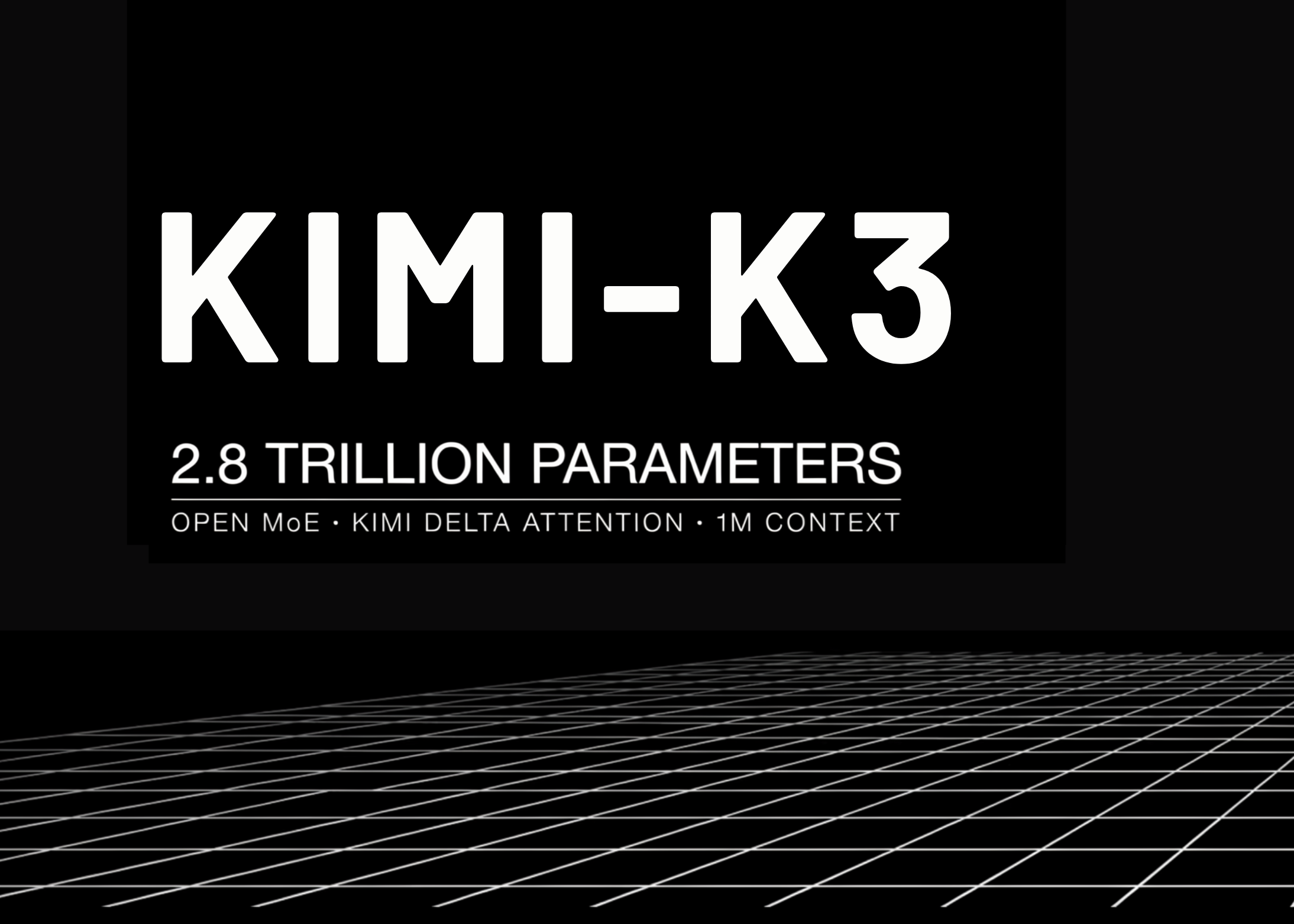
Moonshot AI Kimi K3: A 2.8 Trillion Parameter Open MoE Model Built for Real‑World Business Automation
Moonshot AI’s Kimi K3, a 2.8 trillion parameter open MoE model, is the first model of its kind that actually shifts what automation can do for a small business. It’s powerful enough that you’ll want to pay attention.
TL;DR: Moonshot AI released Kimi K3 (source), a 2.8‑trillion‑parameter open MoE model with a 1‑million‑token context window. It beats nearly every open model on coding and reasoning benchmarks while offering 6.3× faster decoding on long documents. For Malaysian SMEs, this means the automation tools available to you just got a major upgrade – if you know how to use them.
Architecture: Sparse MoE With Two Breakthrough Mechanisms
Kimi K3 is built on two architectural updates that change how information flows across sequence length and model depth. Together they make 2.8 trillion parameters practical for real workloads.
Kimi Delta Attention (KDA)
KDA is a hybrid linear attention mechanism. Moonshot states it enables up to 6.3× faster decoding in million‑token contexts – critical for processing long contracts, support logs, or technical manuals without memory blow‑up.
Attention Residuals (AttnRes)
AttnRes works along the depth axis. It selectively retrieves representations across layers rather than accumulating them uniformly. The result is roughly 25% higher training efficiency at under 2% additional cost.
Sparsity and Optimisation
K3 uses Stable LatentMoE, activating only 16 of 896 experts per token. To make that sparsity work reliably, Moonshot introduced:
- Quantile Balancing – derives expert allocation directly from router‑score quantiles, eliminating heuristic updates and a sensitive balancing hyperparameter.
- Per‑Head Muon – extends Muon by optimising attention heads independently.
- SiTU and Gated MLA – improve activation control and attention selectivity.
“Together these refinements yield roughly 2.5× better overall scaling efficiency than Kimi K2.” – Moonshot AI
Performance Benchmarks
All K3 results use reasoning effort set to max. The table shows how it compares with proprietary and open models:
| Benchmark | Kimi K3 | Fable 5* | GPT 5.6 Sol | Opus 4.8 | GLM‑5.2 |
|---|---|---|---|---|---|
| DeepSWE | 67.5 | 70.0 | 73.0 | 59.0 | 46.2 |
| Program Bench | 77.8 | 76.8 | 77.6 | 71.9 | 63.7 |
| Terminal Bench 2.1 | 88.3 | 84.6 | 88.8 | 84.6 | 82.7 |
| FrontierSWE | 81.2 | 86.6 | 71.3 | 66.7 | 67 |
* Fable 5 and GPT 5.6 Sol are proprietary models; K3 still matches or beats them on several tasks.
For an open model, K3 leads the pack – it outperforms all other open models on every benchmark and even exceeds some proprietary ones on Terminal Bench.
What This Means for Malaysian SMEs
K3’s 1‑million‑token context window lets you feed entire knowledge bases, financial years of customer data, or manufacturing manuals into a single prompt. Its 6.3× speedup makes that practical without waiting minutes for answers. The sparse architecture also means you can run it on more modest hardware than dense models of similar size, lowering the barrier for local deployment.
Ready to Apply This to Your Business?
Kimi K3 brings frontier‑level reasoning within reach of small teams. If you want to turn this technology into real automation workflows, we’re here to help.