
Your delivery driver is circling a block in Petaling Jaya, phone in hand, trying to figure out which charging app belongs to that charger bay.
Sound familiar? If you’re running a small business with any sort of vehicle — a delivery van, a company car for your sales rep, even your own commute to the workshop — you’ve probably looked at electric vehicles and thought: “Maybe, but what about the charging?”
That hesitation isn’t about the cars. Modern EVs are genuinely practical for many routes in Malaysia. The real obstacle has always been the charging experience: multiple apps, multiple RFID cards, chargers that look different from one parking lot to the next, and no clear answer on which ones you can actually use.
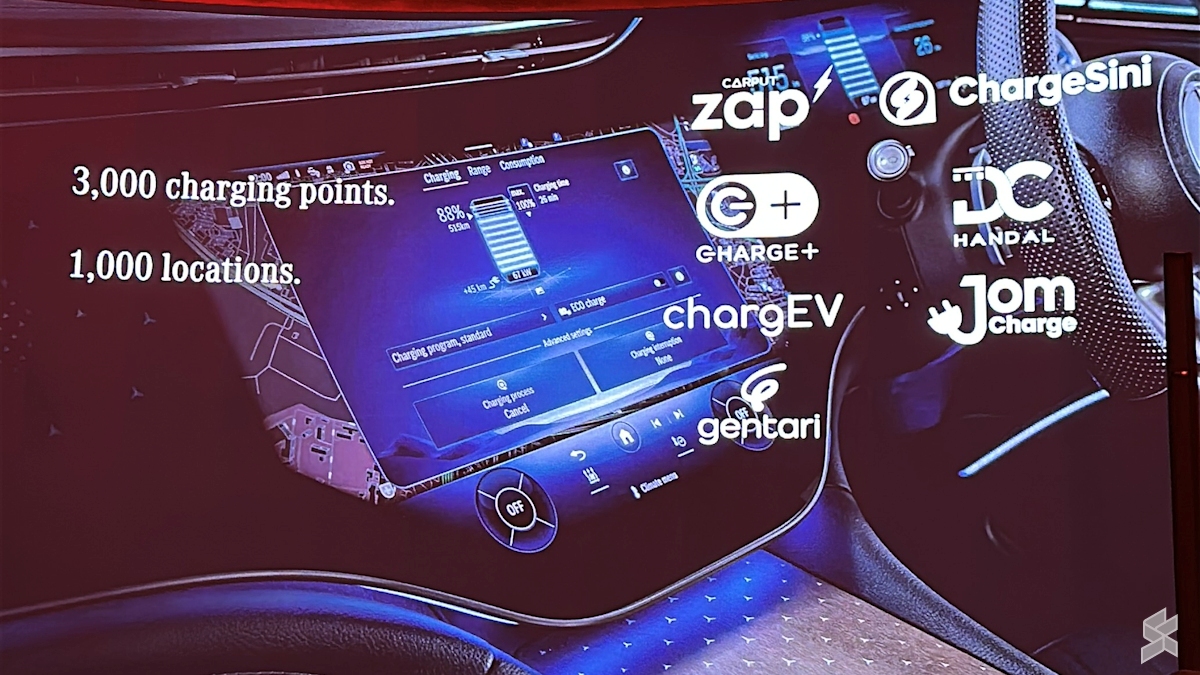
So when Mercedes-Benz announced that its EV and plug-in hybrid owners in Malaysia get direct in-car and app access to more than 3,000 chargers under one system — it’s not just a luxury car perk. It’s a signal that the charging chaos is starting to sort itself out. And that matters for any business thinking about going electric.
The TL;DR
- Mercedes-Benz EV owners now get seamless access to 3,000+ chargers across Malaysia through a single in-car interface and app, covering both AC and DC fast charging, per the official announcement.
- This consolidation means no more juggling multiple network apps — a big step toward “one login, all chargers.”
- For Malaysian SMEs, this signals that EV infrastructure is maturing enough to plan business operations around.
What This Means: Plain Language
Until now, charging an EV in Malaysia often felt like choosing a telco plan — except you had to have six telcos at once. Gentari had an app. ChargeSini had another. JomCharge required its own registration. EV Connection used RFID cards. Each network had its own pricing, its own billing, its own login. If you drove a slightly older EV, you also carried a pile of RFID tags in the glovebox. It worked, but only if you were willing to put up with constant friction.
Mercedes’ MB Charge system changes that — at least for its owners. Instead of the driver figuring out which network runs the charger at a specific mall or highway rest stop, the car or the app handles it. One account, one interface, access to thousands of chargers.
Think of it like the ATM network in Malaysia. You can be a Maybank customer and still use a CIMB ATM to withdraw cash. The networks talk to each other, so you don’t even think about it. That’s the direction EV charging is heading — and this Mercedes move is one of the biggest concrete steps toward it in Malaysia.
How This Applies to Malaysian SMEs
First, delivery and logistics businesses. Say you run a food distribution operation in the Klang Valley with three vans doing daily runs between wholesale markets and retail customers. Your drivers already deal with traffic, loading and customer parking. The last thing they need is a 20-minute detour to discover a charger that requires a registration they don’t have. With consolidated charging access, a driver can see available chargers, start the session and settle it through one dashboard. Route planning stops being a headache.
Second, companies with sales teams or mobile service crews. If you have even two or three employees driving company cars, you already know the pain of tracking vehicle usage. When charging is scattered across multiple apps, the records are scattered too. A consolidated system gives you cleaner charging logs per driver — which makes tracking business usage, and simply knowing where your vehicles were, far simpler. For a non-technical business owner, that’s less admin friction to deal with at the end of every month.
Third, and this is the bigger point: businesses outside the obvious EV zones. The KL–Penang–Johor corridor gets most of the attention, but 3,000+ chargers spread across Malaysia means that even second-tier locations become more viable. If you’re in Ipoh, Seremban or Kuantan, you can start looking at an EV for long-distance runs, knowing that the charging network — accessed through one app — actually covers the route. That shifts the EV decision from “will we be stranded?” to “which model fits our operations?”
“The businesses that win the EV transition won’t be the ones that buy the flashiest electric vehicles. They’ll be the ones that remove the friction around charging.”
The Old Way vs. The New Way
| Before consolidation | With consolidated access |
|---|---|
| 5–6 different charging apps on the driver’s phone | One app, one account |
| RFID cards for networks that lack app support | In-car and app access via one system |
| Hard to know which chargers work with which account | 3,000+ chargers visible and usable |
| Charging records split across platforms | Simplified records for business tracking |
| Drivers waste time figuring out compatibility | Plug in, charge, go |
Practical Takeaways for Your Business
- Reassess your vehicle situation now. If you dismissed EVs six months ago because of charging fragmentation, this consolidation is a reason to look again. You don’t need to buy anything this week, but the calculus has shifted.
- Standardize on one charging account per driver. Even if you don’t drive a Mercedes, pick a single network your drivers will use most and register everyone on it. Fewer apps mean fewer support calls to your office.
- Map your actual routes against charger coverage. Before committing to an EV fleet, run your typical delivery or travel routes through charger maps. The network has grown to the point where most corridors are covered.
- Start with one EV, not three. The smartest SME approach is to convert one vehicle, run it for two months, and measure the operational friction — not just the driving range, but the charging routine — before scaling up.
- Watch for more cross-network announcements. When one premium brand does this, expect others to follow. The Malaysian market is small enough that competitors will respond with similar consolidations.
The Bigger Picture
For Malaysia’s broader electrification story, this is less about Mercedes-Benz and more about interoperability. The government has been pushing EV adoption targets, but those targets live or die on charging infrastructure. A network of 3,000+ chargers that anyone can find and use — regardless of car brand — is what makes EVs a genuine option for the average SME, not just for early adopters.
Long-term, expect to see charging networks bundling with energy providers, telcos and even parking operators. The business model is heading toward “charging as a service” being a background utility, the way mobile data or electricity is today. When that happens, the SME owner’s question stops being “where can I charge?” and becomes “which EV makes sense for my operations?”
For now, the takeaway is simple: the charging landscape in Malaysia just got more orderly. If your business has been eyeing EVs but waiting for the infrastructure to catch up, this is the kind of signal you’ve been waiting for.
Ready to Streamline Your Operations?
Your business should run itself. AutoRunBiz deploys AI agents to automate your daily operations — WhatsApp orders, invoicing, customer follow-ups, and accounting. Book a free 15-min ops audit to see where automation fits your business →