
Why This AI Vocabulary Matters to Your Business
Artificial intelligence is moving from technology demonstrations into everyday business software. For a Malaysian SME owner, that means your accounting platform, customer-service inbox, sales system or internal documents may soon include features described with terms such as “AI agent”, “RAG”, “fine-tuning” and “reasoning model”. Understanding the language helps you ask better questions before adopting a tool, connecting it to company data or allowing it to take action.
TechCrunch’s recent AI glossary highlights how quickly this vocabulary is expanding, including newer phrases such as “opaque recurrence”, which refers to a reasoning technique reported in OpenAI’s Astra model and has attracted attention from AI safety researchers. Read the source article. You do not need to become an AI engineer. You do need enough practical knowledge to tell the difference between a chatbot that drafts a reply and an agent that can update records, send messages or trigger a workflow.
What Happened
AI companies are developing systems that do more than generate text. Large language models can answer questions, reasoning models can break complex problems into intermediate steps, and AI agents can perform multiple actions on your behalf. TechCrunch describes an AI agent as a system that may use several AI technologies to complete tasks such as filing expenses, booking services or maintaining code. Source: TechCrunch.
At the same time, the technology stack behind these products is becoming harder to interpret. Developers work with API endpoints, GPUs, retrieval systems and model-training methods, while business users encounter simpler labels such as “AI assistant” or “automation”. The same label can describe very different levels of capability. One vendor’s “agent” may only suggest the next step; another may connect to your business applications and execute the step automatically.
The glossary also explains related concepts including chain-of-thought reasoning, coding agents, compute, deep learning, diffusion, distillation and fine-tuning. These terms matter because they affect accuracy, speed, data handling and the amount of human supervision your workflow requires. Source: TechCrunch.
Why This Matters for Malaysian SMEs
Imagine you operate a local wholesaler in Shah Alam. A basic chatbot can answer questions from a prepared FAQ, but an AI agent might read a customer’s message, check product availability through an API endpoint, prepare a quotation and create a follow-up task in your sales system. That can shorten response time, but it also creates a clear control question: should the system be allowed to confirm availability or send a quotation without a staff member checking it?
For a Malaysian service business, such as an air-conditioning contractor in Johor Bahru, retrieval-augmented generation, commonly called RAG, can help an AI assistant find answers from your own service manuals, warranty rules and job records. Instead of relying only on general training, the system retrieves relevant business information before generating a response. You could use this for technician support, customer updates or internal onboarding, but your documents must be organised and current.
A café group, online seller or small manufacturer may also use AI for Bahasa Malaysia and English customer communication. A model can draft replies for WhatsApp, email or social media, but local context still matters. Product names, delivery areas, public-holiday schedules, halal-related information and customer expectations should be checked by your team. AI can support consistency; it should not become an unreviewed source of business promises.
| Term | Plain-English meaning | Useful SME question |
|---|---|---|
| AI agent | A system that performs several steps towards a goal | What actions can it take without approval? |
| API endpoint | A connection that lets software request or perform an action | Which of our systems can it access? |
| RAG | A method that retrieves relevant company information before answering | Can we see and update the source documents? |
| Fine-tuning | Additional training for a narrower task or business area | Is our data used for training, and how is it protected? |
| Hallucination | An AI-generated answer that sounds convincing but is wrong | How will incorrect answers be detected? |
| Reasoning model | A model designed to work through more complex problems | Does the extra reasoning improve this workflow enough? |
Terms You Should Understand Before Choosing a Tool
Large language model, or LLM: This is a model trained to process and generate language. It can draft content, summarise documents and answer questions, but it does not automatically know your latest inventory, customer status or company policy.
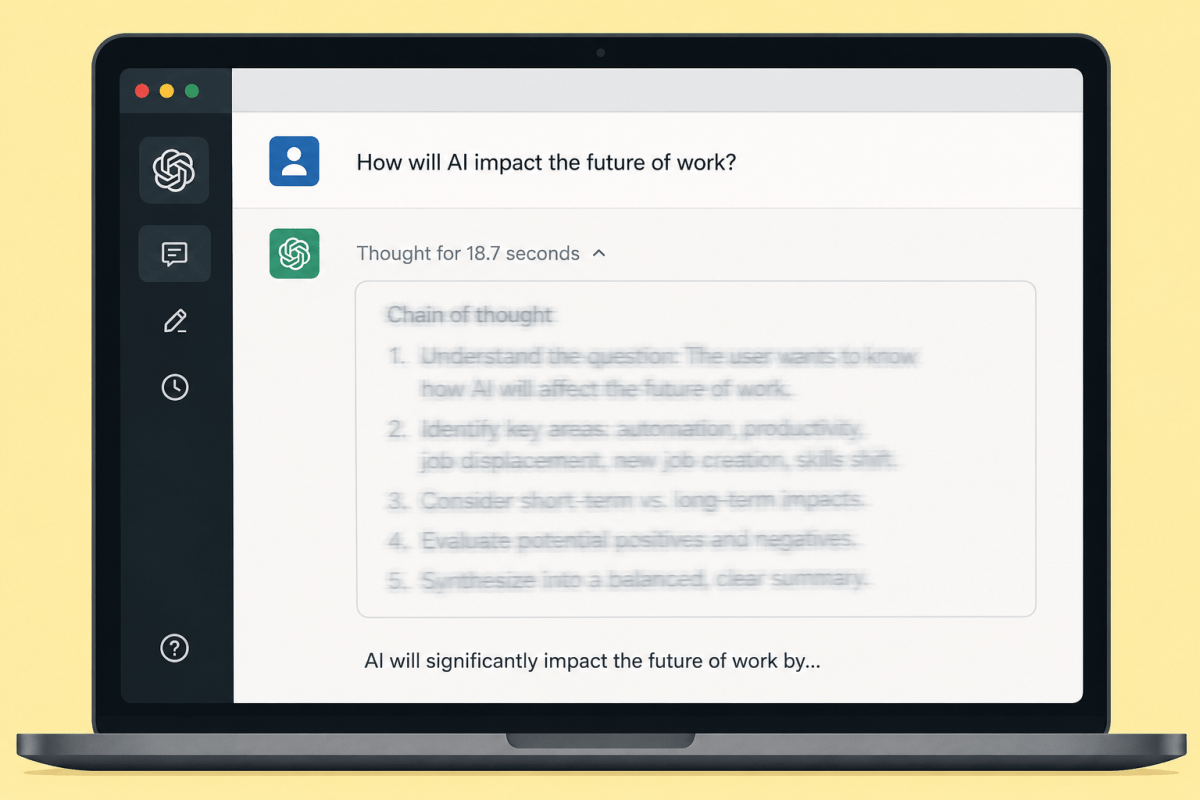
Chain-of-thought and reasoning: AI systems may break a complex task into smaller steps to improve results in logic, coding or analysis. TechCrunch notes that this approach can take longer while improving the likelihood of a correct answer in some situations. Source: TechCrunch. For you, the practical question is whether the task is important enough to require deeper checking, rather than whether the tool uses fashionable terminology.
Fine-tuning: This means further training a model for a specific task using specialised data. A vendor may propose fine-tuning for your tone of voice, product catalogue or support process. Ask whether RAG and good instructions would achieve the same result with simpler data controls.
Distillation: Developers can use outputs from a larger “teacher” model to train a smaller “student” model. The smaller model may be more efficient, but its behaviour can differ from the original. TechCrunch also warns that distilling from a competitor’s service can violate terms of service. Source: TechCrunch. As a buyer, you should ask vendors how their model was developed and whether your data is reused.
Compute: This refers to the processing power used to train and operate AI systems, including hardware such as GPUs, CPUs and TPUs. Source: TechCrunch. You may not manage the hardware directly, but compute affects response speed, service availability and the complexity of tasks a tool can handle.
The Bigger Picture
The most important shift is not that every SME needs an advanced AI model. It is that software is becoming capable of making decisions and taking actions across connected systems. The more connected your workflow becomes, the more important permissions, audit trails and approval rules will be.
Before asking whether an AI tool is “smart”, ask what it can access, what it can change and how you can reverse an error.
Start with a narrow, repetitive process: sorting enquiries, extracting information from invoices, preparing meeting summaries or drafting appointment reminders. Define the expected output, identify sensitive information and keep a human approval step for customer commitments, staff matters, compliance records and financial documents.
When speaking with a vendor, ask six direct questions: Which model powers the feature? Is our data used to train the provider’s models? What systems can the tool access? Can every action be logged? What happens when the AI is uncertain? Can a staff member approve or undo an action?
AI terminology will continue changing, but your evaluation process does not need to. Focus on the business problem, the data involved and the level of control you require. For a Malaysian SME, that practical discipline is more valuable than memorising every new phrase in the AI industry.
Ready to Streamline Your Operations?
Technology moves fast. Your operations should keep up. AutoRunBiz builds AI systems that run your daily workflows — from WhatsApp order capture to accounting. Book a free 15-min ops audit →