
Why Google’s New Forecasting Model Deserves Your Attention
If you run a Malaysian SME, forecasting is already part of your daily work—even if you do it in a spreadsheet, WhatsApp group, or notebook. You estimate how many nasi lemak packs to prepare, which products to restock, how many staff members to schedule, and whether demand will rise during a promotion or public holiday.
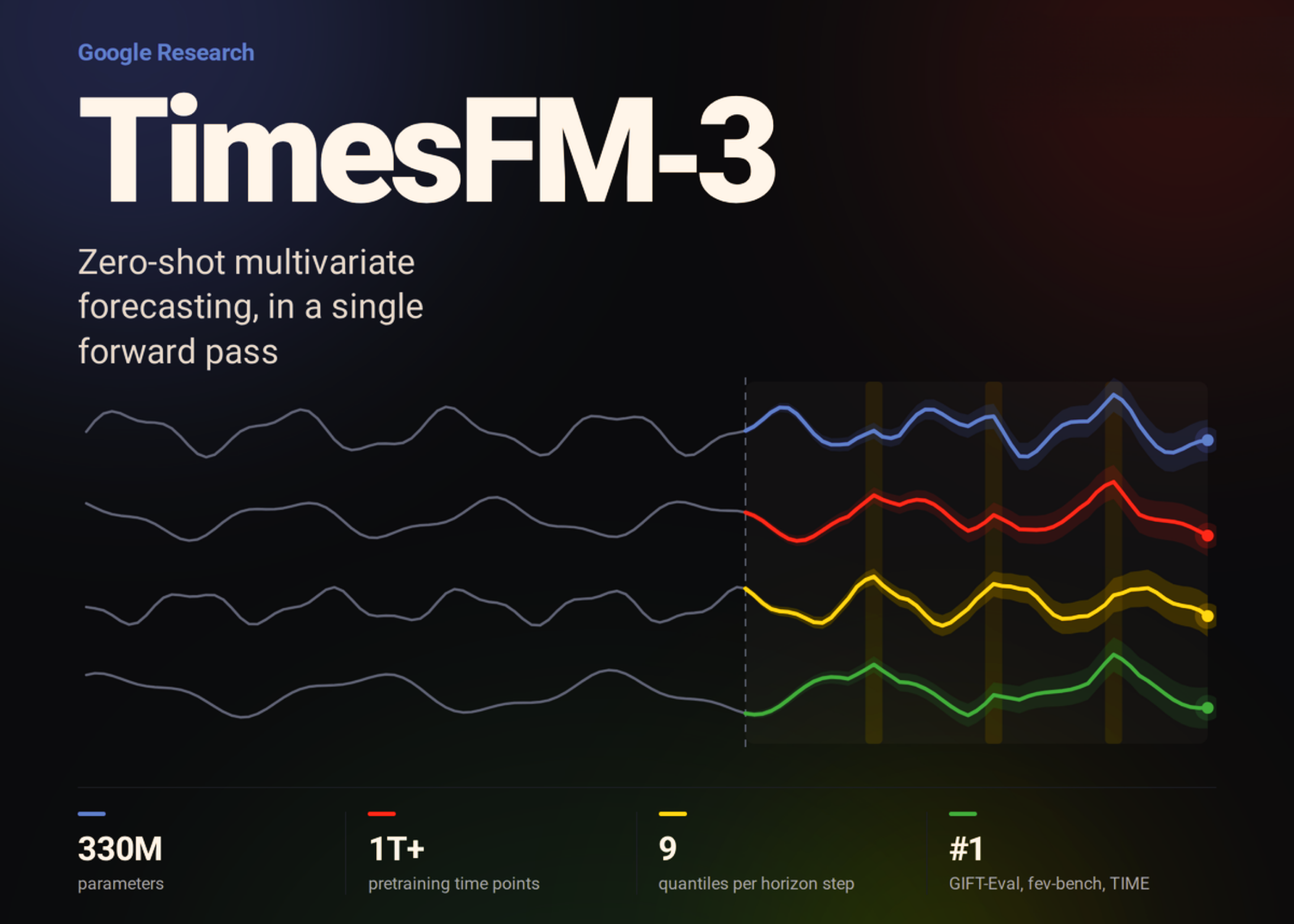
Google Research has released TimesFM-3, a new artificial intelligence model designed to forecast several related time series at once. It has 330 million parameters and was pretrained on more than 1 trillion time points, according to MarkTechPost. For you, the important idea is not the technical number of parameters. It is that the model can look at connected business signals together instead of treating every product, outlet, or activity as an isolated number.
What Happened
Google Research designed TimesFM-3 as a multivariate time-series foundation model. Earlier TimesFM releases through version 2.5 forecast one series from its own history. TimesFM-3 can process multiple targets and supporting signals in one forecasting task, as explained in Google Research’s announcement.
Consider a café. Daily sales for coffee, sandwiches, and desserts may move together. Customer visits may change because of rain, a nearby event, a school holiday, or a marketing campaign. TimesFM-3 is built to consider these relationships. It accepts multiple target series, historical supporting data, and information about future events that are already known, such as a promotion calendar or scheduled holiday.
The model also produces probabilistic forecasts. Instead of returning only one number, it provides nine quantiles ranging from the 10th to the 90th percentile for each forecast step, according to the reported technical details. In practical terms, you can examine a lower-demand scenario, a central estimate, and a higher-demand scenario before making an operational decision.
Google evaluated TimesFM-3 on GIFT-Eval, fev-bench, and the TIME leaderboard. The release notes report that it ranked first among foundation models on GIFT-Eval and took the overall top rank on fev-bench and TIME, as described by MarkTechPost. These results are useful indicators, but they do not guarantee that the model will understand your specific customers, products, or operating conditions without clean business data.
Why This Matters for Malaysian SMEs
Malaysian SMEs often manage demand across several channels. You may sell through a physical shop, TikTok Shop, Shopee, a website, WhatsApp, and business-to-business orders. Each channel creates a separate stream of data, while your stock and staff capacity are shared. A forecasting system that studies these streams together could help you spot connections that are difficult to see manually.
For example, a Klang Valley bakery could forecast bread, cakes, pastries, delivery orders, and walk-in traffic together. It could also include past rainfall, weekends, school holidays, festive periods, and planned promotions. A retailer in Penang could compare demand across outlets while considering local events and delivery activity. A parts distributor in Johor could examine product families, repeat orders, supplier lead times, and customer segments as related series rather than separate spreadsheets.
Malaysia’s calendar creates particularly important future signals. Hari Raya, Chinese New Year, Deepavali, Christmas, school holidays, state holidays, payday periods, and major shopping campaigns can affect demand. The key is that future information must be structured accurately. A model cannot compensate for a promotion calendar that is incomplete, duplicated, or entered after the campaign has already started.
| TimesFM-3 capability | Possible SME application | Data you should prepare |
|---|---|---|
| Multiple targets | Forecast several products, outlets, or sales channels together | Daily or weekly sales by product and location |
| Past covariates | Relate demand to earlier traffic, orders, or weather observations | Historical visits, orders, returns, and operational activity |
| Past-future covariates | Include planned promotions, holidays, or scheduled events | Accurate campaign, holiday, and event calendars |
| Quantile forecasts | Plan conservative, typical, and high-demand scenarios | Clear decision rules for staffing and replenishment |
The practical advantage is not simply “AI predicts sales.” The advantage is being able to compare connected scenarios before you commit stock, staff time, production capacity, or delivery slots.
What You Can Do Before Using a Foundation Model
Start with one operational question. “Can we forecast everything?” is too broad. A better question is, “Can we estimate next week’s demand for our top 20 products across two channels?” A focused project makes it easier to measure whether forecasting improves decisions.
Next, standardise your data. Use consistent product codes, dates, outlet names, units, and sales statuses. Separate completed sales from cancelled orders and returns. Record stockouts because zero sales may mean “no customers wanted it” or “the product was unavailable.” These are very different situations.
Then add business context. Record promotions, public holidays, school breaks, weather observations where relevant, delivery disruptions, and temporary closures. For a Malaysian business, include the states and outlets affected by each event rather than assuming every location reacts in the same way.
Finally, compare the model with a simple baseline. A baseline might use last week’s sales, the same weekday from the previous month, or a rolling average. If an AI forecast cannot improve your existing method, it is not yet useful for that workflow. Track forecast accuracy, stock availability, waste, missed orders, and staff scheduling quality.
The Bigger Picture
TimesFM-3 reflects a wider change in business software. AI is moving beyond chat and document generation into operational planning. Forecasting models can become part of stock systems, production dashboards, CRM tools, logistics platforms, and automated alerts.
However, you should pay close attention to licensing. The TimesFM repository code is available under Apache-2.0, but the TimesFM 3.0 weights are released under a non-commercial licence that restricts them to non-commercial and non-production use, according to the source report. You can benchmark the model today, but you should not place it behind a production forecasting API without confirming that your intended use is permitted. The same report identifies TimesFM 2.5 as the Apache-2.0 option for production use.
This means TimesFM-3 is currently more useful as a research and evaluation tool for most commercial SMEs. You can test whether multivariate forecasting fits your business, identify which data matters, and define the workflow you would want in a future production system. Your technology provider should review the licence, data protection requirements, hosting arrangements, and human approval process before deployment.
A Practical Starting Plan for Your Business
- Choose one forecast target, such as daily orders, product demand, or outlet traffic.
- Collect at least one clean historical dataset with consistent dates and identifiers.
- Add related series such as product categories, channels, locations, or customer visits.
- Document known future events, including campaigns, holidays, closures, and scheduled deliveries.
- Compare an AI forecast against your current spreadsheet method.
- Keep a staff member responsible for reviewing unusual forecasts before action is taken.
- Check the model licence before using any weights or code in a commercial production system.
The main lesson for you is straightforward: better forecasting begins with connected, trustworthy business data. TimesFM-3 shows how advanced models can process those connections, but the business value still depends on how accurately you record sales, events, stockouts, and operational constraints. Start with one decision, one dataset, and one measurable improvement. That is the most practical way to turn a major AI release into something useful for your Malaysian SME.
Ready to Streamline Your Operations?
Technology moves fast. Your operations should keep up. AutoRunBiz builds AI systems that run your daily workflows — from WhatsApp order capture to accounting. Book a free 15-min ops audit →