
When Your Business Has Data but Forecasting Still Feels Like Guesswork
You may already track daily sales, stock movement, customer enquiries, staffing levels and promotions. Yet when you need to decide what to order, how many people to schedule or which products to promote next month, the answer may still depend on a spreadsheet and your best judgement.
The difficulty is not simply having too little data. It is that your business data is connected. Sales of one item may affect another. A public holiday may change foot traffic. A promotion may increase demand for one product while reducing demand for a substitute. Weather, school terms and delivery delays can also influence what happens next.
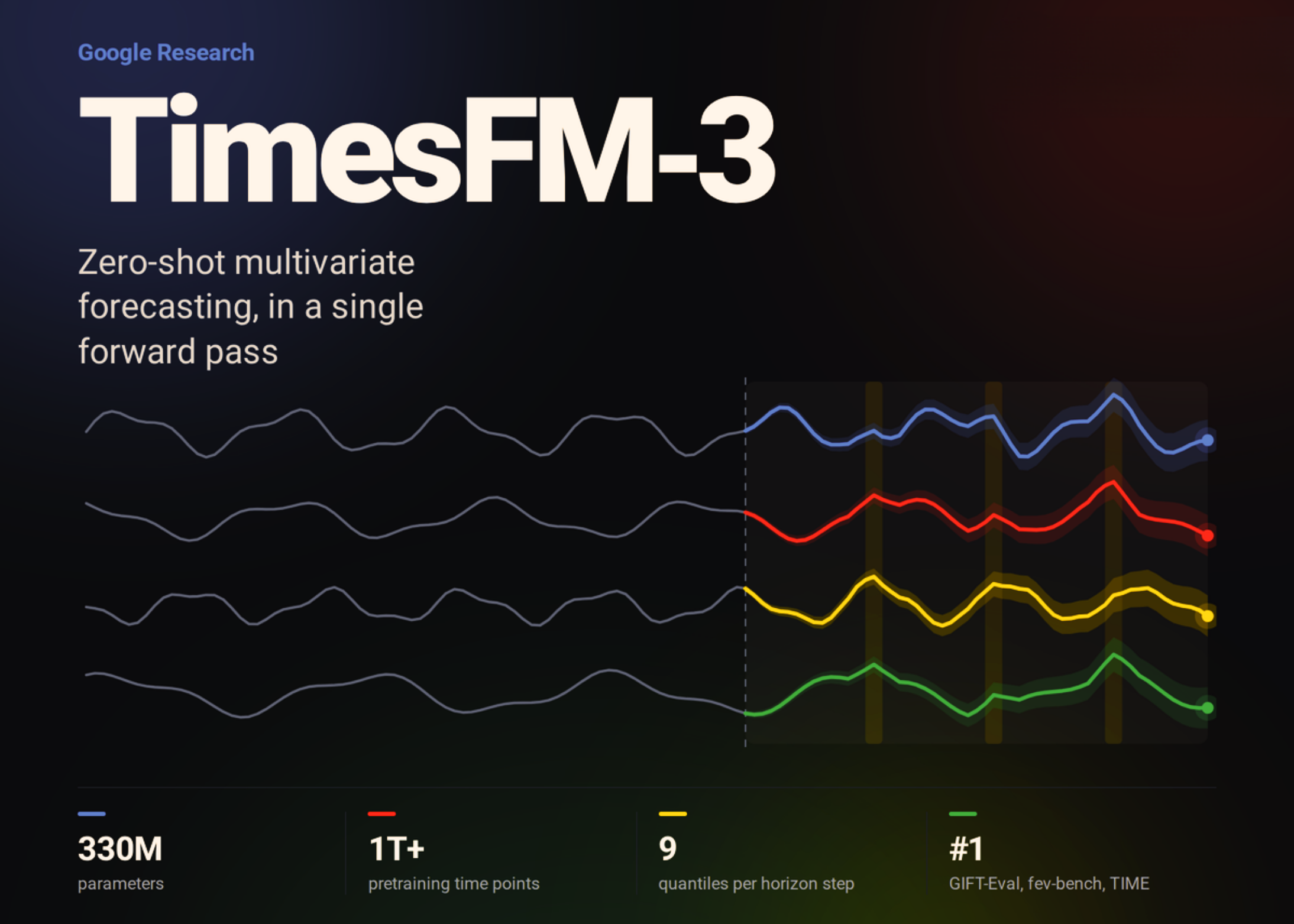
Google Research has released TimesFM-3, a time-series foundation model designed to forecast several related series together. It contains 330 million parameters and was pretrained on more than 1 trillion time points, according to the source article.
TL;DR
TimesFM-3 can study multiple connected business trends at once, such as product sales, foot traffic and promotions, without task-specific fine-tuning.
It is useful to understand as a forecasting direction, but its current model weights are restricted to non-commercial and non-production use. You can benchmark it, but you should not place it behind a live business forecasting service yet, as explained in the source article.
What This Means
A time series is information recorded over time. Your daily sales, weekly orders, monthly bookings and hourly website visits are all examples. Traditional forecasting often looks at one series at a time: yesterday’s sales, last week’s sales or last year’s sales.
TimesFM-3 is built for multivariate forecasting. In plain language, it can examine several related series together. For example, it could consider sales of rice, cooking oil and canned food alongside customer visits, past promotions and a future campaign calendar.
The model supports three important types of information:
- Multiple targets: several items or business outcomes forecast together.
- Past covariates: historical supporting information, such as previous foot traffic or past weather.
- Past-future covariates: information already known about the future, such as a scheduled promotion, holiday or event.
It produces both point forecasts and quantile forecasts. A point forecast gives one expected value. Quantiles provide a range of possible outcomes, including lower and higher scenarios. TimesFM-3 produces 9 quantiles from the 10th through the 90th percentile at each forecast step, according to the source article.
This matters because a business decision should not rely only on one neat number. If your expected demand is 100 units, you may also want to know whether a realistic lower scenario is 70 and a higher scenario is 145. That range helps you decide how much stock or staff capacity to prepare.
The practical lesson: better forecasting comes from showing the model how your business drivers move together, not simply giving it a longer sales spreadsheet.
How This Applies to Malaysian SMEs
Retail shops and mini-markets can use this concept to improve replenishment planning. Instead of forecasting each product separately, you could examine related categories together. Beverage sales, snack sales and ready-to-eat food may all rise during school holidays or hot weather. A known promotion calendar can also help explain why demand may increase on selected days. This is more useful than copying last month’s quantity into a purchase order.
Restaurants, cafés and cloud kitchens face a different forecasting problem. Your demand may vary by weekday, lunch period, delivery orders, dine-in traffic and public holidays. Ingredients are also connected: higher demand for one menu item may increase the need for sauces, vegetables and packaging. A multivariate forecasting approach could help you compare expected orders with ingredient requirements and staffing needs before the busy period begins.
Distributors and wholesalers often manage many customers and product lines at the same time. A customer’s ordering pattern may be affected by seasonal campaigns, delivery schedules or downstream demand. Forecasting related product series together can help you spot when a rise in one category may be followed by demand for complementary items. It can also highlight unusual changes earlier than a manual monthly review.
Service businesses can apply the same thinking even without physical stock. A salon might forecast bookings by service type, day and branch. An air-conditioning maintenance company could study service calls alongside weather patterns and contract renewal dates. A tuition centre could compare enrolment, attendance and enquiry volume against school terms. The common principle is to forecast the connected workload, not one isolated number.
For Malaysian businesses, your calendar data is especially important. Hari Raya, Chinese New Year, Deepavali, school holidays, state-level events and company-specific campaigns can all affect demand. If the date of a promotion or event is already known, it should be recorded in a structured way rather than left inside WhatsApp messages or individual staff memory.
What TimesFM-3 Changes Technically
Earlier TimesFM releases were univariate, meaning they focused on one series at a time. TimesFM-3 was pretrained natively for multivariate forecasting on more than 1 trillion time points, and it uses a 330-million-parameter model, as reported by MarkTechPost.
The model groups nearby observations into patches of 32 steps and uses two attention methods. Causal temporal attention examines earlier points within a series, while full variate attention examines relationships across series at the same time. This design aims to preserve time order while learning how different business signals relate to one another.
It also uses Contiguous Patch Masking to produce the forecast horizon in one forward pass. The release describes this as a way to forecast all masked future patches simultaneously, while keeping known future signals visible. That is relevant when you already know a promotion schedule, event date or planned campaign.
Important Limitation: Do Not Treat It as Production-Ready
The TimesFM repository code is available under Apache-2.0, but the TimesFM 3.0 weights use a non-commercial licence. The weights are restricted to non-commercial, non-production use, according to the Google Research announcement and the source article.
That means you can use it for learning, internal benchmarking and controlled experiments, but you should not build a customer-facing or operational forecasting API around the TimesFM-3 weights without checking the licence and obtaining the necessary rights. TimesFM 2.5 remains the Apache-2.0 option mentioned in the source article, but you still need to review its technical fit and current licence terms before deployment.
Practical Takeaways for Your Business
- Start with clean history: keep daily or weekly records consistent, including dates, quantities, cancellations and stockouts.
- Group related signals: connect product sales with foot traffic, bookings, enquiries, promotions or delivery volume.
- Record known future events: maintain a calendar for campaigns, public holidays, school holidays and planned closures.
- Separate demand from availability: a zero-sale day may mean no customers, or it may mean the item was out of stock.
- Test with past data first: hide a known period, generate a forecast and compare it with actual results.
- Track forecast ranges: review expected, lower and higher scenarios instead of relying on one figure.
- Keep human review: your team may know about supplier delays, local events or customer changes that are not in the data.
- Check licences carefully: benchmarking a model is different from placing it into production.
A Simple Forecasting Data Checklist
| Business area | Useful series to track | Known future signals |
|---|---|---|
| Retail | Category sales, basket size, store visits | Promotions, holidays, store events |
| Food service | Dine-in orders, delivery orders, menu items | Campaigns, bookings, closure dates |
| Distribution | Customer orders, product categories, delivery volume | Contract dates, scheduled campaigns |
| Services | Bookings, enquiries, cancellations, staff workload | Appointments, school terms, planned leave |
The table above is a practical starting framework, not a fixed requirement. Choose signals that your team can maintain accurately. Five reliable columns are more useful than fifty inconsistent ones.
The Bigger Picture
Forecasting tools are moving away from isolated predictions towards models that understand relationships between business activities. For you, that means the future value may not come from asking, “How many units will we sell?” It may come from asking, “How will sales, staffing, stock and scheduled events move together?”
Benchmark results reported for TimesFM-3 place it at the top average rank among pretrained foundation models on GIFT-Eval, fev-bench and the TIME leaderboard. The release notes also report rank one among foundation models on GIFT-Eval, and overall rank one on fev-bench across 100 real-world tasks and TIME across 50 domain datasets and 98 evaluation tasks, as stated in the source article. These results are encouraging, but benchmark performance does not automatically mean the model understands your customers, Malaysian seasonality or your data quality.
Your best next step is practical: organise the data you already have, identify the business signals that move together and test forecasting against historical periods. Even if you do not use TimesFM-3, that preparation will make any future automation project more reliable.
For a small business, the goal is not to chase every new AI release. The goal is to make planning less dependent on guesswork while keeping decisions understandable, reviewable and aligned with your actual operations.
Ready to Streamline Your Operations?
Your business should run itself. AutoRunBiz deploys AI agents to automate your daily operations — WhatsApp orders, invoicing, customer follow-ups, and accounting. Book a free 15-min ops audit to see where automation fits your business →