
Why This Robot Trend Matters to Your Business
If you run a Malaysian SME, you may already be asking how automation can reduce repetitive work without forcing you to rebuild the entire business. You may also be cautious about robotics because many products appear impressive in demonstrations but are difficult to customise, maintain, or connect to your daily operations.
That is why Microduck deserves attention. The important development is not simply that a small robot can walk, kick, or recover after falling. The more useful idea is that its training software, simulation environments, and reinforcement-learning methods are being made available for others to study and adapt.
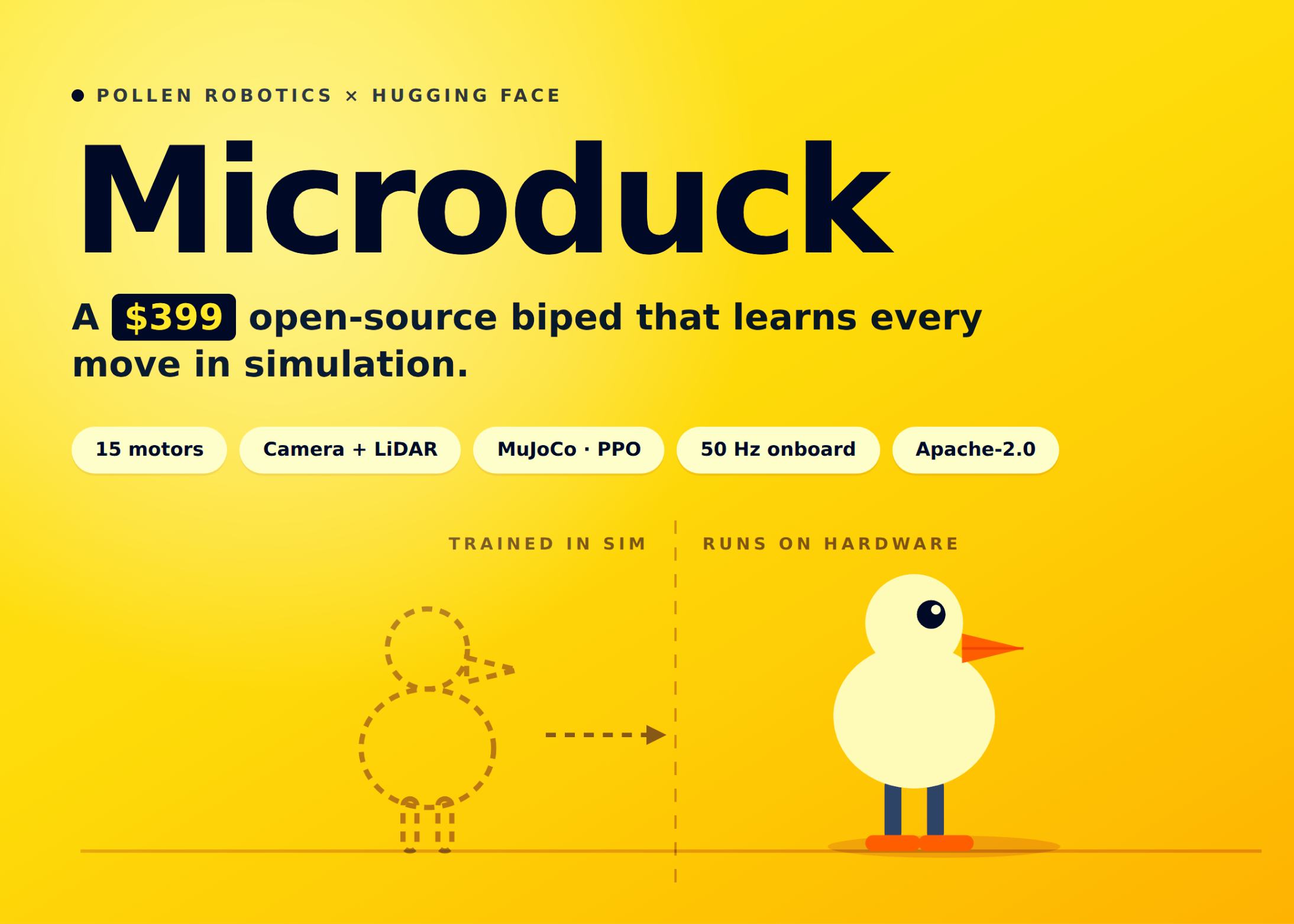
According to the source article, Microduck is a 25 cm bipedal robot weighing under 800 g, with 15 motors, cameras, LiDAR, two motion sensors, Wi-Fi, and Bluetooth. It is designed to move beyond a desk and learn physical behaviours through simulation before those behaviours are transferred to the real machine. Source: MarkTechPost
TL;DR
Microduck shows how open robotics software could make physical automation easier to test, train, and customise.
For Malaysian SMEs, the immediate opportunity is not buying a robot blindly. It is learning how simulation, open software, and small automation pilots can improve repetitive tasks safely.
What This Means
Traditional robotics often works like this: a manufacturer builds a machine for a specific task, installs it, and expects your team to operate it according to fixed instructions. Changing the task can require specialist engineering, new programming, and significant downtime.
Microduck uses a different approach. Its movements are controlled by neural policies trained with reinforcement learning. In simple terms, the robot practises a task inside a computer simulation. It receives feedback for doing something correctly, such as maintaining balance or moving towards a target, and gradually improves its behaviour.
The training process uses PPO, a reinforcement-learning method, inside MuJoCo Warp-based environments. The source article reports that a usable walking behaviour can be trained in approximately one to two hours on a CUDA GPU using 4,096 parallel simulated environments. Source: MarkTechPost
The robot also uses what engineers call sim-to-real techniques. A behaviour that works perfectly in a simulation may fail on a real machine because of battery changes, motor friction, delays, or small mechanical imperfections. Microduck’s training setup introduces these variations deliberately, including voltage sag, command delays, friction differences, and gear backlash. This helps the trained policy cope with conditions that resemble real operation.
The practical lesson is simple: useful robotics depends less on a flashy demonstration and more on whether you can inspect, test, and adapt the training process.
The software is published under the Apache-2.0 licence, while the mechanical and electronic design files are not open, according to the source article. Source: MarkTechPost That distinction matters when you evaluate any open-source hardware or automation product.
How This Applies to Malaysian SMEs
1. You can start with simulation before touching your operations. Suppose you operate a small warehouse in Shah Alam, a food-processing facility in Johor, or a spare-parts business in Penang. You may want to automate movement, inspection, or picking, but you cannot afford to interrupt daily fulfilment while experimenting. Simulation gives you a way to model a task, test different movement strategies, and identify failure points before involving your staff or production area.
This does not mean you need to train a walking robot immediately. The same principle can apply to a virtual warehouse layout, a camera inspection system, or an automated workflow that decides where a customer enquiry should be routed. You can test the logic first, then connect it to real equipment only after the process is reliable.
2. Open training methods can reduce dependence on fixed vendor configurations. Many SMEs worry that automation becomes difficult when their process changes. For example, a bakery may introduce new packaging sizes, a clinic may change its registration process, or a distributor may add new product categories. A system designed only for one fixed setup can become a bottleneck.
Microduck’s shared observation structure demonstrates a useful design idea: different behaviours can use a common interface and be switched during operation. The source article states that its policies share a 61-dimensional actor observation, allowing walking, recovery, and other behaviours to be exchanged while running. Source: MarkTechPost For your business, the equivalent could be a common data format that lets different automation modules work with the same order, inventory, or customer records.
3. Small physical robots may be useful for training and prototyping. A compact robot can help a Malaysian SME learn what is involved in physical AI without starting with a large industrial installation. You might use it for staff training, educational demonstrations, basic object interaction, or testing how a vision system handles movement and recovery.
However, you should define the task carefully. A robot that can walk and pick up a small object is not automatically suitable for handling hot food, fragile products, confidential documents, or heavy cartons. Its source specifications describe a small system with a battery runtime of about one hour, 15 motors, an 8×8 time-of-flight range sensor, a front camera, and onboard computing based on a Rockchip RK3566 with 1 GB of RAM and 32 GB of storage. Source: MarkTechPost Those specifications suggest experimentation and learning rather than immediate replacement of industrial equipment.
4. It highlights the importance of local technical capability. Open software is valuable only when someone can operate and adapt it. If you purchase an open robotics platform but have no plan for maintenance, testing, data handling, or staff training, the project may remain a demonstration.
For an SME, a sensible approach is to appoint one internal project owner and work with a local automation integrator, polytechnic, university, or software partner. The goal is not to create a large research department. It is to ensure someone understands the operating limits, documents each trial, and can explain whether the system is improving a real business process.
Useful Numbers to Understand
| Specification or capability | Why it matters to you |
|---|---|
| 25 cm height | Suitable for tabletop demonstrations and compact test areas |
| Under 800 g weight | Easier to transport between training or testing locations |
| 15 motors | Supports coordinated movement but creates more maintenance points |
| Approximately 1-hour battery runtime | Requires planned charging and test sessions |
| 4096 parallel simulated environments | Shows how many virtual trials can support faster policy training |
| 50 Hz control loop | Indicates frequent control updates for movement stability |
| 13 published task environments | Provides several starting points for research and experimentation |
All numerical specifications in this table are reported in the source article. Source: MarkTechPost
Practical Takeaways for Your Business
- Choose one repetitive process first. Do not begin with a broad goal such as “use robotics everywhere”. Select a task that is frequent, measurable, and safe to test.
- Record the current process. Document how many steps are involved, where errors occur, and which decisions require human judgement.
- Test digitally before testing physically. Use simulation or a virtual workflow to identify problems before introducing equipment into your workplace.
- Check the licence carefully. Open-source software does not always mean open hardware. Confirm what you can modify, distribute, and use commercially.
- Plan for failures. Decide what happens when a robot loses balance, a camera is blocked, a battery runs low, or the network disconnects.
- Keep people responsible. Staff should know when to pause automation and handle an exception manually.
- Measure operational results. Track completion time, error rate, intervention frequency, and downtime before deciding whether to expand.
- Protect business data. Review camera access, stored recordings, network permissions, and who can download training data.
The Bigger Picture
Microduck points towards a future where physical automation is increasingly shaped by software. Instead of purchasing a machine that can perform only one fixed motion, businesses may be able to train behaviours, test them in simulation, and transfer them to different devices.
For Malaysian SMEs, this could eventually make automation more flexible. A logistics company might train a system to recognise handling exceptions. A manufacturer might simulate different workstation layouts. A service business might use small robots for demonstrations, guided assistance, or routine inspection.
But the long-term advantage will not belong automatically to the business that buys the newest robot. It will belong to the business that understands its processes, collects clean operational data, and builds disciplined testing habits. Physical AI still needs good safety procedures, reliable maintenance, clear responsibilities, and realistic expectations.
Your next step does not need to be a robotics purchase. Start by identifying one task that wastes staff time or creates repeated errors. Ask whether it can be described clearly, measured consistently, and tested without disrupting customers. If the answer is yes, you have the foundation for a small automation pilot.
That is the real value of open robotics projects such as Microduck: they make the learning process more visible. You can study how behaviours are trained, how simulation handles uncertainty, and how software connects to hardware. For a practical SME owner, that knowledge can help you make better automation decisions long before a robot enters your workplace.
Ready to Streamline Your Operations?
Your business should run itself. AutoRunBiz deploys AI agents to automate your daily operations — WhatsApp orders, invoicing, customer follow-ups, and accounting. Book a free 15-min ops audit to see where automation fits your business →